
• How to Conquer Your Fears

    Have you ever felt overwhelmed by fear – so much so that it prevented you from doing something you wanted to do? Believe it or not, this is a common problem faced by many people daily.

    Advertisements

    Fear has the power to hold you back from taking risks, following your dreams, or becoming successful at anything you attempt to do. If you allow it to control you for long enough, it can eventually erode your quality of life and keep you locked in a prison of inactivity.

    What many people fail to realize is that fear is nothing more than a conditioned response. It’s a natural reaction to a frightening or unfamiliar situation. While it is usually automatic, there are things you can do to overcome it.

    1) Check your expectations

    One major contributor of fear is the prevalence of negative expectations. Do you usually find yourself expecting the worst in every situation? Do you worry obsessively about what could go wrong, rather than focusing on your strengths and capabilities?

    If you make a conscious effort to expect the best, see the positive side of each situation and keep reminding yourself that you can handle more than you often think, you’ll find yourself with much less fear to deal with. Even if feelings of fear do manage to creep into your consciousness, you’ll still be able to keep them in perspective and balance them against an underlying sense of confidence.

    2) Discredit your fears

    Experts will tell you that the majority of things you fear will never come to pass anyway. While this may be true, it sure doesn’t feel that way when fear has a chokehold on you! However, if you look a little more closely at your fears when they arise, you may be able to dismiss at least a few.

    For example, if you have a fear of public speaking and your boss wants you to give a presentation at work, you might feel like your life (and perhaps your livelihood) is on the line. You may fear getting fired, or worry that your colleagues will lose respect for you if you don’t do a good job.

    But is any of this likely to happen? In most cases, no. Rather than worrying about what “might” happen if you don’t give a solid presentation, you might brainstorm ways to help improve your performance, such as being well prepared, practicing your delivery on friends and family members, writing notes to yourself and so on.
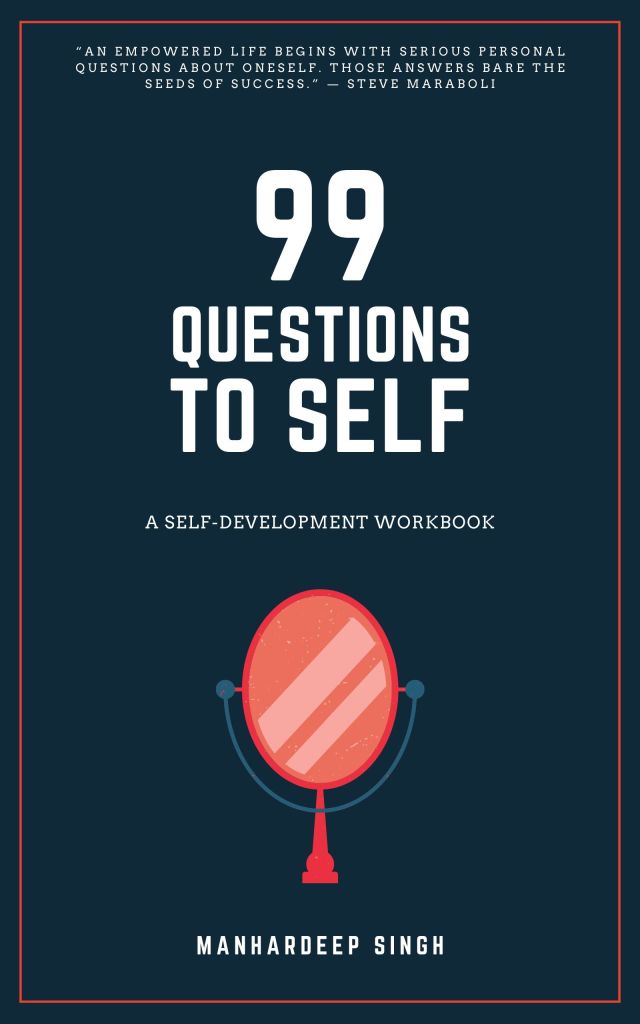
    Would you like to tap into your full potential? Discover the 99 questions that can help you realize the superhuman in you.

    This workbook will help you:

    • Discover your latent talents and hidden strengths
    • Learn how to create instant emotions of happiness and abundance
    • Improve every area of your life
    • Tap into unlimited source of power
    • Create a future you like

    99 Questions to Self is a comprehensive self-development workbook. If you like modern, practical, and interactive books, then you’ll love Manhardeep Singh’s self-help workbook.

    Buy 99 Questions to Self to start your journey of self-discovery today!

    3) Do the very thing you fear

    When you remember that fear is simply a feeling, it loses much of its power. It can’t harm you and except in truly threatening situations you can choose to ignore it and move forward anyway.

    If you weigh the pros and cons in any situation, you may decide that the possibility of negative consequences is minimal so there’s nothing to stop you from ignoring your fear and going for it! This will be determined by you on a case by case basis, of course. The point isn’t to become reckless with your decision-making but rather to empower yourself to know when a fear is groundless and easily overcome.


  • Book Spotlight – 101 Nuggets for Life

    Ready to take yourself to the next level? Find 101 ways that can work as a launchpad. These nuggets are delivered to you one page at a time. Implement it, see the result, repeat!

    These nuggets can help you:
    • Be goal-driven vs emotion-driven
    • Be strong on the face of criticism
    • Handle difficult situations smoothly
    • Increase likability among peers
    • Be irresistibly charismatic

    Buy 101 Nuggets for Life to take every area of your life to the next level today!

  • How to Attract Money

    One of the most common goals people set when first learning about the Law of Attraction is to attract more money into their lives. They’re sick of struggling, sick of not having enough, and they’re eager to find relief. Unfortunately, attracting money is often one of the most difficult objectives, simply because money carries such heavy emotional weight in our lives. There’s a lot riding on the success (or failure) of our goal to attract more money! Namely, our peace of mind, happiness, security – and much more.

    Advertisements

    Unfortunately, placing such strong emphasis on the outcome of money attraction only creates more blockages. The more you think you desperately “need” more money; the more you believe you can’t be happy without it; the more frustrated you get when it isn’t showing up – the longer it’s going to take to attract it.

    The good news is that there are a few simple things you can do to make the process easier:

    1) Lighten up!

    The more tense and serious you are about attracting money, the harder it’s going to be. If you instead look at it like a fun game, you’ll be devoting a perfect mixture of light, positive energy to the process – which is a natural prosperity attractor! In fact, make it your mission to be lighthearted and easygoing about money and everything else in your life from now on. Not only will you end up attracting more money, but also more love, joy, peace, fun and passion in all areas of your life.

    2) Be what you want to attract

    Another common blockage is the perception of “here and there.” You believe you are HERE, in the midst of lack and struggle, and you are trying to get over THERE, where there is peace and abundance aplenty. What you’ll eventually realize is that there is no “here or there.” There is only right now, and whatever you are communicating to the universe right now is what you are creating in your physical reality. Rather than focusing on trying to ATTRACT more money, BECOME a person who has all the money they could ever need. Think, feel and act as if your goal is already achieved, and the universe will make it so! Focus daily on feeling happy, abundant, peaceful, secure, and grateful and you will attract life circumstances that correspond with those feelings.

    3) Let go

    Don’t worry about “how” your money will come. Don’t focus obsessively on winning the lottery, receiving an inheritance or anything else specific. Let the universe decide how it will come. Keep your eyes open for opportunities to receive more money and act on them if you see them, but otherwise detach and know that it’s on the way! This is easier said than done, but the more you try to control “how” your abundance comes, the more blockages you create.

    Advertisements

    Additionally, be sure to let go of WHEN money comes into your life. You might be tempted to set a deadline, but the universe has its own timing and wisdom. Be willing to trust and let go, and you open a gateway for immense blessings to flow into your life.

  • Deer in the Headlights

    People who make their living researching what frightens people the most have made a pretty amazing discovery. Consistently when people list the top five things they are afraid of in life, they have are some pretty intimidating terrors. But you would think that death would rank number one on that list. But death doesn’t take number one, it has to settle for number two. Amazingly, the number one thing that terrifies most people is not death, it is public speaking. A popular comedian once said that this means that people would rather be the guy in the casket at a funeral than the guy giving the eulogy.

    Advertisements

    If you have ever been in a meeting listening to a speaker, you can usually tell if they are terrified. They will get up there and you will see that “deer in the headlights” look. You know that look. It is one of extreme fear, panic, and terror so profound that the person is frozen in place unable to speak of move. And if you have ever been that guy or gal in front of a group giving the “deer in the headlights” look, you know the feeling of terror that happens in front of a group of people can be pretty awful.

    So if you know that public speaking is going to be part of your job or something you have to regularly do, you have to find a way to neutralize that fear and be able to relax in front of a crowd when you speak. How often have you sat and listened to a speaker who was relaxed, funny, bright and even able to field questions with no difficulty at all? It’s easy to admire that kind of public speaker and think that he or she has some magical powers that you will never get. But they don’t have magic. That speaker has just learned some techniques for neutralizing those fears so he or she can appear relaxed and as though he or she is having fun up there. It’s not an inborn talent. It’s a skill which can be learned.

    Of course a lot of the ability to look out at a sea of faces who want to hear what you want to say and not feel sick comes from experience. But experience teaches you things that you can at least understand before you become an old pro at public speaking. One of those things is that the crowd out there doesn’t know what to expect. If you broke down why you feel terrified in front of people, it’s that you think that they think they know what they want and that you are being judged.

    But to understand what people really expect when they are looking at you at the podium on stage, just remember the last time you heard someone speak. You had no predefined idea what was about to be said and you probably had no outline or any frame of reference what that speaker was going to say. That means that even if you don’t deliver your speech perfectly, they will never know that! As long as you don’t let on that you are nervous or not sure about your material, they won’t know if you got it wrong. If you forget an entire segment of your speech, as long as what you do say flows nicely and they never know you forgot it, the people listening will think your speech was just fine and will probably applaud.

    Would you like to tap into your full potential? Discover the 99 questions that can help you realize the superhuman in you.

    This workbook will help you:

    • Discover your latent talents and hidden strengths
    • Learn how to create instant emotions of happiness and abundance
    • Improve every area of your life
    • Tap into unlimited source of power
    • Create a future you like

    99 Questions to Self is a comprehensive self-development workbook. If you like modern, practical, and interactive books, then you’ll love Manhardeep Singh’s self-help workbook.

    Buy 99 Questions to Self to start your journey of self-discovery today!

    Also remember that you are not really speaking to a group. The group has no ears. You are speaking to several individuals. When you are listening to a speaker, you are one person listening to one person. That is how each person in that audience is receiving you, as individuals. So if you speak to them as though they are one person, not a crowd, your presentation will be warm and personal and very successful. And the crowd will like you too which helps a lot.

    Just remember that their expectations of you are fairly low and for the most part, people hearing you speak want you to succeed. So smile at them, use a bit of humor and use that little insider tip to relax up there. And when you can relax, you can actually have fun at public speaking rather than wishing you were the guy in the casket instead.

  • Five Ways To Regain Your Lost Self-Confidence

    Nobody can hurt you without your consent. There are many instances in life where your confidence is hit hard. Sometimes you overcome life’s hardness, sometimes you get overwhelmed. Sometimes your courage and confidence sees you through, but sometimes your self-confidence gets a beating. However, the point here to remember is that “nobody can hurt you without your consent.”

    Advertisements

    The problem is not as important as the impact it had on you, rather the impact that you let the problem create on you. In life pain is inevitable but suffering is optional, as the saying goes. It’s purely your choice, and whether you choose to bounce back or suffer is entirely your prerogative.

    There can be many reasons that your self-confidence is hurt. You may have had a bad marriage and now are heading for a divorce.

    You were not chosen for your college’s football team; you may have been laid off. There’s definitely a lot of pain involved in any of the situations. But you don’t necessarily have to suffer. You must arise and resolve to get back your confidence.

    The following five ways would help you do just that.

    1. Look at the brighter side. If you have been laid off, it would be okay to feel bad about it for a day or two but not more than that. Losing a job is a terrible thing, but it does not mean the end of the world.

    Who knows it might be a blessing in disguise. Maybe you have got some time to review your life, get aware of where you are going, have a look at your likes and hobbies which you could not develop because of pressures of your job. Maybe this is an opportunity to start afresh and live your life a new way which is more in sync with your abilities and aptitude.

    Similarly, a divorce may cause great pain but then you weren’t too happy in your marriage either. It probably was just not meant to be. Now you have a chance to rebuild your life the way you want it to be.

    2. Stop comparing yourself with other people. When we have a problem we always question god – “oh, god, why me?” Certainly god gave you a lot of rewards as well.

    Did you then get up and ask god -“oh god, why me?” That’s what human nature is all about. We complain and remember god when we are in trouble or else we are too busy with ourselves.

    Stop looking at other people who seem too happy and comfortable to you from a distance. Stop comparing their comfort with your suffering.

    This will only frustrate you further. Focus on yourself and make every effort you can make to go out whenever you are feeling down.

    Would you like to tap into your full potential? Discover the 99 questions that can help you realize the superhuman in you.

    This workbook will help you:

    • Discover your latent talents and hidden strengths
    • Learn how to create instant emotions of happiness and abundance
    • Improve every area of your life
    • Tap into unlimited source of power
    • Create a future you like

    99 Questions to Self is a comprehensive self-development workbook. If you like modern, practical, and interactive books, then you’ll love Manhardeep Singh’s self-help workbook.

    Buy 99 Questions to Self to start your journey of self-discovery today!

    3. Self-pity is very addictive and capable of destroying lives. Instead of indulging in self-pity (though we all do from time to time), take control of your life and take responsibility for your actions, learn from your mistakes and make a fresh start.

    4. And yeah…don’t be bogged down when you hear a “no”. A “no” is something which even greats like Edison and Ford, too, had to face. If you look at them positively, you will find that each “no” actually takes you closer to a “yes.” It’s been reported time and time again that Edison conducted more than a thousand failed experiments before he actually made an electric bulb! So get going and take an occasional no in stride.

    5. Are you standing in your own way? You will notice that shadows are caused when we stand in the path of sunshine. In our lives, too, we cause a lot of shadows by standing in the way of our own happiness. In today’s world, it is important to be flexible. A lot of people will look for a job for months, yet still reject work coming their way because they are not willing to adapt to some new job requirements.

    Advertisements

    Jane, a schoolteacher, was laid off from her job. She kept trying for months to get a job as a teacher while rejecting opportunities such as taking private tuitions, being a nanny, doing copy- editing work as a freelancer. The long wait hurt her self-confidence even more. Sometimes it is wise to be a little flexible and adapt ourselves to new job demands rather than to look exactly for what we lost. It helps regain confidence quickly which brings along enough energy to get an even better job in the field of your choice!

    Don’t forget, there is always a way to regain your lost self-confidence. You just have to look for it. Because finding is reserved for those who search. Are you searching for an answer?

  • Discover the Secrets of Personality Type

    Have you ever wondered why your spouse, coworkers, or children seem to think so differently from you? You may not understand why they make the decisions they do, or why they place such importance on things that seem inconsequential to you. It is possible to understand the answers to all these questions. The secret lies in the theory of Myers-Briggs personality type.

    Advertisements

    In the 1960’s a psychological theorist named Katharine Briggs had many of the same questions you do. She wondered why some of her family members had such logical, linear thinking processes, when she herself was more likely to take values and feelings into account when considering an issue. In her research with her daughter Isabel Briggs Myers, she looked into this question and others, and discovered four central aspects of personality. Each one of us can be classified as either:

    • Extroverted/Introverted—Do you get your energy from being with people, or being alone?
    • Sensing/Intuitive—Do you see what’s actual, or what’s possible?
    • Thinking/Feeling—Do you make decisions with your head or your heart?
    • Judging/Perceiving—Do you like to make decisions, or keep your options open?

    Our classifications on each of the scales is combined to make a four-letter type, for instance, ENTP, or ISFJ. There are sixteen types in all, encompassing all possible combinations.

    With so many possibilities, you can imagine how much potential for misunderstanding there is with those around us! If we marry, or parent, or even work with someone who is very different from us, we can become increasingly baffled as to how their minds work. The key to unlocking the mystery and understanding those around us is to first understand yourself.

    “Change the way you look at things and the things you look at change.” This is the principle on which EQUILIBRIUM answers What Makes People Do Things They Shouldn’t Do

    The book unveils 20+ personality traits along with their specific reasons that actually cause someone to behave in a particular way. Such traits includes but is not limited to anger, cheating, obstinate, sarcasm etc.

    Where do you think you fall on the scales listed above? It can be difficult to decide, but fortunately the creators of this theory have also created a scientifically validated assessment that can tell you where you fall. This personality test is called the Myers-Briggs Type Indicator and is the most accurate and efficient way to identify your own type. Most recently it has become available in an online format, which allows convenient access to anyone wishing to discover more about themselves. The official Myers-Briggs Type Indicator can be used to produce several different types of reports, from basic to detailed, all of which you can refer to as you learn more about your own Type.

    Once you have discovered your Type, you can begin to think about how others may differ. If you are an extrovert, you may be surprised when others want to leave a social gathering or end a conversation before you do. It doesn’t mean they’re unfriendly or not having a good time; it’s just that introverts rely on their alone time to recharge. As another example, if you’re a Thinker, you may mistrust people who seem to make decisions based on their “gut” or their feelings rather than logic. But turn this around and you’ll realize that your own decisions may seem cold and uncaring to someone who is a Feeling type. There is no right or wrong; only individual preferences.

    Advertisements

    The world is made up of many types, and this is for the best! We need people who are gregarious, and those that are content to live much of their lives independently. We need visionaries with their heads in the clouds, and people who will take care of all the details. We need planners, and people who fly by the seat of their pants; when making decisions we need both someone to remind us of the logic of the situation and someone to help us do a “gut check.” Learning more about personality types can help you appreciate all the variation you’ll see around you. Most importantly, it will help you use your differences to everyone’s benefit.

  • Overcoming Depression

    Identifying Depression
    Depression, like most mental illness runs the continuum of severity. It can be mild or major. It can last from weeks to months. It can involve anxiety symptoms as well. Depression is primarily characterized by sadness and/or loss of pleasure in nearly all activities. Additionally, there may be symptoms such as changes in appetite, sleep patterns, and psychomotor activity (changes in both mental and physical responsiveness and/or activity).

    Advertisements

    A depressed person may struggle with feelings of low self worth, recurrent thoughts of dying, as well as difficulty concentrating or making decisions. In children and adolescents the mood is often manifested as irritability rather than sadness. Some people may deny having feelings of sadness; instead they may report feeling numb or having no feelings at all.

    Taking Action
    First, it is important to look at how severely one’s functioning may be impaired. If the person’s level of functioning has been significantly impaired, i.e. they are having difficulty performing their daily routine, seek professional help immediately. A trip to the family doctor to rule out any medical conditions that might be causing the mood disorder is a good place to start.

    Second, assess whether there have been any significant changes in circumstances, relationships etc. that may be contributing to the depression.

    Third, if your loved one indicates they have a plan or intentions to harm themselves, take action immediately to get help. Call a mental health professional that you have been referred to by a reliable source or check your phone book for community mental health services.

    Don’t Wait – Get Help
    One of the biggest reasons people do not seek help is the shame they feel about having a mental illness. The reality is that our minds are vulnerable to illness just like our bodies. There is no shame in developing the flu or some other medical condition, so why is there with the mind? Those who avoid seeking help because of the shame they feel only languish longer than necessary.

    Are you tired of motivating people or staying motivated? Start seeing motivation like never before concept with a single shift in perspective.

    The Ultimate Book of Motivation will help you:
    • Take responsibility for your life
    • Be unstoppable on the face of failure
    • Turn self-defeating thoughts around
    • Change your outlook on life
    • Motivate anyone to do anything

    Buy The Ultimate Book of Motivation to start motivating today.

    How Counseling Can Help
    A counselor can help a person gain perspective about their illness; resolve problems that may be contributing to the depression and assist the person in developing coping skills.

    However, in addition to counseling, depending on the severity of the depression, medication may also be a treatment option. You can discuss this with your counselor, who could then refer you to a psychiatrist to prescribe and manage the necessary medication.

    Relief is available for difficulties that plague our minds. It is truly the wise that seek out the help, wisdom and counsel of those whom God has equipped to facilitate the healing of the mind.

  • Have You Checked Your Self-Talk Lately?

    Did you know that you talk to yourself all day long? No, not the mental chatter about activities and chores that you need to remember throughout the day. That’s a form of self-talk too, but I’m referring more to the things you say to yourself on a regular basis; and more importantly, the tone in which you say them.

    Advertisements

    When you make a mistake, do you berate yourself angrily? Do you put yourself down or call yourself derogatory names? When you have a hard time making positive changes in your life, do you bemoan what a “worthless” person you are and conclude that you’ll never do anything right?

    Negative self-talk can be incredibly damaging to your self-esteem, especially if it’s a big part of your daily life. When you keep saying things like that to yourself, eventually you begin to believe them!

    Most often these messages begin as statements uttered by the adults in your life when you were a child. They may have said something negative about you when your actions displeased them, or perhaps they had a habit of saying unkind things even when you didn’t deserve it. As painful as these experiences can be, even worse is when you pick up where they left off and keep repeating the same negative messages to yourself over and over!

    The good news is that you can change your self-talk any time you want. You just have to know how to become aware of the tone of your messages and consciously replace them with more encouraging ones.

    Would you like to tap into your full potential? Discover the 99 questions that can help you realize the superhuman in you.

    This workbook will help you:

    • Discover your latent talents and hidden strengths
    • Learn how to create instant emotions of happiness and abundance
    • Improve every area of your life
    • Tap into unlimited source of power
    • Create a future you like

    99 Questions to Self is a comprehensive self-development workbook. If you like modern, practical, and interactive books, then you’ll love Manhardeep Singh’s self-help workbook.

    Buy 99 Questions to Self to start your journey of self-discovery today!

    Try these simple steps for starters:

    1) Develop awareness of your self-talk. It may take practice, but if you keep “listening” in to your inner voice, you’ll begin to notice when you talk negatively to yourself.

    2) Challenge the negative messages. When you notice yourself saying something negative such as, “You’re such a screw-up, you can’t do anything right” – stop yourself and challenge that belief. Is that really true? Maybe you mess up sometimes, but do you ALWAYS mess up? Probably not.

    3) Replace the negative messages with positive messages. When you realize you’re saying unkind and untrue things to yourself, simply turn it around in your mind. Using the above example, you might say, “Wow, that’s not true at all! I do plenty of things right. It’s true I make mistakes, but so does everyone. I’m a good person and I try my best. That’s good enough for me.”

    Advertisements

    Over time, your efforts will pay off in the form of stronger self-esteem and respect for yourself and your capabilities. It probably won’t happen overnight, but the more you work at turning your self-talk in a more positive direction, the better you’ll feel about yourself.

  • Boost Your Leadership Skills By Disciplining Yourself In The Way Of The Question Mark

    I’m often asked to come in to organizations and give a motivational speech to their employees. I reply that I’m not a motivational speaker. Never have been. Never will be. Don’t want to be. I do something else. I teach their people how to become motivational leaders. That’s a far more productive endeavor.

    The concept and application of motivation are misunderstood in most organizations. The motivational industry is based on a fundamental contradiction; because the focus of motivation is misplaced. After all, leaders (salespeople included) should be motivated. If they aren’t, they shouldn’t be leaders.

    Advertisements

    Here’s where the focus should be: not on the leaders themselves but on the people they lead. Can those leaders transfer their motivation to other people so those people are as motivated as they are about the challenges they face?

    Furthermore: Can those people who “catch” the motivation of their leaders then go out and motivate others — and those others go out themselves and motivate still others … and on and on?

    Finally, can people at each phase of this “cascading of cause leaders” translate motivation into action that achieves results — and not just average results but more results faster on a continual basis?

    I have written many articles on motivation and how to transfer your motivation to others.

    But there is another way of transforming your motivation to others that doesn’t take much explaining. It’s surprisingly simple, easy to use, and effective. Yet few leaders I’ve encountered use it, and those who use it, don’t use it well.

    It’s the Way of the Question Mark. A “way” is a course of life one undertakes to advance in a particular discipline.

    So it is with the Way of the Question Mark. It is not simply a technique; you’ll find it is actually a disciplined course of life. (I’ve been using it for years and am still a long way from mastering it. Because the question mark is often particularly appropriate in a highly charged emotional situation. However, in such situations, when strong emotions are getting the better of me, it takes practice and discipline to step back, gather my thoughts, and ask a question.)

    Are you tired of motivating people or staying motivated? Start seeing motivation like never before concept with a single shift in perspective.

    The Ultimate Book of Motivation will help you:
    • Take responsibility for your life
    • Be unstoppable on the face of failure
    • Turn self-defeating thoughts around
    • Change your outlook on life
    • Motivate anyone to do anything

    Buy The Ultimate Book of Motivation to start motivating today.

    Practicing the Way of the Question Mark can enhance your relationships with the people you lead so you get a lot more results as a leader.

    From now on in all your leadership endeavors, make a conscious effort to put a question mark at what would otherwise be declarative sentences.

    Asking the question rather than using a declarative is usually more effective because it gets people reflecting upon their situation. We can’t motivate anyone to do anything. They have to motivate themselves. And they best motivate themselves when they reflect on their character and their situation. The question prompts people to answer, and when they are answering, they may engage in such reflection. You may not like the answer; but often their answer, no matter what it is, is better in terms of advancing results than your declaration. Also, their answering the question may prompt them to think they have come up with a good idea. People are less enamored of your great ideas than they are of their ideas, even if those ideas are simply average.

    For instance, your organization needs to have people to from point A to point B. An order leader might say, “Go from A to B.”

    Practicing the Way, one might ask: “Tell me what you think about going from A to B?” or “What’s the best way for you to go from A to B?” or “Tell me how I can support you going from A to B?” or “How will you take leadership of others going from A to B?”

    Advertisements

    Mind you, I’m not talking about pandering to people’s whims. I’m talking motivation, motivating people to get more results faster on a continual basis. (In fact, you can’t order people to get more results faster continually. Only motivated people can do it.) I’m talking about challenging people to undertake extraordinary things, to be better than they think they are.

    The question mark, as opposed to the simple declarative, opens up a world of results-producing possibilities. And it’s a world predicated on their choices.

    Make the Way of the Question Mark your way. Discipline yourself to ask questions rather than make statements. You’ll start getting more results.

  • 20 Essential Traits Needed For All Sales Executives

    It has long been my conviction that the dominant factor in success is the set of mental habits possessed by the individual. Of no vocation is this truer than that of the salesman. “As a man thinketh . . .” applies to him in an all-important way. The techniques and skills, methods of approach, demonstration and closing are matters of demanding study and practice.

    These things are cold, mechanical, wooden and ineffective except as they are warmed, energized and implemented by the dynamics of a positive personality. A positive personality is never found apart from deep conviction, genuine belief in the fundamentals, the “copybook virtues” known and honored by men and women of character in all generations.

    Advertisements

    This conviction was strengthened in me some time ago when there came to hand a report of a questionnaire circulated among the members of a Sales Executives Club. These men and women are “top brass” in the sales departments of big business. They have responsibility for the distribution of their firm’s product; have in some cases hundreds, even thousands, of sales managers and salesmen under their guidance and direction. The recruitment, training and management of these forces are their daily concern.

    The question asked to these sales executives was: What are the qualities or traits of character you value most in salesmen? This is the list they offered, the traits being stated in the order of importance attached to them by these sales executives. There is food for thought here. Note for instance that “persuasiveness” is toward the end of the list. Most people would list the art of persuasion as perhaps synonymous with salesmanship but according to these sales executives there are other more import traits, they are listed below.

    1. Dependability was chosen as the most important.

    2. Integrity was next. With this trait the salesman is incapable either of being false to the trust his company places in him or to the real interests of his customer.

    3. Knowledge of product is one of the three fundamentals of success in the field of selling.

    4. Self Time-management Perhaps no vocation gives a man a greater degree of latitude. He must be a good “boss” for himself and exact a high degree of self-discipline for selling.

    5. Work organization is efficiency in self-management. Much of a salesman’s time is wasted by the prospect. He must guard the balance and make every minute count.

    6. Sincerity excludes falsification of every shade. It must be real, few can “pretend” with success.

    7. Initiative is the salesman’s spark plug.

    8. Industriousness is devotion to the job, never being unemployed during work hours.

    9. Acceptance of responsibility for the car, for the sales material, records, samples and above all for the company’s good name and the customer’s good will.

    10. Understanding of buyer motives this being another of the big three fundamentals of selling.

    Are you tired of motivating people or staying motivated? Start seeing motivation like never before concept with a single shift in perspective.

    The Ultimate Book of Motivation will help you:
    • Take responsibility for your life
    • Be unstoppable on the face of failure
    • Turn self-defeating thoughts around
    • Change your outlook on life
    • Motivate anyone to do anything

    Buy The Ultimate Book of Motivation to start motivating today.

    11. Sales ethics. No longer is the slogan “caveat emptor” (let the buyer beware) but “caveat vendator” (let the seller beware).

    12. Judgment is not inherited. It can be developed as a habit. Logic is a subject that should be a “must” for sales people.

    13. Care of health, mental, physical, spiritual, financial.

    14. Courtesy is more than politeness. It is consideration for others, deference to their opinions, their rank, their sex, their age.

    15. Determination is a dogged adherence to a carefully worked out and settled program and purpose. The will to carry through. Unwillingness to compromise with anything less than your best performance.

    Advertisements

    16. Aggressiveness requires self-confidence and the language of assurance in all interviews. It is pressure applied without offensiveness.

    17. Friendliness involves feeling of warmth, a positive type of cordiality that does not involve back-slapping or wise-cracking.

    18. Resourcefulness. Wide knowledge, curiosity, retentive memory, wide-awakeness. Quick thinking in the clinches.

    19. Persuasiveness goes beyond the realm of reasoning, an appeal to feelings, desires, and emotions.

    20. Appreciation of selling as a profession and as the road to personal success. Awareness of the fact that the field of “distribution” offers more in money, satisfaction, opportunity for service, and personal growth in all of the inner virtues and faculties than any other calling, especially more than anything in the field of “production.”