• An overview of hypnosis

    Hypnosis is state of mind where an individual is subjected to controlled thoughts and behavior. Hypnosis involves two persons – the persons being treated to experiment is called subject while the one conducting the experiment is called hypnotist.

    Advertisements

    Hypnotist takes the subject into the mental state, often termed hypnotized, and tries to get response from her. Hypnosis is possibly one of the most debated disciplines in the world. There are so many theories associated with this stream of studies. The basic debate hovers around the state aspect – one school of thoughts suggests that hypnosis is a state of mind while the other school asserts it to be a non-state.

    Practitioners of state theory suggest that the mind can be transformed into an altered setting. In other words, mind of the subject can be taken to another plane, and controlled by the practitioner. Those from non-state theory claim that hypnosis as a phenomenon can be observed as a culmination of focus or attention, and doesn’t necessarily lead to transformation of mind to another state. However, it is sufficient for us to know that hypnosis is a process of induction and observing effects of the same.

    There are many myths and misconceptions associated with hypnosis. Some people opine that hypnosis cannot be affected on persons with strong will power. Champions of hypnosis feel otherwise – they claim that people with strong will power actually make up good subjects. This can be attributed to their higher level of intelligence.

    Lot of research has been done on hypnosis. This research on a scientific basis stems from Psychological research. Hypnosis is often treated as a part of peripherals of psychology. Scientists have been trying to find the most ideal way of hypnotizing a person. Some have been successfully doing it with words, some others with the help of triggers like clock or a pendulum.

    Hypnosis is finding its way in many applications to treat patients. Hypnotherapy is one such discipline. Some practitioners use this technique to solve psychological disorders of the patients. Clinical hypnosis is another application area of hypnosis.

    According to practitioners of clinical hypnosis, physical as well as mental illnesses can be treated and cured with the help of clinical hypnosis. Mass hypnosis is used for prayers or magic shows. Hypnosis applied to forensic science is called forensic hypnosis. It is not only employed in the procedures, but also accepted in the legal perspective.

  • Four Different Ways People Process Your Information

    There are four different ways that audience members assimilate information. They are: visual, auditory, auditory digital, and kinesthetic. While all members of the audience will process information utilizing all four of these approaches at different times, each audience member will individually tend to rely on one of these approaches more than the other three.

    Advertisements

    Visual: These people memorize and learn by seeing pictures and are less distracted by noise than others. They often have difficulty remembering and are bored by long, verbal presentations because their minds will wander. They are interested in how your presentation looks. They like it when you use words like “see, look, envision, imagine, and picture” in your presentation as these words encourage them to make pictures in their minds.

    Auditory: These people are easily distracted by any noises occurring during your presentation. Typically these audience members learn by listening, Your vocal tone and vocal quality will be very important with these people. Words that work well with people in this category include “hear, listen, sound, resonate, and harmonize.”

    Auditory Digital: These audience members spend a fair amount of time in their heads talking to themselves. They memorize and learn by steps, procedures, and sequences.
    They want to know that your presentation makes sense. Words that are effective with these people include “sense, experience, understand, think, motivate, and decide.”

    Kinesthetic: These audience embers often speak very slowly. They are much more oriented towards their feelings than people in the other three categories. They learn by actively doing something and getting the actual feeling of it. They are interested in a presentation that “feels right” or gives them a “gut feeling.” Words that are effective with these audience members include “feel, touch, grasp, concrete, get hold of, and solid.”

    Approximately 40% of the population are primarily visual, approximately 40% are primarily kinesthetic, and the remaining 20% are primarily auditory and auditory digital in how they process information.

  • Happiness: The Ultimate Birthright

    The key to happiness is both simple and complex. It is the sum total of more than 2,000 years of philosophy, psychology, speculation, and discussion about the meanings and sources of happiness. From Aristotle in 340 B.C. through to the modern thinkers, speakers, and writers of today, this key to happiness has hardly changed. It is the same for virtually all men and women in every country and all walks of life. The key to happiness is this: Dedicate yourself to the development of your natural talents and abilities by doing what you love to do, and doing it better and better in the service of a cause that is greater than yourself.

    Advertisements

    This is a big statement and a big commitment. Being happy requires that you define your life in your own terms and then throw your whole heart into living your life to the fullest. In a way, happiness requires that you be perfectly selfish in order to develop yourself to a point where you can be unselfish for the rest of your life.

    YOUR HAPPINESS MUST COME FIRST

    In Edmond Rostand’s Play Cyrano de Bergerac, Cyrano is asked why he is so intensely individualistic and unconcerned with the opinions and judgments of others. He replies with these wonderful words: “I am what I am because early in life I decided that I would please at least myself in all things.”

    Your happiness likewise depends upon your ability to please at least yourself in all things. However, most people are reluctant to use their own happiness as the standard by which to judge the events in their lives. This is primarily because we let others define or affect what brings us happiness. And we often believe it is more important to make other people happy than it is to make ourselves happy. This is nonsense.

    Human beings are happiness-driven organisms. Everything we do in life is oriented toward maintaining and increasing our level of happiness. We are psychologically constructed so that it is impossible for us to be any other way without making ourselves mentally and emotionally ill. The fact is that you can’t give away to anyone else what you don’t have for yourself. Just as you can’t give money to the poor if you don’t have any, you can’t make someone else happy if you yourself are miserable.

    The very best way to assure the happiness of others is to be happy yourself and then to share your happiness with them. Suffering and self-sacrifice merely depress and discourage other people. If you want to make others happy, start by living the kind of life and doing the kinds of things that make you happy.

    LET HAPPINESS BE YOUR GUIDE

    Make happiness the organizing principle of your life. That is, compare every possible action and decision against your standard of happiness to see whether it would make you happier or unhappier. Soon, you will discover that almost all the problems in your life come from choices that you have made — or are currently making — that do not contribute to your happiness.

    There will of course be countless times when you will have to do little things that don’t make you happy in pursuit of your larger happiness. However, as Earl Nightingale said, “Happiness is the progressive realization of a worthy ideal.” You feel really happy only when you are moving, stepby- step, toward the accomplishment of clearly defined goals that you feel will enhance the quality of your happiness.

    Since you can’t be truly happy until you are clear about your inherent possibilities, it’s important that you take some time on a regular basis to analyze yourself and identify your strengths and weaknesses. There is an old saying, “Success leaves tracks.” You can look back on your life and identify who you really are and what you should be doing with your life. One of the best ways to do this is to constantly ask yourself this powerful question:

    “WHAT ONE GREAT THING WOULD I DARE TO DREAM IF I KNEW I COULD NOT FAIL?”

    Imagine that you are absolutely guaranteed success in the pursuit of a particular goal, big or small, short-term or long-term. Imagine that you have all the money, all the time, all the education, all the contacts, all the resources, and everything else that you could possibly need to achieve any one big goal in life. What would it be? This is a very important question because when you remove the limitation from your thinking, you often get a very clear idea of exactly what you should be doing with your life. Your greatest dream is an indication of your natural abilities and of what is really important to you.

    All successful men and women are big dreamers. They imagine what their fortune could be, ideal in every respect, and then they work every day toward their distant vision, goal or purpose. Step-by-step realization of their ideal makes them genuinely happy.

    Advertisements

    LIFE’S 4 CATEGORIES

    Dr. Viktor Frankl, who wrote the book Man’s Search for Meaning, said that you can divide the thing you do in life into four categories. The first category consists of the things that are hard to learn and hard to do. An example for many people is mathematics. Many of us struggled with math in school and still struggle with bookkeeping, accounting, financial statements, and tax returns as adults. If you find mathematics hard to learn and hard to do, this is the sort of activity for which you are clearly unsuited. No matter how much of it you do, or how good you get at it, you will never achieve any lasting satisfaction or happiness from it.

    The next category consists of things that are hard to learn but easy to do. Riding a bicycle, driving a car, and tying your shoes are hard to learn but easy to do once you’ve practiced enough. These are seldom the sort of activities that cause you to feel terrific about yourself when you engage in them. They do not demand your best.

    The third category consists of things that are easy to learn but hard to do. Physical labor falls into this category. Digging a ditch with a shovel and chopping wood with an ax are easy to learn but they are hard to do, and never get any easier.

    The fourth category is the key. These are things that are easy to learn and easy to do. You seem to have a natural proclivity for them. When you are engaged in this sort of activity, time flies. The things that are easy for you to learn and do are the sort of things that you should be doing with your life. They indicate where your natural talents and abilities lie. Engaging in these activities with your whole heart, and committing yourself to become better and better, will give you all the joy, satisfaction, and happiness you could want in life.

    HAPPINESS IS NOT AN ACCIDENT

    Everyone has an area of excellence. Everyone has something that he or she can do in an outstanding fashion. It may take weeks, months, or even years for you to develop yourself in that area so that you can really perform in an extraordinary fashion, but you will be strongly attracted to that sort of activity from the beginning. You will enjoy reading about it and talking about it and thinking about it. You will find yourself admiring people who are outstanding in that area. You will look longingly at that field and wonder what it would be like to be in it and to be successful at it. That is very often your heart’s desire. That area of activity where you can become excellent is probably what you were put on this earth to do.

    So resolve to persist until you succeed. The first part of courage is the resolve to launch in faith toward your objectives; the second part is your willingness to endure in the face of the inevitable disappointments and setbacks you will encounter on the road.

    Happiness is not an accident. Happy people are those who deliberately do the things that invariably lead to happiness. Happy people are those who know what they want and then throw their whole hearts into using their unique talents and abilities to make a contribution to the world in the achievement of their goals.

    You are put on this earth with a special purpose, programmed with unique talents and abilities that have not yet been fully tapped and utilized. When you focus all your energies on unlocking your true potential, you can claim your ultimate birthright: happiness

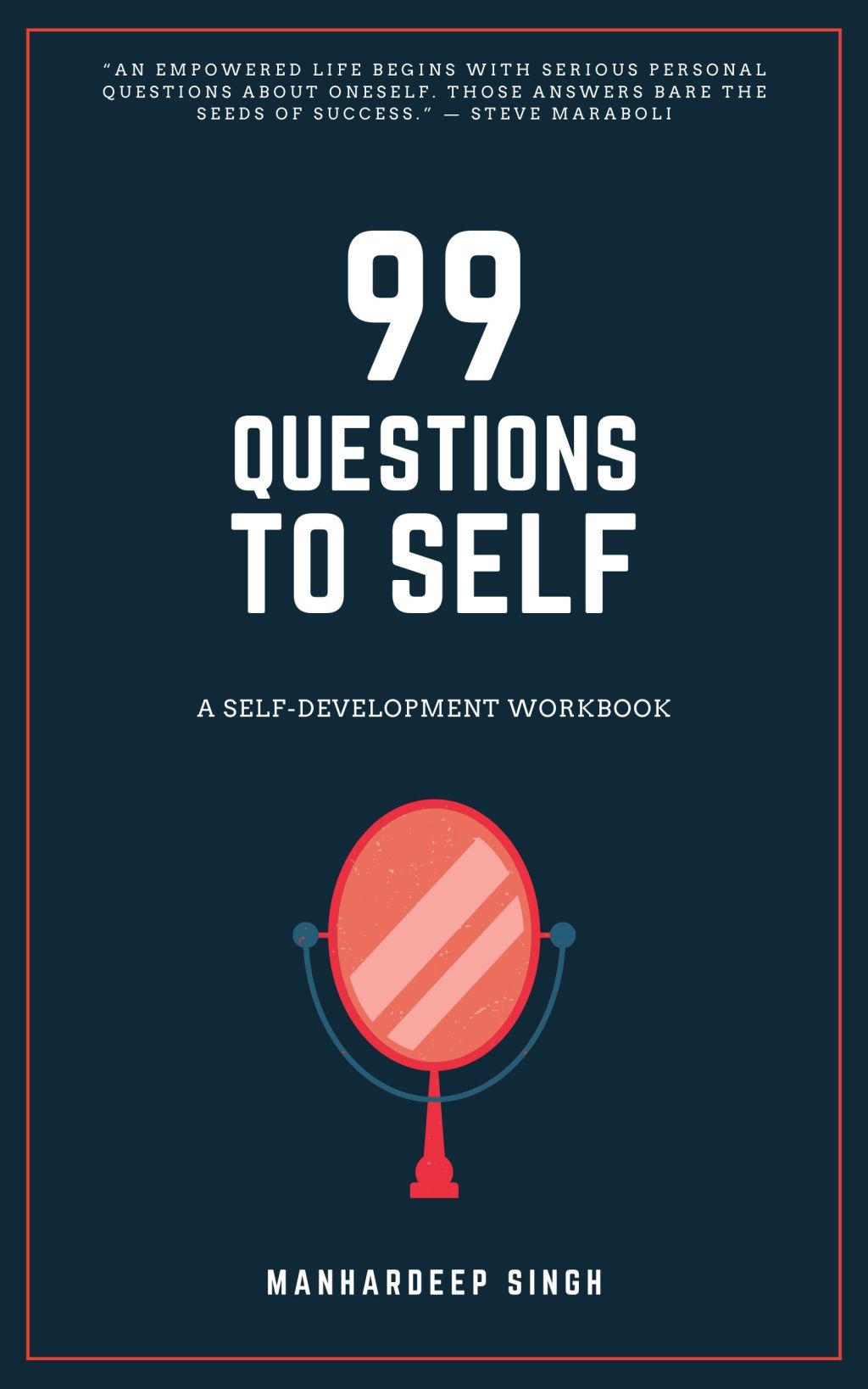
  • Book Spotlight – 99 Questions to Self

    Would you like to tap into your full potential? Discover the 99 questions that can help you realize the superhuman in you.

    This workbook will help you:

    • Discover your latent talents and hidden strengths
    • Learn how to create instant emotions of happiness and abundance
    • Improve every area of your life
    • Tap into unlimited source of power
    • Create a future you like

    99 Questions to Self is a comprehensive self-development workbook. If you like modern, practical, and interactive books, then you’ll love Manhardeep Singh’s self-help workbook.

    Buy 99 Questions to Self to start your journey of self-discovery today!

  • !function(r,u,m,b,l,e){r._Rumble=b,r[b]||(r[b]=function(){(r[b]._=r[b]._||[]).push(arguments);if(r[b]._.length==1){l=u.createElement(m),e=u.getElementsByTagName(m)[0],l.async=1,l.src=”https://rumble.com/embedJS/uz1j88″+(arguments%5B1%5D.video?’.’+arguments[1].video:”)+”/?url=”+encodeURIComponent(location.href)+”&args=”+encodeURIComponent(JSON.stringify([].slice.apply(arguments))),e.parentNode.insertBefore(l,e)}})}(window, document, “script”, “Rumble”);
    Rumble(“play”, {“video”:”vs3k7s”,”div”:”rumble_vs3k7s”});
  • ‘A Is For Action’ – What Time Management Is Really About

    When you get right down to it, time management is really about managing your actions. We all want to use the process of time management to allows us to perform more actions in the day, getting everything done that needs to be done and giving us time to do the things we enjoy doing. But time management isn’t a magical cure for getting the actions done that you need to do. It’s simply a tool. A very powerful tool when used correctly, but still just a tool.

    Advertisements

    For example, you might learn all there is to know about time management – read countless books, listen to CDs, and maybe even attend a few training courses or seminars. But unless you take action to put what you have learned into practice, it will be time and money wasted. And wasting time, as we both know, is one of the worst things you can do.

    On the other hand, perhaps you do decide to take some action, and start to do some of the things you have learned. But only half-heartedly. Maybe you create a to do list at the start of the day, but then never refer to it. Or you organize all your existing files, but just throw any new papers into a single pile. Or you do a few of the exercises you have learned, but never do anything with the results you come up with.

    But perhaps the worst thing that can happen when using the tools time management offers is to follow the actions you have learned, refer to the information you write down, but then simply not get anything done. In the case of a to do list, perhaps you draw the list up for the day, then just procrastinate on tackling even the first task. You may not even do it consciously – looking back on the day, things just always seemed to “come up” (although if you are following good time management advice, that excuse shouldn’t apply any more!)

    If this is happening, it is possible that the issue isn’t time management, but more an issue of motivation.

    If the tasks are part of your job, perhaps the work no longer interests you and you need to find another area to work in. If the tasks are for yourself and are related to your personal goals, perhaps the goals you have set for yourself aren’t the correct goals for you? You may have written those goals down because you thought you should, but it’s not really what you want.
    Of course it may just be that you didn’t realize you were procrastinating on doing the actions you needed to do, and that realization spurs you on to get everything done!

    Ultimately, time management comes down to taking action and applying the methods you have learned to plan your activities, then taking action to do those activities in the most efficient way possible. Everyone can do it – even you!

  • !function(r,u,m,b,l,e){r._Rumble=b,r[b]||(r[b]=function(){(r[b]._=r[b]._||[]).push(arguments);if(r[b]._.length==1){l=u.createElement(m),e=u.getElementsByTagName(m)[0],l.async=1,l.src=”https://rumble.com/embedJS/uz1j88″+(arguments%5B1%5D.video?’.’+arguments[1].video:”)+”/?url=”+encodeURIComponent(location.href)+”&args=”+encodeURIComponent(JSON.stringify([].slice.apply(arguments))),e.parentNode.insertBefore(l,e)}})}(window, document, “script”, “Rumble”);
    Rumble(“play”, {“video”:”vs0d2f”,”div”:”rumble_vs0d2f”});
  • 8 Steps Towards Becoming The Leader You Need To Be To Succeed

    An important part of success in life is the ability to lead. It is important that we not only be able to lead others but be willing to lead ourselves. No one succeeds in life by simply following others. Sometimes we simply must strike a bold new path for ourselves.

    Advertisements

    Being a good leader is more than simply being at the forefront of the crowd. A leader must act. Too often we simply accept that someone looks or sounds like a leader and too rarely do we actually look at the actions that leader performs — and that is the true test of leadership.

    However, in order to become good leaders ourselves, we need to concentrate on actions rather than simple appearances. The title of this article refers to eight steps, but do not think of these as progressive steps like so many recipes or instruction manuals describe. Instead, think of these as actions that you must take on a regular basis.

    First, be alert to new potentials. “Reality” is not absolute but rather subject to constant change. Think about inventors, explorers, and agents of social change who have achieved greatness. Some might simply say that certain people are successful because they are lucky to be in the right place at the right time. Maybe so, but if they hadn’t had their eyes open for the opportunity, then it wouldn’t have mattered if they were in the right place.

    Second, accept inspiration from wherever it comes; even your opponents. The wisest leaders constantly study their competition. In war, politics, and business we constantly see examples of this research and reconnaissance. Too many times though a certain study, many concentrate on finding a weakness to exploit. If you want to a be a leader of positive change don’t fall victim to this trend. Instead, if you find a weakness, make sure to avoid that pitfall yourself. If you find the strength then find a way to strengthen your own qualities to match.

    Third, learn something new and promote in new ways every day. This means you must continually seek to expand your horizons, internally and externally. Feed your mind with new lessons and knowledge, but constantly expand your social horizons as well. Seek out and meet new people and immerse yourself in new social situations. You never know when these new experiences will help you in your leadership role.

    Fourth, search for and find answers in subtle clues. Look beneath the surface and constantly question. This is an extension of the third step in that you are seeking new knowledge. But this also means that you will need to step off the traditional paths of knowledge. Don’t simply read books in the literary canon or the bestsellers list. Take seminars rather than classes as there is more room for questioning and debate. Seek out the unconventional thinkers, teachers, and writers.

    Are you tired of motivating people or staying motivated? Start seeing motivation like never before concept with a single shift in perspective.

    The Ultimate Book of Motivation will help you:
    • Take responsibility for your life
    • Be unstoppable on the face of failure
    • Turn self-defeating thoughts around
    • Change your outlook on life
    • Motivate anyone to do anything

    Buy The Ultimate Book of Motivation to start motivating today.

    Fifth, improvise if no existing solutions are available. No excuses. Necessity is the mother of invention. How do you know it won’t work if you’ve never tried it before? Remember, not all approaches need to come from the front. Look at your problem from all sides and systematically attempt different solutions in various combinations.

    Six, make at least one person you care about happy every day. If you make it a point to be thoughtful and caring for one person every day then soon this thoughtful, caring behavior will become a habit and that habit will spread to the others around you. Making someone else happy also feeds your own personal happiness. Just imagine how much better the world would be if we all did a little bit more to spread happiness.

    Seven, offer help, even if there’s no apparent advantage to you. This means more than writing a check. It means giving of your time and energy and yourself. Sometimes it will mean helping someone you don’t know and sometimes it can be a very personal action.

    Finally, never let negativity be your last word on the subject. If your final words are negative than no matter how hopeful you may be about the potential of a project or action the lasting impression you give to others is one of negativity. Accentuate the positive and you are more likely to see a positive outcome.

    If you follow these eight action steps not only you will be a better leader but also lead yourself to a more successful life.