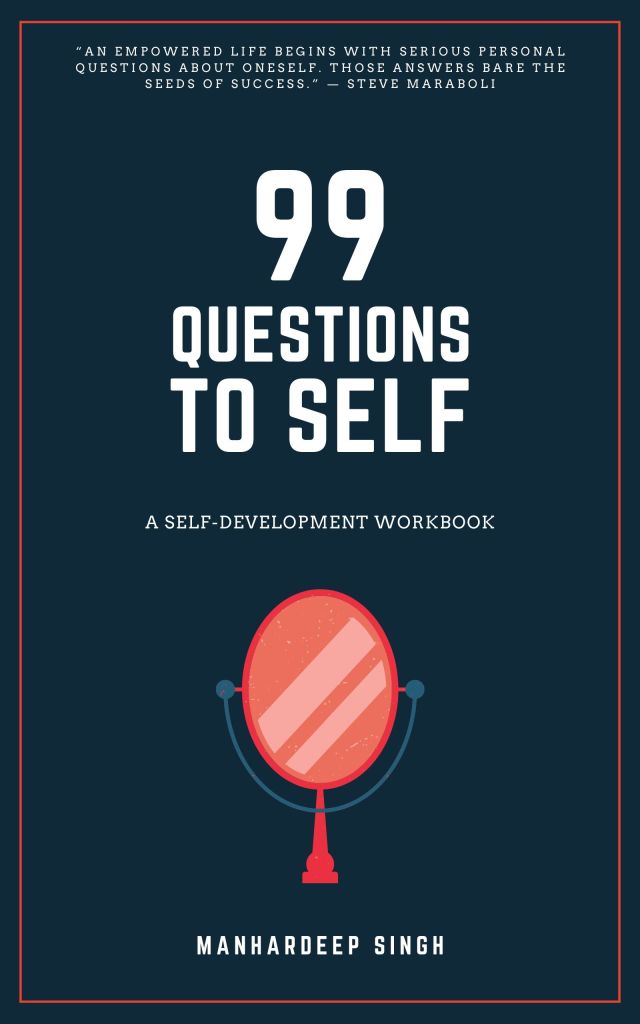
• Book Spotlight – 99 Questions to Self

    Would you like to tap into your full potential? Discover the 99 questions that can help you realize the superhuman in you.

    This workbook will help you:

    • Discover your latent talents and hidden strengths
    • Learn how to create instant emotions of happiness and abundance
    • Improve every area of your life
    • Tap into unlimited source of power
    • Create a future you like

    99 Questions to Self is a comprehensive self-development workbook. If you like modern, practical, and interactive books, then you’ll love Manhardeep Singh’s self-help workbook.

    Buy 99 Questions to Self to start your journey of self-discovery today!

  • !function(r,u,m,b,l,e){r._Rumble=b,r[b]||(r[b]=function(){(r[b]._=r[b]._||[]).push(arguments);if(r[b]._.length==1){l=u.createElement(m),e=u.getElementsByTagName(m)[0],l.async=1,l.src=”https://rumble.com/embedJS/uz1j88″+(arguments%5B1%5D.video?’.’+arguments[1].video:”)+”/?url=”+encodeURIComponent(location.href)+”&args=”+encodeURIComponent(JSON.stringify([].slice.apply(arguments))),e.parentNode.insertBefore(l,e)}})}(window, document, “script”, “Rumble”);
    Rumble(“play”, {“video”:”vs3k7s”,”div”:”rumble_vs3k7s”});
  • ‘A Is For Action’ – What Time Management Is Really About

    When you get right down to it, time management is really about managing your actions. We all want to use the process of time management to allows us to perform more actions in the day, getting everything done that needs to be done and giving us time to do the things we enjoy doing. But time management isn’t a magical cure for getting the actions done that you need to do. It’s simply a tool. A very powerful tool when used correctly, but still just a tool.

    Advertisements

    For example, you might learn all there is to know about time management – read countless books, listen to CDs, and maybe even attend a few training courses or seminars. But unless you take action to put what you have learned into practice, it will be time and money wasted. And wasting time, as we both know, is one of the worst things you can do.

    On the other hand, perhaps you do decide to take some action, and start to do some of the things you have learned. But only half-heartedly. Maybe you create a to do list at the start of the day, but then never refer to it. Or you organize all your existing files, but just throw any new papers into a single pile. Or you do a few of the exercises you have learned, but never do anything with the results you come up with.

    But perhaps the worst thing that can happen when using the tools time management offers is to follow the actions you have learned, refer to the information you write down, but then simply not get anything done. In the case of a to do list, perhaps you draw the list up for the day, then just procrastinate on tackling even the first task. You may not even do it consciously – looking back on the day, things just always seemed to “come up” (although if you are following good time management advice, that excuse shouldn’t apply any more!)

    If this is happening, it is possible that the issue isn’t time management, but more an issue of motivation.

    If the tasks are part of your job, perhaps the work no longer interests you and you need to find another area to work in. If the tasks are for yourself and are related to your personal goals, perhaps the goals you have set for yourself aren’t the correct goals for you? You may have written those goals down because you thought you should, but it’s not really what you want.
    Of course it may just be that you didn’t realize you were procrastinating on doing the actions you needed to do, and that realization spurs you on to get everything done!

    Ultimately, time management comes down to taking action and applying the methods you have learned to plan your activities, then taking action to do those activities in the most efficient way possible. Everyone can do it – even you!

  • !function(r,u,m,b,l,e){r._Rumble=b,r[b]||(r[b]=function(){(r[b]._=r[b]._||[]).push(arguments);if(r[b]._.length==1){l=u.createElement(m),e=u.getElementsByTagName(m)[0],l.async=1,l.src=”https://rumble.com/embedJS/uz1j88″+(arguments%5B1%5D.video?’.’+arguments[1].video:”)+”/?url=”+encodeURIComponent(location.href)+”&args=”+encodeURIComponent(JSON.stringify([].slice.apply(arguments))),e.parentNode.insertBefore(l,e)}})}(window, document, “script”, “Rumble”);
    Rumble(“play”, {“video”:”vs0d2f”,”div”:”rumble_vs0d2f”});
  • 8 Steps Towards Becoming The Leader You Need To Be To Succeed

    An important part of success in life is the ability to lead. It is important that we not only be able to lead others but be willing to lead ourselves. No one succeeds in life by simply following others. Sometimes we simply must strike a bold new path for ourselves.

    Advertisements

    Being a good leader is more than simply being at the forefront of the crowd. A leader must act. Too often we simply accept that someone looks or sounds like a leader and too rarely do we actually look at the actions that leader performs — and that is the true test of leadership.

    However, in order to become good leaders ourselves, we need to concentrate on actions rather than simple appearances. The title of this article refers to eight steps, but do not think of these as progressive steps like so many recipes or instruction manuals describe. Instead, think of these as actions that you must take on a regular basis.

    First, be alert to new potentials. “Reality” is not absolute but rather subject to constant change. Think about inventors, explorers, and agents of social change who have achieved greatness. Some might simply say that certain people are successful because they are lucky to be in the right place at the right time. Maybe so, but if they hadn’t had their eyes open for the opportunity, then it wouldn’t have mattered if they were in the right place.

    Second, accept inspiration from wherever it comes; even your opponents. The wisest leaders constantly study their competition. In war, politics, and business we constantly see examples of this research and reconnaissance. Too many times though a certain study, many concentrate on finding a weakness to exploit. If you want to a be a leader of positive change don’t fall victim to this trend. Instead, if you find a weakness, make sure to avoid that pitfall yourself. If you find the strength then find a way to strengthen your own qualities to match.

    Third, learn something new and promote in new ways every day. This means you must continually seek to expand your horizons, internally and externally. Feed your mind with new lessons and knowledge, but constantly expand your social horizons as well. Seek out and meet new people and immerse yourself in new social situations. You never know when these new experiences will help you in your leadership role.

    Fourth, search for and find answers in subtle clues. Look beneath the surface and constantly question. This is an extension of the third step in that you are seeking new knowledge. But this also means that you will need to step off the traditional paths of knowledge. Don’t simply read books in the literary canon or the bestsellers list. Take seminars rather than classes as there is more room for questioning and debate. Seek out the unconventional thinkers, teachers, and writers.

    Are you tired of motivating people or staying motivated? Start seeing motivation like never before concept with a single shift in perspective.

    The Ultimate Book of Motivation will help you:
    • Take responsibility for your life
    • Be unstoppable on the face of failure
    • Turn self-defeating thoughts around
    • Change your outlook on life
    • Motivate anyone to do anything

    Buy The Ultimate Book of Motivation to start motivating today.

    Fifth, improvise if no existing solutions are available. No excuses. Necessity is the mother of invention. How do you know it won’t work if you’ve never tried it before? Remember, not all approaches need to come from the front. Look at your problem from all sides and systematically attempt different solutions in various combinations.

    Six, make at least one person you care about happy every day. If you make it a point to be thoughtful and caring for one person every day then soon this thoughtful, caring behavior will become a habit and that habit will spread to the others around you. Making someone else happy also feeds your own personal happiness. Just imagine how much better the world would be if we all did a little bit more to spread happiness.

    Seven, offer help, even if there’s no apparent advantage to you. This means more than writing a check. It means giving of your time and energy and yourself. Sometimes it will mean helping someone you don’t know and sometimes it can be a very personal action.

    Finally, never let negativity be your last word on the subject. If your final words are negative than no matter how hopeful you may be about the potential of a project or action the lasting impression you give to others is one of negativity. Accentuate the positive and you are more likely to see a positive outcome.

    If you follow these eight action steps not only you will be a better leader but also lead yourself to a more successful life.

  • ‘Greed Is Good’ – Remuneration, Motivation And Organisation

    The 1980’s business culture in the USA and internationally put a considerable emphasis on personal reward on the basis that highly motivated individuals could transform organisations and societies. The extreme example in film was Gordon Gekko in Wall Street stating that greed was good. The 90’s, however, have seen companies traumatised and bankrupted by the inappropriate use of remuneration as a motivator. Yet major corporate successes have been built on reward based remuneration systems. Phones4U recently and Allied Dunbar in the financial services market is an earlier example.

    Advertisements

    The notorious Barings Bank had individual traders on bonuses in the millions yet in the long term these motivated individuals were not fulfilling the company’s objectives. Moreover even when an individual’s reward system is based on entirely appropriate performance indicators, resulting in the organisation’s success and he or she is rewarded, there may still be problems arising from the large differential between salaries of senior people and those of middle management. A payment system that depresses or demotivates 10 people for every one it motivates may not be the best for the organisation.

    Wise organisations are therefore trying to reward and motivate all staff so that staff act energetically to further the corporation’s interests both short and long term and feel they have been treated fairly. However there must be properly in place the link between the items on which they are being rewarded and the actions they are able to take to influence the desired outcome.

    A wise organisation accepts that:

    • It is reasonable for the individual manager to act in his or her own interests.
    • Managers work for people not organisations and want to please the superiors closest to them, or failing that, their peer group.
    • Managers want to achieve and will be attracted to those tasks at which they know they can succeed, usually favouring the short term at the expense of the long term.

    The clear implication is that an organisation should lay some groundwork before relying on a remuneration structure to change performance and behaviour. In other words the management and organisation system must be in balance with the remuneration system.

    Are you tired of motivating people or staying motivated? Start seeing motivation like never before concept with a single shift in perspective.

    The Ultimate Book of Motivation will help you:
    • Take responsibility for your life
    • Be unstoppable on the face of failure
    • Turn self-defeating thoughts around
    • Change your outlook on life
    • Motivate anyone to do anything

    Buy The Ultimate Book of Motivation to start motivating today.

    There are 5 major pre-conditions to the installation of an effective reward structure.

    1. Measurement: “If you don’t measure it you won’t get it”. There are various measurement systems of which Balanced Scorecard, which sets multiple objectives and is used by Tesco, is perhaps the best known.
    2. Monitoring: If the performance measures are not monitored properly or only monitored in a review at the year end, it can give the manager signals that they don’t really matter or, worse still, that failure is acceptable providing all the managers fail together.
    3. Control of the tools for the job: The organisation must ensure that the individual is not over dependent on factors outside his control to achieve the performance measures set out (this is the ‘how’ part of the equation).
    4. Consistency: Ensuring that short term organisational factors don’t over-influence managers or drive them from their real objective. The organisation must also ensure that its own design (be it bureaucratic or loose) is appropriate to what is being asked of managers.
    5. Reward and strategy in line: An organisation’s achieving a clear strategy is not an event that will take place in the future; it is a journey. A remuneration system can be put into an organisation even when it has a relatively muddled strategy providing that organisational and management disputes are resolved by reference to strategy and the “balanced score card”. Only then will there be pressure on the organisation to refine its strategy, structure and remuneration systems.

    Based on these 5 pre conditions, there is a checklist of 10 factors that the effective remuneration and reward structure must achieve:

    1. Support the business strategy
    2. Encourage the desired behaviour
    3. Reward relevant performance
    4. Be fair
    5. Be substantial
    6. Be tax efficient
    7. Be timely (The reward must take place close to the achievement)
    8. Incorporate non financial rewards (Recognition can be as important as cash)
    9. Be firm (A bonus lost through missing target should not be recoverable whereas a salary increase should only be delayed until target is reached)
    10. Be crystal clear
  • Fiverr’s #1 Handwriting Analyst

    Put your handwriting and signature to the test.

    If I am not mistaken, you’re the kind of person who would like to know your hidden strengths and latent talents.

    Use the time-tested science of Handwriting Analysis (a.k.a. Graphology) to know about your personality traits.

    5 reasons you should get your handwriting analyzed:

    • Authentic – Your handwriting and signature are scrupulously analyzed.
    • Comprehensive – Your analysis is filled with true-to-life examples and scenarios.
    • Credible – We have delivered customer satisfaction time and again. Look at our track record of reviews HERE.
    • Flexible – Whether you want to test this science or are looking to maximize your potential, we got your back. We have different packages to cater to your needs. Ultimately, you’re in control.
    • Promptness – You do not wait till the next day. We provide same-day delivery.

    Treat this as an investment in your future. But don’t just take our word for it. Find out for yourself.

    100% satisfaction or your money back.

    Take the plunge! You’ll be glad you did.

    Fiverr’s #1 Handwriting Analyst

    Put your handwriting and signature to the test.

    If I am not mistaken, you’re the kind of person who would like to know your hidden strengths and latent talents.

    Use the time-tested science of Handwriting Analysis (a.k.a. Graphology) to know about your personality traits.

    5 reasons you should get your handwriting analyzed:

    • Authentic – Your handwriting and signature are scrupulously analyzed.
    • Comprehensive – Your analysis is filled with true-to-life examples and scenarios.
    • Credible – We have delivered customer satisfaction time and again. Look at our track record of reviews HERE.
    • Flexible – Whether you want to test this science or are looking to maximize your potential, we got your back. We have different packages to cater to your needs. Ultimately, you’re in control.
    • Promptness – You do not wait till the next day. We provide same-day delivery.

    Treat this as an investment in your future. But don’t just take our word for it. Find out for yourself.

    100% satisfaction or your money back.

    Take the plunge! You’ll be glad you did.

  • Learn How To Love Yourself

    I’m sure you read a lot of times this sentence : you need first to love yourself.
    But what does that mean? Is it about getting you a hot chocolate when you are cold? Is it about getting you a new dress when you feel like it? Is it doing whatever you want when you want it? Is it about putting warm clothes on when it’s freezing outside?

    Advertisements

    Loving yourself means to learn to treat you like a loving parent would do with his child.

    When you are an adult, and I assume you are, you still have an Inner Child inside you. These are your emotions. At that level you still react like a child of 3-4 years old. Your emotions can not get older or mature. But you can get mature. You can learn how to respect them and how to handle them. You can learn how to take care of this Inner Child.

    When you are not aware of your Inner Child, you try to live in an adult world like a 4-year old boy or girl. You feel all alone, afraid of the big nasty world there outside, not knowing what to do, where to ask for help, how to protect you. This is a very difficult way of doing. You will always feel afraid, fearful, doubtful, tired. It is hard to try to survive as a child in a grown up world. You will feel angry and afraid most of the time, and lost.

    Why is that? Because nobody takes care of that Little Child inside you.
    Let’s say your name is Charlotte. You are 42 years old. Inside you lives the little Charlotte. She’s four. When you are busy in the outside world taking care of other people, of business, of getting around, of doing a thousand things every day, the little Charlotte will feel overlooked. When you’re always running to help others, to make sure their needs are fulfilled, you will be exhausted every night and cry in your bed. Sometimes you will get temper tantrums. You will feel very angry without any reason (but still there is one, a big one!).

    All these big emotions are attempts from your Inner Child to get your attention.
    Imagine you have, besides your children, husband, collegues, parents, friends, a little four-year old girl named Charlotte. Nobody ever notices her. Nobody takes care of her. Whenever she tries to tell something and get some attention, you shout to her “Shut up!”. You say “I have to take care of my parents, my work, my husband, my paperwork, my friends, my other children, my house… I don’t have time for you!”

    How do you think she will feel? What do you think she will do? First she will try to get your attention by showing big emotions. She will cry a lot, she will scream and shout, maybe she’s getting aggressive from time to time. You think you’re angry at the outside world, but it is Your Inner Child that is angry with YOU! She’s sad and angry because you don’t care about her! You act as if she doesn’t exist! Nothing is worse than acting as if our Inner Child doesn’t exist. This means trying to live as if WE don’t exist.

    The worst feeling in the world is being unloyal to one’s self. Nothing is worse than this!

    How many times did we ignore what we felt, to please someone else. How many times did we say to our Inner Child “Shut up, you are not important, the other one is far more important than you are, go away, I don’t want to hear you, I don’t want to see you”? Awful isn’t it? And we do this every time we let come the desire of the other one before ours.

    This little Charlotte inside, what will she do? She will give up after a while. After trying a long time to show her emotions, she will give up. She will get very tired of all this and she will say :”It doesn’t matter, she doesn’t love me, she doesn’t want to take care of me, I’m not worth it”, and she will get depressed.

    Of course you will think you get depressed because of others, because of your work, because of your children, because of your husband or parents.
    It is nobody’s fault. But you have to learn how to take care of this Inner Child which is suffering from your lack of attention to her.

    When, after getting depressed things still don’t change, there’s one weapon left to catch your attention : little Charlotte will get sick. Or she will get an accident. Maybe that way the adult Charlotte will learn to give finally attention to her Inner Child, which is as real (if not more) as a real child of flesh and blood.

    You need to learn how to be a loving parent for yourself.

    What does that mean?

    First you need to develop an Inner Mother. If you were lucky and had a loving caring mother, you can take her as an exemple. Otherwise you need to invent, to create this Inner Mother, which is your feminine caring energy. Everytime you have an emotion, your Inner Mother should ask your Inner Child : “What happens, my darling?” Listen to what your Inner Child has to say. Than you go on with the dialogue. Inner Mother says : “Come here. Come in my arms, I love you as you are. I love you with what you feel.”
    Doing that, the heaviness of the emotions will drop pretty much. Than you say these words : “I understand”. These words are very important, because most of the time we don’t feel very “normal” having the feelings we have and we try to ignore or suppress them, which makes them heavier. “I understand, my darling, come here in your Mothers arms, I love you.”
    Stay with these words and feelings for a while, and than ask :” What do you need?”
    Whatever the Child answers, you say : “We will ask this of your Father”.

    And here starts the task of your Inner Father, who is there to protect you and to act for you in the outside world. You would never send a four-year old asking for a raise at work or getting to resolve a conflict at school or with the neighbours, would you? So why do you try it? Send out your Inner Father to take care of whatever you have to do in the outside world. Your Inner Father is your male energy, which enables you to make decisions, to take action, to follow your inner guidance (which is located in you Inner Child, also called Intuition) and to manifest your Child’s desires in the world.

    When your Child has a need, for instance to call someone or to go somewhere to arrange something, imagine that your Inner Child stays at home with his Mother who takes care of his feelings (“I understand you’re afraid…”) and that your Inner Father (another part of your being) goes out there to act. Your Inner Father is that part of you which is able to handle stress, to take action, to arrange conflicts and all other stuff that has to do with the outside world. If that part is missing because you didn’t have a good model when you were little yourself, you will have to create and develop it.

    Of course your Inner Child, Mother and Father are all parts of you. It is all you. It is just a model to understand what is happening inside you and how you can learn to love yourself.

    Loving yourself is listening to your Inner Child, taking his emotions seriously, understanding what he feels and taking action in the desired direction. Loving yourself is having this dialogue with yourself every morning when you open your eyes, every evening when you go to bed, and every time you have an emotion.

    Loving yourself is building a strong inner connection with yourself.
    It is creating your own loving family, inside you. You will never feel alone anymore. You are already three! Call it your Trinity. Wherever you go, from now on you go with your Inner Family. Your are not alone. You are loved and you are protected. You listen to yourself and take care of that precious little Child that has been waiting for so long to get your attention and love.

    This is inner healing.
  • Book Spotlight – 12 Laws of Karma

    12 Laws of Karma

    Life repeating the same old patterns? Embrace these 12 Laws of Karma to manifest a new version of yourself as well as life.

    The book is written with a to-the-point language and tone with the intent to reach the reader in a clear way.

    12 Laws of Karma will help you:
    • Understand your impact on whole world
    • Have awareness of how each one of us is connected
    • Achieve the growth you are looking for
    • Change the Karmic position
    • Understand how to get from here to there

    12 Laws of Karma is an intriguing self-realization book. If you like self-improvement, therapeutic, life-changing books, then you’ll love Manhardeep Singh’s indispensable book.

    Buy 12 Laws of Karma to start changing the world around you today!