
Do you want to know what women really want? Discover the 16 types of women and what really matters to them.
2021-02-15T10:00:00
days
hours minutes seconds
until
THE BOOK LAUNCH

days
hours minutes seconds
until
THE BOOK LAUNCH

Why do some people seem to succeed in all they do, but others flounder along at the rear? Mostly it’s because the successful people have set goals and take steps to successfully achieve them. So how do they always seem to achieve their goals?
Here are five strategies they use:
1. Start with a long-term goal, write it down, taking into account when you are goin to achieve the goal and why it’s important. Try and be as visual as possible, explaining how the achievement of this goal will change your life for the better. Once this long-term goal has been documented, break the goal into tangible steps that need to be taken to achieve the goal.
2. Make certain that you really want the goal. Ask yourself, “Do I really want this goal? Will this goal give me a better life?” Answering these questions will give you more drive to achieve your goal.
3. Speak up. You should not keep your goals to yourself. Sharing your goals can help you get the support you may need from others. Some people are concerned with telling others about their goals because they are worried they will fail. However, telling others means that you are more likely to achieve your goals either with their support or in-spite of them.
4. Write down your goals. This strategy is advisable for those who have a long list of goals. After writing them down, review them regularly. You may also want to keep them handy to keep you motivated.
You have to discipline yourself to stick to what you have written. Do not just write them and tuck them away somewhere ‘safe’. Its better to keep them where you will see them, try sticking them to the refrigerator.
5. Stay on track and do not give up. Reviewing your goals will help open your mind to see if you are on the right track. While on track, you may have to face challenges that might change the way you see yourself.
Never be discouraged. Encountering obstacles is just a test for how dedicated one is to achieve the goals you’ve set. It will all boil down to you preparing yourself to face anything and doing everything to get to the goal that you have set for yourself. Only you can make it happen. Nothing can stop you if you have set your mind to it and commit to taking action.

I recently had a conversation with one of my former students. She has been out of school for a few years now but isn’t satisfied with the direction her career has taken. In fact, she’s not too happy with her personal life either. Her voice developed more than a touch of whine as she said: “I don’t know what to do.”
So I asked her about her goals. Her response was a rather slack-jawed look of surprise. “Goals?” Well at least she wasn’t whining anymore.
I asked her what she would like to see her career in a few years. I asked her where she’d like to see her life in a few years. She knew the answers to those questions and quickly became animated as she discussed her desire to start her own business. We talked about what she would need to accomplish her goal and what she would have to change.
When we parted ways she felt a lot better about her job because she knew that she wasn’t trapped in it. She was taking a necessary step to prepare herself for a long-term goal. She had her eye on the prize and that focus energized her.
That is the power of goals. What are your goals? There are seven reasons why you need to have goals.
While it can be fun to live without direction in the short-term, in the long-term human beings are wired to need a purpose and direction. Goals give a sense of direction and purpose to life.
It is often easy to let others set our direction for us. We take a job because family or friends point us in that direction and then we follow the dictates of our bosses. We move in other directions because popular culture or the media tells us to do so. The simple truth is that if we do not set our own goals then we will find it too easy to follow a path set by others. This can lead to stress and unhappiness. We have a greater chance of happiness and fulfillment following our own path and pursuing our own goals.
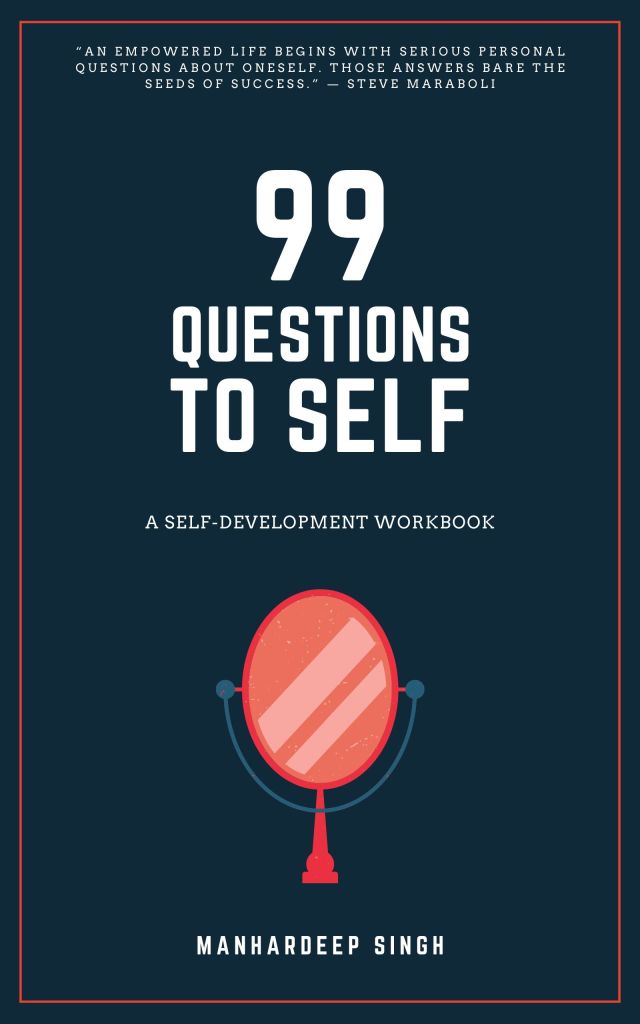
Would you like to tap into your full potential? Discover the 99 questions that can help you realize the superhuman in you.
This workbook will help you:
99 Questions to Self is a comprehensive self-development workbook. If you like modern, practical, and interactive books, then you’ll love Manhardeep Singh’s self-help workbook.
Buy 99 Questions to Self to start your journey of self-discovery today!
While goals certainly give our lives direction, they also provide the motivation to get us through difficult times and choices. Perhaps going to college at night while working full-time may be stressful and difficult in the short-term, but in the long run being able to pursue the professional goals we desire will make it worthwhile.
Goals also serve as the destination for what we really want out of life. For some people, goals are measured in money or material goods, while for others goals are measured in time or freedom. If we do not have goals outlined that suit our unique perspective on life it is easy to become sidetracked by life and others.
Goals can also help save time. When your “To Do” list becomes too long and your calendar too full, then you can simply compare your goals to the list. What items help you achieve your goal? What items are necessary to your goal? Scratch off the rest as unimportant.
Just as goals save time they also reduce stress because using your goals to focus your life and choices makes it easier to make those choices. Should you take that new position at work? How does it match your goals?
Finally, goals give you a measurable sense of accomplishment. Every goal you achieve, in fact every step you make toward that goal, can give you a boost of energy and momentum to keep going. Each success powers you toward the next level of success.
Now go out and set your goals!

Cricket is my life. Before the cancer, I was happy-go-lucky. I used to think about my career and worry about the future. But post it, my thinking has completely changed. I’m happy to eat and breathe normally. I’m happy to have my life back.
Yuvraj Singh

The ‘Golden Rule’ occurred in the Greek and Chinese cultures thousands of years before the Christian era: “Do unto others as you would have them do unto you.” The spirit of the Golden Rule is one of generosity and altruism and is at the heart of any personal networking and ‘right’ living. Ralph Waldo Emerson said ‘To have a friend, you have to be one’, and his words are as true today as they ever were.
You can test this out yourself by completing the following simple exercise:
List ten people you know best: 1 – 10
After each name, write an ‘H’ if the person is happy, or an ‘N’ if the person is not happy. (H/N S/N) Then write an ‘S’ if the person is selfish or a ‘U’ for unselfish. Rimland in Psychological Reports (51); Brain/Mind Bulletin 1983 defines ‘selfish’ as:
“A stable tendency to devote one’s time and resources to one’s own interests and welfare – an unwillingness to inconvenience oneself for others.”
In his experimental study, the 2000 individuals who completed this exercise reported very few individuals who were both happy and selfish. The findings represent an interesting paradox.
Selfish people are, by definition, those whose activities are devoted to bringing themselves happiness. Yet at least as judged by others, these selfish people are far less likely to be happy than those whose efforts are devoted to making others happy.
So the Golden Rule in networking, as in life, is if you think about the other person rather than yourself, not only is that going to increase your empathy and rapport skills but it will make you a much more attractive person to know and be a magnet for personal happiness.
Another vital part of your networking skills is your ability to build rapport quickly and effectively with others. Successful rapport building will attract others to you and in turn attract personal happiness.
To build rapport successfully with another individual you need to understand ‘where’ they are coming from and have ’empathy’ with them.
People often think of empathy as a mystical commodity, a special, almost uncanny ability to experience the thoughts and feelings of someone else. In fact ’empathy’ is quite simply applied imagination and only requires a little exertion and discipline.
The next time you are sitting in a room conversing with three or more people, try this very simple activity:
Temporarily remove yourself from the conversation. Be very quiet for a few moments. Pay particular attention to the person doing the most talking.
Imagine the following things: Imagine the physical sensations the speaker is experiencing.
Mentally place yourself in that person’s body, sitting or standing in a particular position, eating the same food, drinking the same drink.
Mentally become that person. Do you feel energised? Tired? Irritated?
Imagine what kind of day the speaker has had – using all your knowledge about the speakers’ day. If you know little about the person, guess.
Continue to imagine yourself as that person. How does your day colour and affect what you are saying? Imagine the person’s relationships to everyone in the room – including yourself.
Continue to mentally be that person. What kind of feelings are generated by the people around you? How do they affect the things you say?
Now step back into yourself and rejoin the scene. Does your own role in the conversation feel different? Empathy, like memory is a creative act, not a mystical property and it requires imagination and practice.
It lies within the grasp of all of us.

We are a pleasure seeking society. Most of us spend our energy seeking pleasure and avoiding pain. We hope that by doing this, we will feel happy. Yet deep, abiding happiness and joy elude so many people.
There is a huge difference between happiness and pleasure. Pleasure is a momentary feeling that comes from something external – a good meal, our stock going up, making love, and so on. Pleasure has to do with the positive experiences of our senses, and with good things happening.
Pleasurable experiences can give us momentary feelings of happiness, but this happiness does not last long because it is dependent upon external events and experiences. We have to keep on having the good experiences – more food, more drugs or alcohol, more money, more sex, more things – in order to feel pleasure. As a result, many people become addicted to these external experiences, needing more and more to feel a short-lived feeling of happiness.
Thomas sought my counseling services because he “had everything” – his own successful business, a lovely wife and children, a beautiful home, and time to enjoy life. Yet he was not happy. While he had momentary feelings of happiness while watching a ball game or socializing with his friends, he also felt anxious and depressed much of the time. In fact, the anxiety had become so bad that he was having almost constant stomach pain, which his doctor told him was from stress.
As we worked together, it became apparent that Thomas’s main desire in life was to have control over people and events. He wanted others to do things his way and to believe the way he believed. He was frequently judgmental with his employees, wife, children and friends, believing that he was right and they were wrong and it was his job to straighten them out with his judgment and criticism. His energy would become hard and tough and he would be like a steamroller in his efforts to get his point across and get others to do things his way. When it worked and others gave in, Thomas felt a momentary pang of pleasure. But the pain in his stomach kept getting worse and worse, which is why he decided to consult with me.
Thomas also wanted control over his own feelings, and would often judge himself as harshly as he judged others in an effort to get himself to perform well and feel okay. He especially judged himself harshly when he felt rejected by others, frequently telling himself that he was an inadequate jerk.
As we worked together, Thomas began to see that happiness is the result of choosing to be a kind, caring, compassionate and gentle person with himself and others – quite the opposite of the judgmental, controlling person he had chosen to be. Thomas learned that happiness is the natural result of being present in each moment with love and kindness toward himself and others, rather than with being attached to the outcome of things and trying to control the outcome regarding events and others’ behavior. He discovered that he felt deep joy whenever he let go of control and chose caring instead. The anxiety in his stomach went away whenever his intention was to be a kind and caring person rather than a controlling one.
Have you ever found yourself stuck in a situation for too long? Is your career at a stagnant halt? Are you in a relationship turmoil? Worry no more.
Handwriting Analysis surfaces your strengths and gives you insight into the areas you can improve.
Handwriting analysis has helped people:
• Be more self-aware
• Have better control of their life
• Eliminate weaknesses
• Create better career opportunities
• Improve relationships within and outside the family
This is a MUST TRY service to take your life to the next level. Order Today and know what handwriting says about your personality.
You get:
• Handwriting Analysis
• Signature Makeover (Modifying signature so that it attracts wealth and happiness)
• Grapho-therapy Plan (Changing how you write specific letters to remove unnecessary traits from the personality)
It is not easy to shift out of the deep devotion to control and become devoted to love and compassion toward oneself and others. Our ego wounded self has been practicing control since we were very little. Yet the moment our intent is to control, our heart closes and we feel alone and anxious inside. Our intent to seek safety and pleasure through controlling others, outcomes, and our own feelings leads to an inner feeling of abandonment and emptiness. We abandon ourselves when we are trying to control our feelings rather than be kind and compassionate with ourselves. Our anxiety and feelings of emptiness lead to more seeking outside ourselves to fill up with pleasurable experiences. The momentary pleasure leads to addictive behavior.
When the intent shifts out of controlling and not being controlled to becoming loving to ourselves and others, the heart opens and joy is the result. Deep and abiding happiness and joy are the natural result of operating out of the spiritual values of caring, compassion and kindness.

Goal setting is the true secret to success in any area of life. But although setting a goal may seem simple, achieving it is usually another question altogether.
Why is that?
Because you will never achieve your goals unless you: (1) know exactly what you want, (2) are passionate about your goal, and (3) have a solid, realistic plan of action. This is what marks the difference between nebulous dreams and wishes – and truly achievable goals!
Many obstacles and challenges will fly right in your face when you’re going after a goal. Here are 5 time-tested methods that will help get the success you deserve.
1. Know exactly what your goal is
Your first job is to discover exactly what your goal is. What will achieving that goal really look like? Be as specific as possible about exactly what your desired end result is. Your success will be a measure of your clarity – since an achievable goal plan cannot be created around a nebulous “dream.”
If your goal is to create a more successful business, what will that look like? Are you thinking in terms of simply hiring someone else to give you more free time? Are you looking for a very specific monthly profit? Or can your goal be best expressed in terms of a certain lifestyle?
Regardless of what you want, the best way to get it is to first clarify exactly what you want in as much detail as possible. This can be hard work. But without a clear mental picture, you’ll never have the focus required to achieve your goal.
2. Be willing to pay the “entry fee”
Success takes dedicated planning and effort. In a way it’s like building a house. In the beginning all you have is a rough concept. Then you develop a complete set of plans – and you immediately move closer to success. The same is true of creating a better lifestyle, or a more successful business.
But there’s always an entry fee to be paid for success.
The entry fee?
Creating more success in your business may mean less recreational time. Writing your own book may require less TV. Being closer to your children may require adjusting your work or social activities.
It’s the “full glass” deal. If your life (your time) is already full to the top, there’s no room for something new. The entry fee is carving out the time to create that something new.
3. Focus on your goal every day
I’m sure you probably want to achieve your goal as fast as possible. That’s why clear mental focus is so very important.
Consistent daily focus is absolutely necessary to “burn in” the new neural pathways you need to create your new goal. Without daily focus, the old mental habits that have kept you from your goal will continue to take over.
This happens automatically – since these old habits replay 24/7 deep in your subconscious mind. The only way to override subconscious anti-success messages is to consciously focus on what you DO want – and build new neural networks!
That’s why success is an every-day event.
Re-commit to your goal every day. Don’t let your goal take a back seat to the daily tasks and distractions that will try to take over. Life WILL try to get in your way. Just get, and stay, on course every day. Focus on your goal, and on success!

Are you tired of motivating people or staying motivated? Start seeing motivation like never before concept with a single shift in perspective.
The Ultimate Book of Motivation will help you:
• Take responsibility for your life
• Be unstoppable on the face of failure
• Turn self-defeating thoughts around
• Change your outlook on life
• Motivate anyone to do anything
Buy The Ultimate Book of Motivation to start motivating today.
4. Get passionate
One of the most powerful tools in your “success tool box” is having real passion for your goal.
Why passion?
Because intense passionate desire for your goal will help you burn in those new neural pathways even faster. Many, many scientific studies have shown that intense emotion (passion) is a key success tool.
PLUS (and this is really a big plus), intense passion will also help you rapidly override any inappropriate old “failure messages” stored in your subconscious mind.
5. Take consistent action
In many ways, actually taking action can be the most difficult step. Successful goal achievement is built by taking one small action after another.
The word is ACTION!
If you commit to take at least one small action each day, your actions WILL add up and make a difference. So avoid sitting back waiting for that big second when everything will magically “just happen.”
You CAN create whatever you want in life. The secret is to determine exactly what you want, then pursue it passionately. But remember — in the end, only action counts! You can’t just dream about it! You have to DO IT!

Taking responsibility for your actions is the way to improve overall personal life. When you take control of your actions, you are putting bad habits behind you and moving forward down a new highway. At the end of the highway, you will find happiness. Responsibility is a good thing. Sometimes we make mistakes. There is nothing wrong with this, as long as you learn from these mistakes. You are a human being and will make mistakes for the rest of your life. Mistakes is a part of life, you will have to face.
Blame:
Too many people in this world blame others for their mistakes. Taking responsibility is the way to stop blaming others and start putting the blame where it belongs. Once you learn to take blame, you will see new horizons in your future. Sadly, the law talks about society casting blame, but these people too are worse at casting blame than anyone else casts. We see this in the media, etc. Unfortunately, we have bad examples to follow in life, so you will need to learn to become your own best example. No one can guide you to improve your life better than you can. When a person takes blame they do not dwell on the mistake they made, rather look at the options to make things right. For instance, if you cause an accident while driving, you would take the blame and find a way to resolve the problem.
Once you learn to take reasonability for your actions, you will see the road that leads you to success. Someone taking responsibility for their action is the master of their own mind and body.
In life, you will have risks. You will need to learn to take risks whether you like it or not. Sometimes you will take risks that cause you harm, or causes harm to other people. To avoid taking risks that cause harm, try using your critical thinking cap to discover consequences first. Be willing to take chances, as well as participating even if you feel it is stupid. Many people say, I am probably going to ask another stupid question. The fact is there are no stupid questions. The point being, don’t be afraid to ask questions when in doubt. In fact, when in doubt don’t do it.
When you are willing to join in with others to make your life better, take responsibility for your actions, etc, you are improving your life. a person willing to improve their life is not sitting on the back burner. This person is taking the steps, playing the game of life and taking action to achieve his or her goals.
Are you a generalist?
Do you take interest in all things around you? Do you keep an open mind when something good comes your way? Are you willing to learn? If you take action to acquire these skills you will successfully walk through life without running backwards taking responsibility for bad mistakes you made.
Do you accept the unknown?
The unknown can become your best friend. When you learn to accept the unknown, it can help you improve your overall personal life. For instance, if you know English are you willing to learn French. Broaden your horizons and I promise you that you will improve your overall personal life.
Do you acknowledge your limitations?
We all have limits. We must set limits for our self each day. If you fail to set these limits, you will spend the rest of your life casting blame, since you will live in a chaotic world.
A door to the next level:
Have you ever found yourself stuck in a situation for too long? Is your career at a stagnant halt? Are you in a relationship turmoil? Worry no more.
Handwriting Analysis surfaces your strengths and gives you insight into the areas you can improve.
Handwriting analysis has helped people:
• Be more self-aware
• Have better control of their life
• Eliminate weaknesses
• Create better career opportunities
• Improve relationships within and outside the family
This is a MUST TRY service to take your life to the next level. Order Today and know what handwriting says about your personality.
You get:
• Handwriting Analysis
• Signature Makeover (Modifying signature so that it attracts wealth and happiness)
• Grapho-therapy Plan (Changing how you write specific letters to remove unnecessary traits from the personality)

Self-confidence is the innate quality of trusting your own abilities and instincts. Self-confident people are often successful, attentive, and flexible, and can deal with most any life situation. A self-confident person realizes what his or her potential is and works to realize it. Those that are around a self-confident person are aware of his or her character by his or her actions.
People that are self-confident demonstrate it by their actions, and not through their words alone. However, if you are always trying to impress your friends, family, or coworkers by overtly asserting your self-confidence, then you are likely arrogant. There is a big difference between the two characteristics, but the line between them is not clearly defined. Often, people who are usually highly self-confident cross the line into arrogance and don’t even know it.
If your family, friends, or coworkers find you arrogant, they will not enjoy being around you. It is more important to impress individuals through actions than through words. The maxim “actions speak louder than words” is very true. We are all more likely to trust someone who gets the job done rather than someone who simply boasts about doing it. An arrogant person is not seen as trustworthy. How do the people in your life see you?
If you think that you are arrogant instead self-confident, it is time to rethink approach. Instead of bragging about your own personal triumphs, try to bring attention to someone else’s achievement. Take part in group and team projects and work with others, not against them. Think before you speak, and do not overwhelm people with negative comments or critiques or speak highly of yourself.
That is where you start transforming your arrogance into self-confidence. Think of self-confidence as having the strength and ability to complete a goal and arrogance as boasting to everyone how well you will complete it. Make a change by taking on tasks that you have not successfully completed before. This will help to unleash your self-confidence, and develop it further. Your self-confidence will help you to start and finish this project without any self-doubt. It is important to spend more time working on your goals than boasting about your imagined achievements.
Living with self-confidence rather than arrogance provides you with the opportunity to live your life in a new way. It is a time to make amends with those you might have insulted or offended, and start brand new relationships. Having and using you self-confidence, and not arrogance, will let you achieve any goals that you set your mind to.

Easy to identify, yet probably difficult to define, conceptualize, and measure what does self-confidence mean?
One of the main requirements to success, happiness and reaching your goals is confidence. Having enormous self-confidence will also be useful in just about every part of your life.
Lets get straight to the point, you were not born with self-confidence, that is, self-confidence is not something innate this can be taught, nurtured and built over the years, at any stage in life.
Confidence is the personal ownership of no one; the person who has it learns it and goes on learning.
Your degree of confidence is truly the outcome of how you perceive yourself – which is eventually how people will perceive you. How people interrelate and respond to you is a reflection of how you perceive yourself.
Therefore, if you don’t have a high degree of self-confidence or a huge deal of self-esteem then its mostly because you are concentrating on your negative traits and on what you are doing wrong.
In other words, you are being your own worst enemy! The good thing is that you can alter this and improve your self-confidence.
The most talented person on earth has to build confidence in his talents from the foundation of faith and knowledge, like anybody else. The device will be different from one person to the other, but the necessary job is similar. Confidence and attitude are accessible to all of us according to our skills and requirements not somebody elses as long as we make use of our talents and develop them.
Are you tired of motivating people or staying motivated? Start seeing motivation like never before concept with a single shift in perspective.
The Ultimate Book of Motivation will help you:
• Take responsibility for your life
• Be unstoppable on the face of failure
• Turn self-defeating thoughts around
• Change your outlook on life
• Motivate anyone to do anything
Buy The Ultimate Book of Motivation to start motivating today.
Self-confidence is an approach which lets individuals have positive yet reasonable viewpoints of themselves and their conditions.
Self-confident people trust their own skills and abilities, have a general sense of influence in their lives, and believe that, within reason, they will be able to do what they desire, plan, and anticipate.
Having self-confidence does not necessarily mean that people will be able to do everything.
Self-confident people do have expectations and standards that are realistic and reasonable. Even if some of their standards are not met, they remain to be positive and to accept themselves.
People who are not self-confident rely extremely on the consent of other people in order to feel good about themselves. They have a tendency to prevent taking risks because they are afraid to fail. They usually do not expect themselves to succeed.
They often place themselves down and tend to disregard or overlook remarks and praises paid to them.
On the other hand, self-confident people are willing to risk the disapproval of others because they normally believe in their own skills and abilities. They tend to accept themselves; they don’t feel they have to conform in order for them to be accepted.
Self-confidence is not essentially a general trait or characteristic which permeates all aspects of a persons life. Usually, people will have some aspects of their lives where they think they are quite confident, for instance, academics and sports, while at the same time they do not feel confident at all in other fields, for example, personal appearance, social relationships, among others.
 Manhardeep Singh