• 9 Tips for Handling Public Speaking Questions

    How you handle questions from an audience can often be the deciding factor as to how your presentation is received. If you’re pitching for business, then it’s absolutely vital to handle questions well.

    Advertisements

    1. Be prepared for questions – When you write your presentation, think about what you’re likely to be asked and what your answer is going to be. Maybe you won’t want to answer a particular question there and then, so think about what you’ll say to satisfy the questioner.

    2. Make it clear at the start – You may decide to take questions as you go or at the end of your presentation. Whatever you decide, make it clear at the start and don’t change your mind. I would suggest questions at the end in a short presentation; if you take questions as you go, then your timing will get knocked out. And always remember, an audience won’t forgive you for taking half an hour when you were only scheduled to speak for fifteen minutes.

    3. Never finish with questions – Far better to ask for questions five or ten minutes before the end, deal with the questions and then summarize for a strong finish. Too many presentations finish on questions and the whole thing goes a bit flat – particularly if you don’t get any.

    4. Listen – When asked a question, listen and look like your listening. It may be something you’ve heard a million times before. Treat the questioner with respect and don’t trivialize their point.

    5. Thank the questioner – It’s only polite, it shows respect and it gives you a bit more time to consider your answer.

    6. Repeat the essence of the question – Some people may not have heard the question so your answer may not make any sense to them. It can also be irritating for them not to hear the question. Again, it gives you more time to think of the answer and it makes you look so clever and in control.

    7. Answer to everyone – Don’t fall into the trap of only answering the questioner. If they happen to be near the front then you could end up having a conversation with them and exclude everyone else.

    8. Keep it simple – Many speakers, when it comes to questions, have become more relaxed and the fact that someone is interested enough to ask them a question, leads them to go on too long with the answer – DON’T.

    9. Don’t bluff or bluster – If you don’t know the answer to a question, say so and find out. Suggest to the questioner that you’ll phone them or come and see them with the answer. It can even be a good way to make further contact after the presentation.

    Advertisements

    As we all know, it’s possible that you may not be asked any questions and you then have that awkward silence. People may be thinking about what you’ve just said and may need more time to ask. They may also be a bit shy and may take a few minutes to speak out. Why not have a question of your own prepared and say something like. “You may be asking yourself…?” If you still fail to get any questions then go straight into your summary and closing statement.

    Handling a question and answer session well, demonstrates your professionalism and reflects on your message.

  • Anger in Control

    The mind can create a mysterious atmosphere if everyone has a different source of thinking. We all have our problems, some of us more than others do. Most of us have emotions, which include sadness, anger, joy, and so forth. The trick is learning to deal with it in our own way. Some techniques suggested are logs. Logs are a recorded list of emotions, feelings, expressions, solutions, and problems.

    After sitting around for about a half hour or hour we can look back over our log to see what ignited our fire. It is important to recognize the problem and learn a strategy to deal with it, or else learn to cope with the problem in your own way. If possible, you can look at both sides.

    For example, if Jack angered you then you want to record what Jack did or said to make you upset. A great approach for addressing the problem is confronting Jack in a mild manner if Jack in fact did something justifying your madness.

    Another way to deal with anger is talking you through the madness. Why am I mad? What trip my trigger? What was I thinking when I blew up? Why can I deal with this problem? This is self-talk and it works wonders.

    Talking to a trusted individual is also great for dealing with uncontrolled anger. The problem is you need someone with mental health knowledge. If you are talking to a friend and he or she says something that makes you angry then another problem is in the making. It is important to try hard to control your emotions when you are talking. This will help you to learn self-control if you practice this each time that you talk.

    A great solution is exercise. Exercise has proven to enhance health, the mind, and the body, as well as controlling emotions. If you see that you are about to lose control, take a walk. Go around the block, or even walk three or four blocks. The more you exercise the more it helps. You might also want to go for a bike ride. Paddle until your anger blows through the wind.

    Laughing is another great remedy for relieving anger. If you are angry, try to look at the situation with a sense of humor. For example, I was ready to blow up the world at one point due to an incident and injustice. When I was dealing with it, I literally wrote funnies on paper and laughed uncontrollably at the way I put things in perspective.

    The truth is if you do not control anger, it will control you. If you do not want to exercise, create logs, write, or laugh, then think of this: if you do not take control of your anger one day you are going to blow up at someone and this person is either going to attack back and may be more dangerous than you are, and/or you will be sitting at the local country jail searching for a resource to bail out. Once you get your buns in the criminal system, it is difficult to get out. You might pay your fines, spend some time in jail, hang around the courts for a while, and have someone else telling you what to do while on probation…this might last for a few months or years.

    Now, when you get your mug shot, fingerprints, and other reports you will see during the course of your life that others will constantly judge you as a violent source to society. This can affect your job, family, and life in whole. Now, if anger is a problem, then you need to sit down and take a look at the consequences of your behaviors. If you fail to see consequences then you are in big trouble. Anger is an emotion that we all share. It is how we deal with anger that makes or breaks our lives and controls our level of success. If you have anger issues, you might want to read the many reports that are available, analyze the scientific research for answers, and support to your uncontrolled anger problems.

    RECOMMENDED RESOURCE:

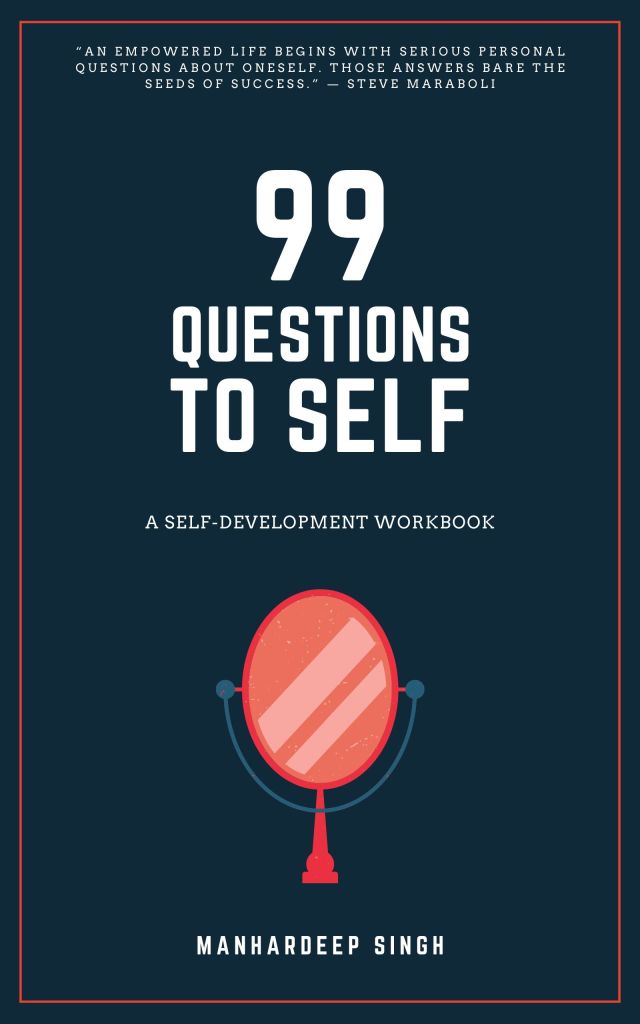
    Would you like to tap into your full potential? Discover the 99 questions that can help you realize the superhuman in you.

    This workbook will help you:

    • Discover your latent talents and hidden strengths
    • Learn how to create instant emotions of happiness and abundance
    • Improve every area of your life
    • Tap into unlimited source of power
    • Create a future you like

    99 Questions to Self is a comprehensive self-development workbook. If you like modern, practical, and interactive books, then you’ll love Manhardeep Singh’s self-help workbook.

    Buy 99 Questions to Self to start your journey of self-discovery today!

  • Audiences Are Your Friend

    For the rank amateur to the ignorant professional, audiences create the same effect no matter how small they are to a speaker. Fear and anxiety.

    Advertisements

    From a single person to a crowd as big as the fans in the Super Bowl, speaking in front of a serious listening audience is the true test and baptism of fire.

    Despite this, audiences are predictable. Audiences listen to you because they want to learn something from the speaker.

    Following this logic, the speaker would do well to follow the strategy of making it informative as well as interesting to listeners to see your speech through till the end.

    Here are some tips on how you can have the audience listen in rapt attention.

    1. Speak according to the listeners’ interests. It is always a good idea to find out what the crowd you are speaking to is interested in. For example, if you have more teenagers in the crowd, you don’t really want to talk about your subject in a way that bores them, like good education. Other aspects to consider would be the local culture, age, sports, religious inclinations, etc. Talk about what’s important to them, something they can easily relate to without a stretch of imagination.

    2. Praise the audience. Audiences are human too, and each and every one of them has a need to be acknowledged as much as you want to be acknowledged for speaking well in front of them. There is only one requirement for this maxim, that your praise be one hundred percent sincere. Anything less and you’ll have resentment in your hands.

    3. Connect with the audience. Find a common thread that makes the audience relate to you, and you’ll find that the speech will come through really well. Finding a common thread humanizes you and the speech. It makes them want to listen to you because it may in some way be of great benefit to them.

    4. Have the audience participate. Get somebody to come onstage and participate in a demonstration. Ask questions to the audience. Get feedback. Encourage them to walk up to the microphone and give you a piece of their mind. The point is to involve the audience, once more, making it more real to them. Taking them along with you in your experience.

    Advertisements

    5. Less you, more them. Play yourself down. Nobody, especially an audience, likes to be lectured to. This will cause resentment that will last a long time. Never feel that you are above them. The better way to think about your audience would be that you care about their welfare. Think of yourself as their best friend, and more often than not, this will hold you in good stead.

    RECOMMENDED RESOURCE:

    Ready to take yourself to the next level? Find 101 ways that can work as a launchpad. These nuggets are delivered to you one page at a time. Implement it, see the result, repeat!

    These nuggets can help you:
    • Be goal-driven vs emotion-driven
    • Be strong on the face of criticism
    • Handle difficult situations smoothly
    • Increase likability among peers
    • Be irresistibly charismatic

    Buy 101 Nuggets for Life to take every area of your life to the next level today!

  • Committing to Your Goals

    Have you ever set a goal and not achieved it? Most people have. In fact, it’s quite common for people to get stuck in an endless cycle of setting goals and then quitting them shortly afterwards – and accomplishing nothing at all.

    Advertisements

    Why do people do this? One of the biggest reasons is a lack of commitment to their goal. Without commitment a goal will gradually shrink in importance, and the temptation to quit will seem much more attractive, especially when obstacles cause setbacks and delays.

    On the other hand, if you make a serious commitment and then continually remind yourself of it, you’ll be much more likely to persevere and achieve the goal.

    Here’s how to commit to your goals:

    1) First and foremost, you have to make sure that every goal you set is of VITAL importance to you. This can be tricky because we so often fool ourselves into thinking we want one thing when we want something entirely different. Take some time with this part of the process, and be sure that you get to the heart of what you really want. Why do you want it? What will it do for you? What positive things will it bring to your life? How will it help you? How will it make you feel when it’s accomplished?

    Write all of this down and keep it handy so you can refer to it as often as necessary if you feel your commitment beginning to slip.

    Also ask yourself if your goal is worth the effort and sacrifice that will be needed to achieve it. If you can honestly answer yes, you are on the way!

    2) Think about what will happen if you don’t follow through. Would nothing much happen if you don’t achieve your goal? If not, then you need to raise the stakes! You have to make your goal the most important thing in the world, and if you don’t do it, you’ll deal with negative consequences. Even if you have to indulge in a bit of “make believe” in order to do this, do it. For example, play up the fact that you’ll lose respect for yourself if you don’t follow through; or you might agree to give up something you love if you don’t make it happen.

    3) Then, each and every day, renew your commitment. It’s easy to be committed to your goal when it is new and your motivation is high, but you need to be able to STAY committed – no matter what! Each day when you awaken, read through the goal you wrote down on the first day, and stress again how vitally important it is to you. Promise yourself that you’re going to do as much as you can to work on your goal that day, and every day until you achieve it.

    When it comes right down to it, no one can achieve your goals for you. If you want to achieve them, you’ll have to find the determination necessary to keep going. Inactivity and procrastination are usually nothing more than bad habits. Turning those habits into something more positive and productive is as simple as taking it a day at a time and working your hardest to change your life. The more committed and determined you are to making your goal happen, the more likely you’ll do just that.

  • What is Creativity?

    In England, September represents the end of Summer and the beginning of Autumn as well as the start of the new school year and the start of many new initiatives in business, life and lots more besides.

    Advertisements

    When anyone is looking to make any kind of change in their life, often the approach they take needs to become attractive or appealing in order for them to maintain it and often it may not remain attractive or appealing for as long as we like. I get lots of people that tell me that they find it difficult to maintain enthusiasm or keep on investing the required levels of energy in order to make a real success of a project or a goal.

    So, for that reason, I want to talk about enhancing creativity today. When you become more creative, you can begin to make more out of your every day experiences and perceptions of what it is that you are doing, you can make life more colourful and have more fun and joy when you are more creative.

    So what actually is Creativity?

    Good question. We can all be creative; creativity is about making new connections – and that is literally physiologically true within our neurology. Creativity is the mind’s growing edge. It often involves a lot of discovery. By creating new connections you build your brain power and develop mental and interpersonal flexibility which can begin to heighten your ability to do a huge array of things with more and more ease.

    Imagine this: every time you link two things together, you create a third entity. That new connection can itself then connect with other ideas, additional possibilities. Imagine the impact this can have throughout a system like your brain!

    Neil Armstrong first stepped onto the moon in 1965. That event changed our beliefs and thoughts about the universe. It also altered thoughts and beliefs about human inventiveness and skill: this event helped us to recognize that if we want something enough, we can find ways to do something that we may have believed to be impossible before. I reckon this gave many people some powerful and liberating thoughts and beliefs about human capability.

    Being creative on an individual level has the same potential: when you connect things together, you go beyond both of them; and you have the possibility of forming new beliefs about yourself and your potential. I remember when I was first learning about NLP, hypnosis and my other beloved subjects, I was so excited, I would read so much material that I felt like my brain was literally growing and stretching. That’s not too scary is it?

    I love working with children. They have such a vivid imagination, I can remember when I used to play football for hours and days on end as a youngster, I was not just imagining scoring in the World Cup final, I really was actually there at the stadium scoring that goal, I am telling you I was there!

    Children are amazingly creative, each of us has been a child (some still are!). Children show their creativity in the way they discover their environment and make their own meanings of it. Many children create new worlds while playing with toys, they don’t need elaborate or sophisticated toys, equipment or props, the meaning comes from within them; the meaning comes from out of themselves.

    You need to give yourself permission and time (and energy) to make new connections and links which is what creativity is all about. It is about the process rather than the outcome or the final product. You can be creative at home or at work, when changing habits, updating behaviours, resolving issues, or just making life happier in any way you can. You can be creative with words, ideas, thoughts, materials, food and the kind of fun you have. You can be creative with your surroundings or with your internal world.

    Advertisements

    In addition to this, creativity creates something new. That’s right, even if every ingredient is already known to you or is familiar. An insight for example, is creative because the new conclusion is gleaned from information you already had; it is the new perspective that makes the difference.

    Above all, being creative returns us to that state where we are scoring goals in World Cup finals. It is about being absorbed and enjoying doing what you are doing, paying attention to detail, having a grand vision, being excited and playful, wondering what would happen if…

    RECOMMENDED RESOURCE:

    Would you like to tap into your full potential? Discover the 99 questions that can help you realize the superhuman in you.

    This workbook will help you:

    • Discover your latent talents and hidden strengths
    • Learn how to create instant emotions of happiness and abundance
    • Improve every area of your life
    • Tap into unlimited source of power
    • Create a future you like

    99 Questions to Self is a comprehensive self-development workbook. If you like modern, practical, and interactive books, then you’ll love Manhardeep Singh’s self-help workbook.

    Buy 99 Questions to Self to start your journey of self-discovery today!

  • Anxiety Attacks

    Anxiety or panic attacks are sudden periods of intense anxiety, fear and discomfort. While these attacks might seem to happen for no reason, they’re actually the body’s response to what it perceives as the need
    for “fight or flight”.

    Advertisements

    The attacks usually last about ten minutes, but can be as short as one minute. In severe cases, these attacks can happen in cycles. These cycles may last for extended periods. These cycles can cause “anticipation” anxiety between episodes.

    Physical symptoms of anxiety attacks generally include shortness of breath, heart palpitations and sweating. Tingling and numbness in the extremities, dizziness, lightheadedness, headaches and nausea are also commonly experienced. These may appear to be random, but they’re actually the result of the body’s preparations for protection.

    The anxiety attack is brought on by a sudden onset of fear. In response, the body releases adrenaline followed by increases in the heart and breathing rate and production of sweat (to regulate body temperature).

    These actions prepare the body for the physical activities of fighting or escaping. Because the anticipated strenuous activity rarely follows the
    panic attack, these reactions result in physical discomfort.

    The increased heart rate is felt as heart palpitations. Rapid breathing (hyperventilation) results in a drop in carbon dioxide levels in the lungs and blood.

    This leads to the tingling, numbness, dizziness and lightheadedness. The adrenaline causes a narrowing of the blood vessels which results in less blood flow to the head. This also contributes to the lightheadedness and headaches.

  • Mental Health and Improving Your Personal Life

    Your mental health is an amazing part of what makes you as a person. Personal development is a way of life that affects your mind, actions, and how you treat others around you. It plays a vital role on your over-all well being and the relationships around you. Often times, we get so caught up in the physical aspects of what’s on the outside and forget to take care of the inside.

    Advertisements

    Exercising our brain consciously and subconsciously is an important factor when improving one’s life and creating a healthy state of mind as we age. When a person is depressed, stressed, tired, and frustrated it affects everything we do as well as the people closest to us. I remember someone telling me in a depressed state, that she couldn’t even watch television because she didn’t want to watch the living.

    When I get down, I often think of that comment and it reminds me of a place I don’t ever want to be. Isolating yourself for others could turn into something very dangerous and unfortunately help will only start with one person. YOU! Although there is a laundry list of books and professional help, also recommended, but if this article gives you a jump start to just get you slightly motivated to move forward, then moving an inch is greater than lying still.

    Depression and anxiety will use every good power that you have against you. Keep in mind that the most talented individual wouldn’t get anywhere without persistence. Persistence and determination are the first steps to controlling your thoughts and feelings. Many medications can trigger depression, make sure to consult with your doctor to see if this has any effects on the way you are feeling.

    Studies indicate that the most common reason for depression is the lack of interests and activities. When improving your personal life, interests and activities are vital in mental health, self-esteem and happiness. Although this does not help much when fighting boredom, or other problems but you can best improve your mental health by practicing many of them until you do well. When you are depressed it is easy to forget all of the things we liked to do. Motivation can help us overcome trying something new or remembering exactly what made us happy. Asking friends and family to help motivate me is a tool that I use when I’m in the need of a little push. Reward yourself when accomplishing tasks, such as getting the laundry done before watching your favorite television show.

    Negative thinking also plays a major role in depression. The happiest of people experience the same pain, suffering and sorrows, just like a person depressed. To accept troubles gracefully and keeping a positive attitude is where you’ll find how some people cope with things on a different level.

    Ask yourself, are your expectations realistic? Accepting a situation for what it is can eliminate your negative feelings. Taking action for your own negative ways of thinking and turning those thoughts positive means that you are motivating yourself to change. Tackle what is bothering you, and take a bad situation and turn it into something good. A little humor helps my situation from time to time, meaning laughter does a great deal for our mind and body. Try not to constantly worry about being happy. Developing interests, activities, friendships and learning how to cope with the emotional pain will conquer your personal problems and further solve your thinking habits. Doing this will get you on the road of happiness, as long as you put forth the effort.

    RECOMMENDED RESOURCE:

    Are you tired of motivating people or staying motivated? Start seeing motivation like never before concept with a single shift in perspective.

    The Ultimate Book of Motivation will help you:
    • Take responsibility for your life
    • Be unstoppable on the face of failure
    • Turn self-defeating thoughts around
    • Change your outlook on life
    • Motivate anyone to do anything

    Buy The Ultimate Book of Motivation to start motivating today.

  • How Do You Deal With Adversity

    “We shall draw from the heart of suffering itself the means of inspiration and survival.”

    Winston Churchill

    I remember reading some time ago about a study of longevity in humans. There has been a large body of scientific research into the reasons why some people are long-lived but of course while various diets, health regimes, and regional or ethnic differences are often linked to living long, it is a very difficult cause and effect relationship to determine because there are so many other variables involved. However, the study I remember didn’t spend as much time on health and diet as many others. The researchers spent time observing and interviewing a number of people who are living long lives to determine what common factors these very diverse people shared.

    Advertisements

    Do you know what the single largest factor they all shared – the trait that the researchers determined played the largest role in their long lives? It wasn’t a specific food or faith or daily activity. It was simply the way these folks dealt with adversity.

    The ways that these folks dealt with adversity did vary. Some had great religious faith, others had an unquenchable zest for life, and others had a great determination that they could and would overcome difficulty.

    If you think about it then this does seem to make sense. After all, the longer you live then the more adversity you must overcome. Human life is fraught with adversity – both physical and emotional – although each person’s experience varies greatly. In order to survive adversity, to overcome loss and difficulty, and to succeed in life a person must have inner resources to draw from.

    As Oliver Wendell Holmes says: “If I had a formula for bypassing trouble, I would not pass it round. Trouble creates a capacity to handle it. I don’t embrace trouble; that’s as bad as treating it as an enemy. But I do say meet it as a friend, for you’ll see a lot of it and had better be on speaking terms with it.”

    Most of us have seen the evidence of this even if we have never formulated a scientific theory about it. We have seen the cancer patient diagnosed and then does not even live out the time doctors predicted. We have seen the heart patient diagnosed who far outlives expectations – by months and then years. What makes the difference between these two groups of people? I believe it has to be a will to live, some inner resource, that one group possesses and the other does not.

    A few weeks ago my friend Carl’s left hand was amputated after being injured in an accident with a log splitter. It was devastating to those who love him and certainly no one would have blamed him for becoming depressed and grieving.

    But Carl hasn’t chosen that path. Instead he focused on what he can do, not on what he can’t. And if he discovers something that he can’t do one-handed then he puts his considerable problem-solving abilities to work on a solution. He isn’t simply reacting to a tragic accident but proactively seeking solutions.

    Advertisements

    He is not a saint. He complains about the pain and discomfort of the healing process and is sometimes frustrated by the trial-and-error process of his problem-solving, but he is not wasting time feeling sorry for himself. He knows he has been given many gifts and those gifts include the ability to solve problems and overcome adversity.

    I can only hope when my time comes to face adversity that I can meet it with as much energy, determination, and confidence.

  • Dealing with Others

    In all application of magnetism to persons, you are urged to remember that your very first goal, always and preeminently, is an agreeable feeling within their minds. You should never try to induce a person to act your way until you have thoroughly established in him a good feeling toward yourself. This is the prime initial step. When such a condition has been secured, you are then ready for the magnetic assault and then only.

    Advertisements

    When you are dealing with other people, endeavoring magnetically to win them to your wish, you should summon the general magnetic feeling within yourself, will them to do as you desire, and at the same time think of them as already consenting and acting. Your inner condition should be perfectly calm, buoyant, hopeful, whatever the external means employed, your mind should be concentrated upon the thing desired, and its accomplishment should be thought of as now secured.

    The response of the person may be delayed, but this should not discourage you, for some minds do not take suggestions (those of your unspoken will are referred to) quickly, and they do not act instantly upon their own thought. It is invariably best to induce people to believe that they are acting on their personal impulse or judgment; they should be made to feel perfectly free, not at all coerced, and that they are doing their own will rather than yours simply because they wish so to do.

    We may summarize all these suggestions in the words of a distinguished scientific writer:

    “Life is not a bully who swaggers out into the open universe, upsetting the laws of energy in all directions, but rather a consummate strategist, who, sitting in his secret chamber over his wires, directs the movements of a great army.” This is a good description of magnetism.

    The success-magnetism assumption: We are now ready for the great assumption-principle of magnetism in applied life.

    Think of every goal as already reached, of every undertaking as already achieved.

    RECOMMENDED RESOURCE:

    Ready to take yourself to the next level? Find 101 ways that can work as a launchpad. These nuggets are delivered to you one page at a time. Implement it, see the result, repeat!

    These nuggets can help you:
    • Be goal-driven vs emotion-driven
    • Be strong on the face of criticism
    • Handle difficult situations smoothly
    • Increase likability among peers
    • Be irresistibly charismatic

    Buy 101 Nuggets for Life to take every area of your life to the next level today!

  • Personal Magnetism

    Let us understand. You cannot reasonably hope to succeed by merely dreaming about success. You surely cannot achieve success if you plunge blindly through your career. You cannot really succeed without possessing some degree of personal magnetism.

    Advertisements

    When you began reading this article, you certainly possessed a measure of magnetic capacity, either physical or psychic. If you have energetically observed its directions, you have developed both varieties; but, above that, you have also combined them into one living whole, the magnetic personality.

    This result has required at least a year of persistent effort. If you have arrived at this point in less time, you should go back and begin where haste first retarded your progress.

    Magnetism is a natural growth

    No matter how great may be your ability to read and understand books, that growth, that law, requires time as well as intelligent effort. No matter how poor may be your ability in such respect, that growth is absolutely certain if you put reasonable time and genuine effort into its acquisition.

    The giant trees of California were once puny saplings. The slow lapse of time has drawn nature into their mighty hearts. Magnetism can no more be acquired by the mere reading an article, or by hurried practice of its directions, than can these giants of the West be produced in the hot-house culture of a northern summer.

    Magnetic growth is naturally slow. Its principles, its methods, and the results of its study, have to be deeply sunk into and absorbed and assimilated by the subjective self before the reaction of magnetism in the objective life can obtain. If you have read these lines correctly, you have learned that magnetic growth cannot be hurried. These statements are placed here because, had they appeared at the beginning, the outlook would have seemed, perhaps, discouraging, but more especially because they would not have been understood. You now understand them because you have toiled, and you can afford to smile at such possible discouragement. You have paid an easy price for magnetic power, for the gains discount the pains.

    Magnetism and practical life.

    The faithful observance of these suggestions has developed many surprises during the time occupied. The growth of magnetism involves an intense and continuous concentration of thought upon the psychic field, and it is very likely that you may find it necessary to guard against that danger. The method of so guarding is briefly indicated below.

    The sole value of magnetism consists in its practical application to everyday affairs. Success-Magnetism is not an accomplishment merely; it is a practical power. When rightly developed and used, it controls the subjective self in the concrete work of the objective. The definition of the goal you have been seeking now appears:

    Success-magnetism is personal magnetism intelligently multiplied into actual life.

    The first duty of man is practical sanity.