• Self Mastery and Philosophies

    Philosophers have brought some major conflicting issues, which circle around particular religious and philosophical sects. Some of the religious members believe that humans body and mind is essentially dual in nature, which includes the physical, mental, and spiritual nature. This is disregarded by many since there are not any concrete proofs to back such allegations.

    Taking some time to explore the underlying assumptions of scientific theories we need to consider some ways to work toward self-mastery. When one can identify the philosophies in the western traditions, it can help them discover the chief ways to form discipline and self-mastery. Building self-mastery skills often involves taking control of one’s behaviors yet this entity must learn to take control of the emotions and mental responses.

    Many psychological studies form as discipline. Once you have explored the processes of self-development and self-mastery you can then examine the root constituency of study in relation to the body and mind and how they work in unison. By identifying distant messages from past learning, knowledge, experiences, et cetera, you can pinpoint emotional reactions that cause a disturbance to the mental processes, thus enforcing your behaviors. It will help you to recognize behavior patterns that could be useful to help you expand your self-mastery skills.

    We have to recognize the main contributors to discover ways to move through self-development by associating the neurological psychological processes. Self-development is the initial stage that moves you through progress. The processes will nurture you as you begin to mature along the way.

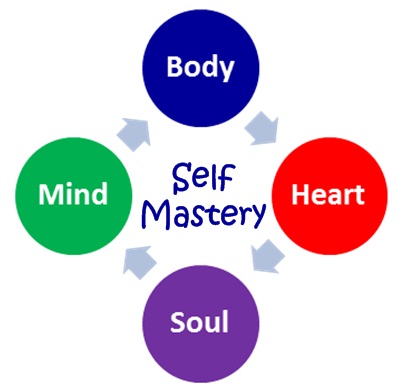
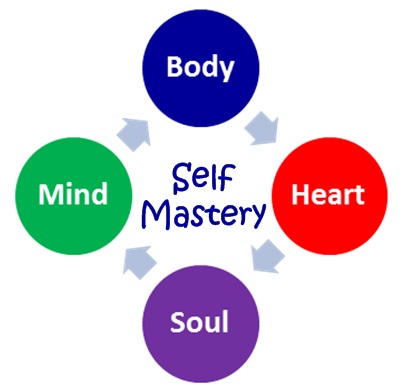
    Studies indicate that the central nervous system keys into our physiological responses and psychological response. When one can examine the mind and body, it helps them to take control of his or her emotions, mental processes, and body respectively. This is your guide to self-mastery. It deals with all aspects of the human makeup and directs you to work in harmony with the mind and body. Examine the body and its processes, as well as the mental processes to discover unison.

    One of the major concerns the vast majority of people face each day, is that most times these people are shaped by beliefs and traditional ways of thinking. It is vital that people start to find a way around allowing others shape who they are. This is one of the preponderant enigmas we face today, i.e. most common people are shaped by their influences of one’s environment. Instead of allowing others to shape who you are, take control of your own life by working through self-mastery.

    We have the ability to expand our knowledge, which gives us power to find our way through the self-mastery processes. It is the unparalleled solution we enjoy, yet we must also learn to allow our inner strength to guide us as well.

    There are disturbing authenticities that point that man has no aptitude to guide his own direction without his creator giving him a hand. It is time we start focusing on connecting our spirituality by recognizing and believing in more than one’s inner self connects. The single way we can achieve creating the certainty is to stop relying on false confessions that delude our direction, instead to scrutinize, recount, and study to discover the authenticities for self. This will protect us against the evilness as expressed above.

    We have so much information today that it would be a lie if someone says; they do not know how to work through self-development and self-mastery. All one needs to do is surf the Internet to find a wealth of information available. Applying effort is essential as well. When you apply effort, good rewards come to you.

  • Self mastering and Goals

    When you are trying hard to get things together, then you really have to consider what you are doing. One of the things that you have to do is to be able to learn how to use your self-mastering skill. This world is full of hatefulness as well as anxiety. Here are some things that might help you to get it together as you might want to say it.

    How would one go about getting it together?
    When you want to get it together, you might want to figure out some things that might be beneficially to you. That may be hard for some of you but again for others it might not be hard at all.

    The first thing you are going to have to do is decided what it is that you want to do something about. In other words, sometimes you have to step back and take a longer look at situations before you step into them. Alternatively, you may just want to go from sad to happy. The way you take life is totally up to you. With this in thought, you are going to have to sit down and really think about what it is that you want to do and get a plain.

    You may want to set a goal know when you are setting your goals don’t make them so high that you are unable to reach them, so with this in mind start little and reach that goal then make another one. Goal setting is not the easiest thing to do it takes a lot of work and determination to get where you want to be. However, every one can do what they want to do if they put there minds to it.

    Where can I go to get some insight on the new me?
    When you decide that you are ready and have your goals in order then you may want to do some checking into learning how to go about setting your goals. They might have some kind of support group in your area that will help you to set your goals as well as to meet them. However, for the most part you have to be able to do it on your own. What am trying to say is that you have to be able to dig deep with in your self and pull out what you want to change and put some effort in to it. Many people have difficulties setting goals. Most people realize that often life will step in and hold them back from reaching their goals. If you decide that, you want to go on a diet, and then make it a part of your plans to achieve your goals. Then you set your goal to lose weight, losing weight is one of the hardest things to do. You start your diet your doing good then you go and weigh in and you haven’t lost the weight as fast as you would like what do most of us do then we stop every thing and for get about all of the goals and effort that we have put into it. We shouldn’t do that we should keep going with it we might or we might not make it to our goal that we are wanting but new have learn to use your will power, and that is what we are trying to do when it comes to self-mastering skills.

  • How to Make Miserable Decisions

    If you’ve ever been around someone who is persistently miserable you’ll find that they have a working strategy for making their experience unpleasant for themselves.

    This article will give a few explanations why they use a strategy that makes them miserable, how that process works, and if this describes you, why you might want to change. It will also describe what you’ll have to sacrifice if you no longer want to be miserable.

    Also, if the benefits of being miserable are enough you’ll learn how to continue to make choices and decisions that contribute to your misery.

    The Benefits of Misery:

    It’s hard to believe that there are benefits to feeling bad but the fact is that there are. Some of these benefits include:

    * Uniqueness. If you are suffering you at least can see yourself as special and even persecuted.

    * Righteousness. If you are miserable because of something outside of your control you can hold it up as a banner and proclaim that you must be right to have such an enemy.

    * Blame. As long as your misery can be something external to you then you can blame it for all your problems. This releases the burden of self-reflection and change.

    * Familiarity. Sometimes misery is the only thing that seems familiar. Getting rid of it would mean launching yourself is a completely unfamiliar territory and might mean new things about yourself that you had never considered before.

    * Misery is easy. There are very few people who go through life and are naturally happy. Those that are have found a strategy that works for them often after a lot of effort. It takes some work to change ones thinking process.

    How to make decisions that make you feel miserable.

    * Ask a series of miserable questions of yourself like
    “What could go wrong about today?”
    “What do I have to feel guilty about?”
    “Why do bad things always happen to me?”
    “Why am I feeling so terrible?”

    * Make vague and unreasonable expectations and goals.
    By making a goal or expectation unreasonable you’ll make it impossible to achieve. By making them vague you’ll never know exactly if you achieve them and you’ll always be able to say “No, that’s not what I meant.”

    * Think the worst first.
    For any event that occurs you have a million ways of thinking about it. Go for the worst possible interpretation. For example, if you walk into a store and teenagers are outside laughing and smoking cigarettes they are probably laughing at you.

    * Cling to past hurts.
    Progress can be easily inhibited when you use past hurt of slow you down. These can take the form of lingering on why your life has been so terrible or even by saying “We’ve never done it that way before. Why start now?”

    Why you might want to stop feeling miserable:

    * Without a doubt misery is the number one cause of suicide. If you want to live you want to get rid of your misery.

    * You will have more power (much, much more) and control over your life if you stop all the misery producing processes and take responsibility for your life.

    How to stop making miserable decisions.

    * Set reasonable goals using the S.M.A.R.T. goals process. If you don’t know what this is do a google search.

    * Know when your emotions are trying to influence away from your goals and work to keep your focus.

    * Agree to take responsibility for your life and especially for your emotions. This is very hard work but very rewarding.

    What you will have to give up when you stop making miserable decisions.

    * You will have to give up on the belief that your suffering makes you unique. The fact is suffering is ordinary and boring to most people. We’ve all experienced it and there is little you can say about your suffering that will make us think of you for very long. What is exceptional and unique is someone who makes no excuses for their life and decides to excel and feel joy AS A CHOICE.

    * You will have to give up blame. This means blaming anyone or anything. It means even giving up blaming yourself.

    * You will have to give up on fear and timidity. Only boldness and audacity can overcome a longstanding habit of misery.

    Final note:

    While all of this may seem vary callus and cold it’s important to point out that this is not an essay by which you should judge other people but only yourself. Bad things do happen to good people and it’s a good idea to help them when you can. On the other hand, if you find someone who is persistently and habitually miserable it’s generally a good idea to keep your distance from them lest they infect you with their misery and, believe me, they can do that more easily than you think.

  • Happy as You Want to Be

    Almost everyone have heard the hit single ‘Don’t Worry, Be Happy’ by Bobby McFerrin. The song has a very catchy way of conveying its message of being happy to everyone. Bobby Mcferiin’s simple message surely made a lot of people by telling them not to worry.

    Living a happy, resilient and optimistic life is wonderful, and is also good for your health. Being happy actually protects you from the stresses of life. Stress is linked to top causes of death such as heart disease, cancer and stroke.

    One of the better things ever said is – ‘The only thing in life that will always remain the same is change’, and in our life we have the power to make the necessary changes if we want to. Even if we find ourselves in an unbearable situation we can always find solace in the knowledge that it too would change.

    Social networks or relationships are essential to happiness. People are different, accept people for who or what they are, avoid clashes, constant arguments, and let go of all kinds of resentments. If arguments seem unavoidable still try and make an effort to understand the situation and you might just get along with well with

    Happiness is actually found in everyone, increasing it is a way to make a life more wonderful and also more healthy.

    To be happy is relatively easy, just decide to be a happy person. Abraham Lincoln observed that most people for most of the time can choose how happy or stressed, how relaxed or troubled, how bright or dull their outlook to be. The choice is simple really, choose to be happy.

    There are several ways by which you can do this.

    Being grateful is a great attitude. We have so much to be thankful for. Thank the taxi driver for bringing you home safely, thank the cook for a wonderful dinner and thank the guy who cleans your windows. Also thank the mailman for bringing you your mails, thank the policeman for making your place safe and thank God for being alive.

    News is stressful. Get less of it. Some people just can’t start their day without their daily dose of news. Try and think about it, 99% of the news we hear or read is bad news. Starting the day with bad news does not seem to be a sensible thing to do.

    A religious connection is also recommended. Being part of a religious group with its singing, sacraments, chanting, prayers and meditations foster inner peace.

    Manage your time. Time is invaluable and too important to waste. Time management can be viewed as a list of rules that involves scheduling, setting goals, planning, creating lists of things to do and prioritizing. These are the core basics of time management that should be understood to develop an efficient personal time management skill. These basic skills can be fine tuned further to include the finer points of each skill that can give you that extra reserve to make the results you desire.

    Laugh and laugh heartily everyday. Heard a good joke? Tell your friends or family about it. As they also say -‘Laughter is the best medicine’.

    Express your feelings, affections, friendship and passion to people around you. They will most likely reciprocate your actions. Try not to keep pent up anger of frustrations, this is bad for your health. Instead find ways of expressing them in a way that will not cause more injury or hurt to anyone.

    Working hard brings tremendous personal satisfaction. It gives a feeling of being competent in finishing our tasks. Accomplishments are necessary for all of us, they give us a sense of value. Work on things that you feel worthy of your time.

    Learning is a joyful exercise. Try and learn something new everyday. Learning also makes us expand and broaden our horizons. And could also give us more opportunities in the future.

    Run, jog, walk and do other things that your body was made for. Feel alive.

    Avoid exposure to negative elements like loud noises, toxins and hazardous places.

    And always remember the quote from Abraham Lincoln, he says that, “Most people are about as happy as they make up their minds to be.”

  • Goal Setting Strategy

    Goal setting breeds success.

    Goal setting strategy is a common practice among successful people. Successful people know that people must be proactive instead of reactive. If you are already successful and want to stay that way, goal setting is one way of being in control.

    Goals provide us with direction and objective enhancing our motivation and focus. It allows us to look beyond our actions and see the progress that is made. This anticipation provides us with fuel to further our drive to reach our goals.

    The strategy of goal setting is an influential aspect of every research and practice in improving performance.

    Goal Setting Strategy

    There are several goal setting strategies that should be considered first before actually laying down goals. Visualize this strategy and picture the story of the bucket that never seems to get full:

    1. Core values

    A primal goal setting strategy is to decide on what is important to you. If you can identify your core values you can decide what core projects to set that your life should have primary focus on.

    Imagine that these core values are the rocks that would be the first to be fit down in the bucket.

    2. Secondary Values

    We could divide the core values of our life into several aspects. We can then identify secondary values to complement the core values that you have identified previously.

    Imagine that these secondary values are the pebbles that will fit down into the bucket in the spaces between the rocks.

    These pebbles represent the other projects that contribute towards those widest categories of your life’s core values.

    3. Daily Activities

    Another goal setting strategy would be to identify actual daily activities that contribute towards our multitude of projects. These daily activities actually complement our secondary values.

    Imagine that these daily activities are the sand that would fill out the spaces left behind by the rocks and the pebbles.

    4. The Action that We Take

    The bucket is already full of rocks, of pebbles and of sand. Yet there are still some very small cracks or crevice that needs filling. That is water. Even a small crevice could be filled-up by water.

    This extra space that is available to water is also the most sensitive part of goal setting strategy.
    This represents the very next action steps that we can take.

    Remember that the big projects would only happen by the small action steps that we take. Remember to discard the things that do not truly contribute to your core and secondary values.

    Always be mindful of the little strategies that you could use around you. It could be a book for learning, a paper for writing, PocketPC use, earphones for listening to training audios, etc. You can incorporate various mediums to effectively take action on your goals.

    The Strategy to Success

    The goal setting strategies mentioned above will make sure that you are always connected, mindful, and focused to the bigger picture.

    Try to do it all. You can do this by breaking everything down into a hierarchy and make the most of every moment. It would always fit everything together by size, location, or by movement.

    People who try to prioritize by level of importance, and who try to schedule specific activities to time, usually fail. This is because of the many distractions, interruptions, even changes in a persons mood and energy levels, or new inspirations or projects that reveal themselves as you move through time.

    Try hard to prioritize or else you would get confused and worst be overloaded. Do this by keeping a running list of next step activities. Remember that willpower does not last long but pure intent together with preparation & organization allows you to do things you have never thought you could do.

  • Four Cognitive Skills for Successful Learning

    The word “cognition” is defined as “the act of knowing” or “knowledge.” Cognitive skills therefore refer to those skills that make it possible for us to know.

    It should be noted that there is nothing that any human being knows, or can do, that he has not learned. This of course excludes natural body functions, such as breathing, as well as the reflexes, for example the involuntary closing of the eye when an object approaches it. But apart from that a human being knows nothing, or cannot do anything, that he has not learned. Therefore, all cognitive skills must be TAUGHT, of which the following cognitive skills are the most important:

    CONCENTRATION

    Paying attention must be distinguished from concentration. Paying attention is a body function, and therefore does not need to be taught. However, paying attention as such is a function that is quite useless for the act of learning, because it is only a fleeting occurrence. Attention usually shifts very quickly from one object or one thing to the next. The child must first be taught to focus his attention on something and to keep his attention focused on this something for some length of time. When a person focuses his attention for any length of time, we refer to it as concentration.

    Concentration rests on two legs. First, it is an act of will and cannot take place automatically. Second, it is also a cognitive skill, and therefore has to be taught.

    Although learning disability specialists acknowledge that “the ability to concentrate and attend to a task for a prolonged period of time is essential for the student to receive necessary information and complete certain academic activities,” it seems that the ability to concentrate is regarded as a “fafrotsky” — a word coined by Ivan T. Sanderson, and standing for “things that FAll FROm The SKY.” Concentration must be taught, after which one’s proficiency can be constantly improved by regular and sustained practice.

    PERCEPTION

    The terms “processing” and “perception” are often used interchangeably.

    Before one can learn anything, perception must take place, i.e. one has to become aware of it through one of the senses. Usually one has to hear or see it. Subsequently one has to interpret whatever one has seen or heard. In essence then, perception means interpretation. Of course, lack of experience may cause a person to misinterpret what he has seen or heard. In other words, perception represents our apprehension of a present situation in terms of our past experiences, or, as stated by the philosopher Immanuel Kant (1724-1804): “We see things not as they are but as we are.”

    The following situation will illustrate how perception correlates with previous experience:

    Suppose a person parked his car and walks away from it while continuing to look back at it. As he goes further and further away from his car, it will appear to him as if his car is gradually getting smaller and smaller. In such a situation none of us, however, would gasp in horror and cry out, “My car is shrinking!” Although the sensory perception is that the car is shrinking rapidly, we do not interpret that the car is changing size. Through past experiences we have learned that objects do not grow or shrink as we walk toward or away from them. You have learned that their actual size remains constant, despite the illusion. Even when one is five blocks away from one’s car and it seems no larger than one’s fingernail, one would interpret it as that it is still one’s car and that it hasn’t actually changed size. This learned perception is known as size constancy.

    Pygmies, however, who live deep in the rain forests of tropical Africa, are not often exposed to wide vistas and distant horizons, and therefore do not have sufficient opportunities to learn size constancy. One Pygmy, removed from his usual environment, was convinced he was seeing a swarm of insects when he was actually looking at a herd of buffalo at a great distance. When driven toward the animals he was frightened to see the insects “grow” into buffalo and was sure that some form of witchcraft had been at work.

    A person needs to INTERPRET sensory phenomena, and this can only be done on the basis of past experience of the same, similar or related phenomena. Perceptual ability, therefore, heavily depends upon the amount of perceptual practice and experience that the subject has already enjoyed. This implies that perception is a cognitive skill that can be improved tremendously through judicious practice and experience.

    MEMORY

    A variety of memory problems are evidenced in the learning disabled. Some major categories of memory functions wherein these problems lie are:

    Receptive memory: This refers to the ability to note the physical features of a given stimulus to be able to recognize it at a later time. The child who has receptive processing difficulties invariably fails to recognize visual or auditory stimuli such as the shapes or sounds associated with the letters of the alphabet, the number system, etc.

    Sequential memory: This refers to the ability to recall stimuli in their order of observation or presentation. Many dyslexics have poor visual sequential memory. Naturally this will affect their ability to read and spell correctly. After all, every word consists of letters in a specific sequence. In order to read one has to perceive the letters in sequence, and also remember what word is represented by that sequence of letters. By simply changing the sequence of the letters in “name” it can become “mean” or “amen”. Some also have poor auditory sequential memory, and therefore may be unable to repeat longer words orally without getting the syllables in the wrong order, for example words like “preliminary” and “statistical”.

    Rote memory: This refers to the ability to learn certain information as a habit pattern. The child who has problems in this area is unable to recall with ease those responses which should have been automatic, such as the alphabet, the number system, multiplication tables, spelling rules, grammatical rules, etc.

    Short-term memory: Short-term memory lasts from a few seconds to a minute; the exact amount of time may vary somewhat. When you are trying to recall a telephone number that was heard a few seconds earlier, the name of a person who has just been introduced, or the substance of the remarks just made by a teacher in class, you are calling on short-term memory. You need this kind of memory to retain ideas and thoughts when writing a letter, since you must be able to keep the last sentence in mind as you compose the next. You also need this kind of memory when you work on problems. Suppose a problem required that we first add two numbers together (step 1: add 15 + 27) and next divide the sum (step 2: divide sum by 2). If we did this problem in our heads, we would need to retain the result of step 1 (42) momentarily, while we apply the next step (divide by 2). Some space in our short-term memory is necessary to retain the results of step 1.

    Long-term memory: This refers to the ability to retrieve information of things learned in the past.

    Until the learning disabled develop adequate skills in recalling information, they will continue to face each learning situation as though it is a new one. No real progress can be attained by either the child or the teacher when the same ground has to be covered over and over because the child has forgotten. It would appear that the most critical need that the learning disabled have is to be helped to develop an effective processing system for remembering, because without it their performance will always remain at a level much below what their capabilities indicate.

    Strangely, though, while memory is universally considered a prerequisite skill to successful learning, attempts to delineate its process in the learning disabled are few, and fewer still are methods to systematically improve it.

    LOGICAL THINKING

    In his book “Brain Building” Dr. Karl Albrecht states that logical thinking is not a magical process or a matter of genetic endowment, but a learned mental process. It is the process in which one uses reasoning consistently to come to a conclusion. Problems or situations that involve logical thinking call for structure, for relationships between facts, and for chains of reasoning that “make sense.”

    The basis of all logical thinking is sequential thought, says Dr. Albrecht. This process involves taking the important ideas, facts, and conclusions involved in a problem and arranging them in a chain-like progression that takes on a meaning in and of itself. To think logically is to think in steps.

    Logical thinking is also an important foundational skill of math. “Learning mathematics is a highly sequential process,” says Dr. Albrecht. “If you don’t grasp a certain concept, fact, or procedure, you can never hope to grasp others that come later, which depend upon it. For example, to understand fractions you must first understand division. To understand simple equations in algebra requires that you understand fractions. Solving ‘word problems’ depends on knowing how to set up and manipulate equations, and so on.”

    It has been proven that specific training in logical thinking processes can make people “smarter.” Logical thinking allows a child to reject quick and easy answers, such as “I don’t know,” or “this is too difficult,” by empowering him to delve deeper into his thinking processes and understand better the methods used to arrive at a solution.


  • Setting Employee Goals for Success

    Since human resource is an essential element to your organization’s success, start setting goals for your employees.

    Employee goal setting will allow you to be strategic in your means of operating programs or initiatives with the goal of directly contributing to the long-range objectives of your organization. The first and foremost goal is for the human resource division to increase employee productivity and corporate revenues.

    Employee goal setting is just part of the entire objectives of the company. Others are production, financial and sales marketing targets. Employee goal setting brings a lot of benefits to the company.

    There are a lot of reasons for you to set employee goals. Goals can give constant motivation to employees by focusing them on the purpose of your business. Success is made possible through employee goal setting because the employees’ efforts and concentration are geared towards the company’s goals.

    Each organization must know how to evaluate the performance of its employees and align organizational goals that will eventually lead their growth. Employee goal setting will increase employee productivity which is vital to the growth of the company.

    Employee goal setting increases employee productivity and profits because it builds a strong foundation of employees for the business to prosper. It gives an external focus that assures the efforts of the human resource department since its builds performance culture and coordinated efforts among all employees.

    It is also important for employee appraisal or bonus system because without goals, achievements are not easily gauged or measured.

    Ultimately, it helps to provide a competitive advantage because of the products and services offered are superior to the company’s direct competitors in the market.

    Pointers on employee goal setting

    • Set goals that will tie employees into the success of the organization. Financial incentives and bonuses can be the basis to encourage hard work and teamwork among your employees. This will also show that you value your employees’ contribution to the company’s growth.
    • Set annually modified goals at the beginning of the year. This is a good way to start your new year.
    • Set the goals with employees. They are the best source of information about what they can contribute to increase over-all productivity. It eliminates the potential for resistance that can arise when goals are forcibly imposed without taking any reference to what they think and want.
    • Make specific, measurable and attainable employee goals. Do not set goals that are too high for your employees to reach – this gives way to losing your employees’ fervor in work and support. Be specific as well for a general goal does not exactly show what they should and should not do.
    • Show consistency. Give the same goals to all employees with the same functions in your organization. Giving various guidelines for the same group of employees will result to resistance and rivalry (remember that you want your employees to work together for the company). You can also be held legally responsible for charges of discrimination.
    • Goals do not necessarily be associated with sales. It may still be necessary to practice cost cutting measures even when profit is good.

    Other things you must be able to do with employee goal setting are:

    • Create employee goal sheets
    • Facilitate team goal setting conferences
    • Align employees’ goals with corporate goals, among others.

    There are customized performance management solutions that help you maximize employee productivity while simultaneously improving employee loyalty and morale.

  • Self Mastery Options

    When you have to deal with emotions often, it gets in the way of your progress and slows your performance. Emotional interruptions will get in the way of happiness, and can cause you to feel depressed. When you are depressed, you will become lazy, and not feel like doing anything productive. The emotional difficulties can interrupt your entire life, and in the end, drain the life out of you. It takes a lot of energy to deal with emotions. For this reason, we must find ways to express our emotions and feelings without causing harm to someone.

    When you feel angry, instead of bursting out in anger, count to three or take a walk until you calm down. Take control of your emotions and mental strengths by assessing the problem closer, and in a broader light. Most of the problems we all face are related to misconceptions. By looking at the bigger picture and learning something new each day, you can retrain your mind to think like a professional. It is the process of becoming master over your emotions, mental, and physical strengths.

    Once you get depressed your domed, it’s so hard to get out of it. When you try to do this on your own it takes a lot of well power, with most of us when we are depressed no one has well power to do anything, with out trying to fight off depression. It can be done if you want it bad enough some people think that depression is a way of thinking that no one really gets depressed. However, that is not the truth there is an illness called depression.

    What will happen if I don’t get over depression?
    There is a lot that can happen if you don’t get help for depression. You can get to the point that you don’t want to live anymore and may even take your life. Therefore, you need to try to take a hold of this; and get rid of it as soon as you are able. There is help for you if you want It.; there is medication, and people that are trained to deal with this. For some of you that want to fight this on your own you will have to have a lot of will power. This is something that you have to work on all day and night ever day.

    How would one go about trying to get rid of depression?
    When wanting to get rid of depression you will have to find out what is causing you to be this way and try to get rid of it. This could be your job, the people that you talk to, if you got drinking problems and trying to quite or even getting of drugs. So in this fact you may want to make new friends, if you like going to church this is a good way to get out and met new people, may6be finding a new job when your able to. You might want to go and just spend some time with your self and think about what is going on causing this depression. This can be done if you want it bad enough.

    How would you go about getting rid of this?
    When trying to get rid of depression you have to be able to keep it together. This means your going to have to use your self-mastering skills. Every one has them but the treat is we don’t always us them. Therefore, this would be a good time to start using them. We can all get rid of this once we have them we will have a much better out look on life, as well as feel better about you.

  • Self Mastery Skills

    self-mastery-2

    Today is hard not to want to use your self-mastering skills. The world is full of emotions, fears, and a lot of depression. This is especially hard for us that have issues the world. At what time some one is dealing with all of these issues or at lest one of these it is hard for them to be able to think. This can make learning hard for some one learn new things about using there self-mastering skills.

    What do we have to do to get a hold of our self?

    When you are dealing with all of these emotions, it’s hard to really sit down and try to figure out ways to help you to even start to use your self-mastering skills. For most of us, we do not know the first thing about using your self-mastering skills. Every one has self-mastering skills we just do not know how or when we should use them.

    You will have to learn ways that will help you to stay calm in the most comfortable ways possible. Some people have found that walking will help them to get a hold of things in a different out look. Why is the well they have time to think the whole picture out why they are walking? This will help them to be about to analyze the situation in a better way. For some this may not work for them and they have to find another way form of mastering skills. Therefore, what they might find may not help them. However, it may help you to be able to deal with your emotions in a calmer way.

    When it comes to your emotions they can make you make you feel like you are on an emotional roller caster at all times. There will be times when you feel like you are on top of the world and nothing can bring you down. Then there are times when you will feel like there is no hope in the world so then what do you do. You will need to be able to learn how to manganese this. It can be done if you are willing to put some work into it.

    Where would I do for help to learn how to manager my self-mastering?

    You can turn to when you are trying to deal with something like this many researches. This can be battle on your own if you have to but why do it alone when you can go on and use your resources to help you to get where you want to go. The first place I would go would be to check yourself and your thoughts some times people are able to do some thing about this just by being able to dig within your self to get your answers you are looking for. There are more places that you are able to turn to for help as well. You might decide that you may want to check out the internet. The internet has many suites that might be able to help you in all of these areas. You just have to sit down and figure out what they have to offer you. The internet is a great way to get help. If you are not able to get on the internet at home then maybe you can get on it at work, of course when you are on break. If you find that this is not going to be any help then you might want to go and visit your local doctor. Your doctor will be able to help you in all the problems that are coming your way. If he/she does not have the answers then they might be able to help you get the answer you are looking for.

  • Problem Gambling: What You Should Know

    xknow_when_to_fold_1_1080x608-1080x675-pagespeed-ic-xsme0sht2h

    Americans spend more on gambling than all other recreation combined. For most, it’s a fun diversion but for a few, gambling can become a serious, life-altering problem.

    Problem gambling is behavior that causes disruptions in any major area of a person’s life. It affects as many as six to nine million Americans.

    Would you recognize a gambling problem in someone you know? It may be easier if you know the signs. Here are some questions from the National Council on Problem Gambling. If you or someone you know answers yes to any of the following questions, it is likely that gambling has become problematic.

    1) Have you gambled until your last dollar is gone?

    2) Have you often gambled longer than you had planned?

    3) Have you lied about your gambling to friends or family?

    4) Have you used your income or savings to gamble while letting bills go unpaid?

    5) Have you made repeated attempts to stop gambling?

    6) Have you broken the law or considered breaking the law to get money to gamble?

    7) Have you borrowed money to finance your gambling?

    8) Have you felt depressed or suicidal because of your gambling losses?

    9) Have you been remorseful after gambling?

    10) Have you gambled to try to get money to meet your financial obligations?

    “Problem gambling is not a bad habit or a moral weakness. It’s a serious condition that responds well to treatment,” explains Keith Whyte, executive director at the National Council on Problem Gambling. Whyte says that anyone can develop a problem with gambling. It can affect men or women of any age, race or religion, regardless of their social status. Some risk factors, individually or in combination, might make a person more vulnerable:

    • A stressful life event such as the death of a loved one, divorce, job loss, injury/disability
    • An early big win
    • Pre-existing mental health problems such as depression, anxiety, alcoholism
    • Family history of addictions such as alcoholism, compulsive gambling and drug addiction.

    A problem gambler doesn’t need to wait to “hit bottom” before asking for help.