• How to detect the symptoms of child anxiety

    wp_8-activities-for-treating-anxiety-in-children-740x389Children, as they say, love to play and go silly. Constantly running around, goofing his/her favorite routine, and other behaviors that we love to see in them. These manifestations say that our children are still physically and emotional fit. However, what if these little critters show unusual behavior?  Feelings of restlessness, fatigue, irritability, and chronic sleep disturbances – these are the basic symptoms that your child may be experiencing child anxiety. These excessive sensations do not only happen once a while, child anxiety attacks may even last up to six months.   Children, as they say, love to play and go silly. Constantly running around, goofing his/her favorite routine, and other behaviors that we love to see in them. These manifestations say that our children are still physically and emotional fit. However, what if these little critters show unusual behavior?  Feelings of restlessness, fatigue, irritability, and chronic sleep disturbances – these are the basic symptoms that your child may be experiencing child anxiety. These excessive sensations do not only happen once a while, child anxiety attacks may even last up to six months.

    Children, like all older human beings, experience different kinds of anxiety. Occasional feelings of fear and distress are very natural to a child’s healthy growth. However, to certain extent, these overwhelming sensations, are considered to be unhealthy if they overly distressing to children. Given all the possible child “stressors” and other work that could induce stress to a child, it’s very important to be able know the various child anxiety disorders to be able to help our children.  Parents have a very big role to play in helping children manage stress.  At home, parents can ask their children about how their day went or whether they have concerns they want to discuss.

    Actually, there are a number of child anxiety disorders such as Generalized Anxiety Disorders (GAD), Panic Attacks, and Separation Anxiety. GAD, as a form of child anxiety, is characterized by a overwhelming fear or worry to an event whether past, present of future.  This can be caused by traumatic experienced such as physical or verbal abuse committed by a parent or an adult;  an unusually burdensome test in school; and other serious events that have left emotional scars on a child.  Parents and other adults must be able to identify the many symptoms of anxiety.  The use of positive self-talk and therapy should be strongly considered.  Panic disorders are described to be tenacious panic attacks and chronic concern   that could cause further panic attack, or worse, harm. It is associated with intense feeling of fear and tense and sometime is accompanied with fearful thoughts. Physical manifestation of panic disorder ranges from sweating, choking, dizziness, chest pain and even faster heart rate. Symptoms of this anxiety type may intensify quickly but will, however, loss momentum henceforth.

    Lastly, separation anxiety disorder, in layman’s terms, is an overwhelming fear or worry upon knowing that a person close to their heart is about to leave.  Children would most likely show actions of disapproval. General symptoms of this anxiety are nightmares, nausea, headaches, vomiting and stomach pains.   Anxiety, in children is no child’s play. giving them proper care and assistance is always the best way to help them to cope up with the situation. Wouldn’t you like your child to retain their juvenile joy?

    Symptoms of child anxiety are not only matters for discussion at the clinic or at the office of your therapist.   These symptoms must be studied and consciously observed by parents and adult guardians. If left to chance, we may be putting our children’s health and happiness at risk.

  • Creation and Self Determination

    creation-universe-1The way we as humans were created by God, made us the greatest creation, simply because of our ability to think, communicate, and evaluate ourselves. The traits we have as humans cannot compare to most of the subordinate order animals. The negative aspect is most humans do not use their strengths to the greatest possible level.

    Humans by definition of most are complex people that have the ability to understand other fellow human beings. Yet, because of the competitive nature of the basic human being, and because of the advancement in modern world, human beings have lost touch with their inner strengths and self. Most peoples’ minds are under enemy control with earning money, striving into the future in life and being victorious that they tend to forget the most important purpose of human life i.e. deliverance and identifying with their soul. Humankinds’ greatest role in life is to find their aim and to follow the laws of the true God.

    Because the world is out of order, we must learn to stay allied with ourselves while searching for ways to stage-manage from first to last self-development and self-determination — and lastly to self-realization. This level of growth will put you in touch with your purpose, morals, values, and standards. These people are able to demarcate their goals, preferences, and values in life at a very early stage. This is what enables them to tread on the pathway to steady progress. They are usually very energized and passionate about their hope in life and will not hesitate from working hard in order not only to achieve it, but to maintain it when they arrive.

    As humans, and in the eyes of God, we are all equal. Man has taking away this equilibrium to a great extend and until God restores our equal opportunities by abolishing wicked souls from the earth, we all must obtain self-development through immeasurable resources of spiritual and mental understanding.

    We all must learn to depend on ourselves in order to survive. In the time of crisis, instead of seeking answers from others, often we can find the answers within our self. Our inner being is profoundly enriched with infinite resources of creativity, self-determination, motivation, and mature understanding. Our inner person is the storeroom of our deepest talents, deepest desires. And only when we are in touch with ourselves, can we utilize these hidden talents of ours to the best possible level. The movement through self-realization will build your Self-determination.

    At what time an entity stays in connection with the self, it plays a vital role in controlling our anger. A person who knows the inner self and is spiritually connected with himself has a better control over his emotions. Such an entity, when motivated or provoked can control himself and his anger.

    The process of discovery the self however is a lifelong commitment. An entity can spend years identifying the self, his or her strengths, and weaknesses. This process of trying to know oneself is essentially known as self-introspection. Self-introspection requires a little bit of time and attention on the part of a person so that he may learn about himself. It is a sort of meditation process, which guides a person about the right path to choose in the course of life.

    When you need help do not forget that it is ok to ask for support, but realize that the ultimate responsibility rests on your shoulders. If you want to build self-determination, look within yourself to find the answers. Only you know what’s best for you. Since you were created, follow the rules of your creation and nature and you will do fine.

  • Problem Solving Games For Groups

    problem-solving-activities-for-kids-e1475564746385Problem solving games are a natural when you want brain exercise and fun. Some of the best problem solving games can be played as a group. The added element of competition and “showing off” can stimulate some truly creative ideas. These games are especially good for long trips in a car, or for bored kids trapped inside by bad weather.


    Best Ideas Game

    This game uses a problem solving technique called “random presentation,” and might even lead to some good money-making ideas. First, have someone look out the window or around the room and choose any object at random. Don’t put any restrictions on this. It can be a rock on the side of the road, a stick laying in the yard, a truck, or anything at all.

    Now everyone in the car or room can try to come up with the best way to make money with the chosen object. A street sign becomes a place to advertise, and trees are to be sold door-to-door. A truck can be used in a hundred ways to make money, but look for the best new way for the sake of the game maybe a traveling grocery store?

    There is no winner or loser in this game. It is just an opportunity to let your imagination run wild, and to exercise your creativity. You may get a few laughs out of it too.

    Concept Combination Game

    Another good problem solving game for a group involves using a specific creative thinking technique, called “concept combination.” You basically take two concepts or objects and combine them in some novel way. As a group game, the point is just to see who has the best idea.

    What can you come up with from the combination of a chair and a microwave? Perhaps an easy-chair that has a cooler and microwave and television built in. Or microwaveable “couch potatoes” – a potato snack in the shape of a couch.

    Change Of Perspective Game

    You can also try the “change of perspective” technique for problem solving games. One way is to just take a topic ranging from morality to having a job, and see who can come up with the most unique (and perhaps coherent) new perspective? Could there be a world where there were no jobs? What would morality be to a virus if it had consciousness?

    Once again, there are no losers in this game, or any of these types of games. It is just a chance to get creative and work that mind power. You could vote on the best idea if you want some sort of score keeping, but either way you’ll enjoy these problem solving games.

  • Be Happy!–For Happiness Universe and Life were Created Against Impossible Odds

    schermafbeelding_2015-06-11_om_11-50-14_grande

    Let us start our search for happiness from the very beginning.  That is from the beginning of the universe. Let us start our search for happiness from the very beginning.  That is from the beginning of the universe.

    The most plausible and widely accepted theory of the creation of the universe is the “Big Bang” theory of creation. According to it, the universe is created from an explosion in the super condensed material and consequent expansion of material.  However, even if all the conditions for the creation of the universe were right at the beginning, many factors had to be right for the consequent formation of the universe.  For example:

    • Our universe is expanding like a polka dotted balloon which is being blown out.  Each dot (representing a star or a galaxy) on it is distancing itself from each other.  Now, if the rate of expansion of the newly created universe had differed even very minutely from what it were actually, there would have been no universe.  A little slower and the cosmos would have collapsed back, a little faster and the cosmic material would have long ago completely dispersed.

    • If the density of the universe were a little more, the universe would not be expanding but, due to the force of attraction of atomic particles, contracting, ultimately collapsing.  If the initial density were a little bit less, then the universe would be expanding far rapidly than now and no stars and no galaxies would ever have formed.

    • Both the mass and the volume of a proton are incomparably larger than those of an electron; but strangely enough, these two particles have equal (though opposite) electrical charges.  Because of this fact atoms are electrically neutral.  If the atom was not neutral electrically, each atom would repel the other and the entire universe would explode.

    • The four fundamental forces in the nature, in decreasing order of intensity, are—Strong nuclear force, Weak nuclear force, Electromagnetic force, and Gravitational force.  The difference between the strongest and the weakest is about 25 followed by 38 zeroes. Still within that great range the individual and the comparative magnitudes of the forces are delicately balanced otherwise the universe would not have existed.
    If the creation of the sustained universe was a miracle, the evolution of life on it was also the same:

    • Had our sun been 30% larger it would have been burnt out in four billion years, too short a time for intelligent life to evolve.  Had it been smaller—95% of stars are smaller than the sun—other difficulties would have followed.  Similarly, had the sun not been a source of steady energy for billions of years, had the orbit of earth around sun been a bit narrower or wider, had planet Jupiter been too close or too far to save earth from the rain of steroids, had moon not been so improbably large to stabilize the tilt of the Earth’s axis to around 23 degrees, had the solar system’s position in the galaxy been too near the edge or too close to the middle, advanced form of life would have been impossible.

    • Carbon based molecules can only survive between the limits of 120° and -20° C and earth is the only [planet whose average temperatures fall within those limits.  When one considers the universe as a whole, coming across a range of temperatures as narrow as this is quite a difficult task because temperatures in the universe vary from the millions of degrees of the hottest stars to absolute zero (-273° C).

    • Nearly all of the radiation emitted by the sun falls into a single band that is 10-25 of the whole spectrum.  Radiations which are necessary and conducive for life fall in this narrow band. This is also the only radiation under which photosynthesis works and our eye is able to see.

    • Water also has extraordinary properties conducive for life—below 4° C it expands (so that even if ponds etc. are frozen at surface underneath water is not), highest latent heat, high thermal capacity, high thermal conductivity while that of ice and snow is low, high surface tension, and viscosity, etc.

    The first step to happiness is to realize this happy but impossible odd of creation and life.  We are extremely lucky to have a universe even more so to have a universe full of life.  Since life is so improbable earth may be the only planet on which there is life.  In living beings to be born as human being is the happiest thing which could ever happen to anybody!

    BE HAPPY!

  • Anxiety Disorder Symptoms

    6400491-1964567340Worry, fear, and anxiety are a normal part of our life. Have you experienced feeling anxious before taking an exam and later find out that you got a higher result more than what you’ve expected? Or, feeling anxious for a job interview and ended up getting hired, or feeling frightened walking down an alley where bad things often happened? Normal anxiety helps us cope in any stressful situation, it also keeps us watchful.
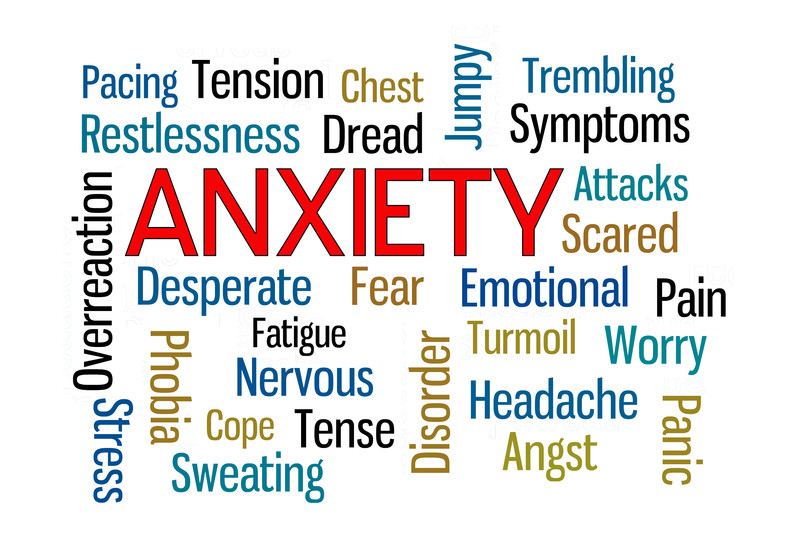
    Mental health professional are not concerned with normal anxiety. But, if your anxiety suddenly occur without apparent reason and lasts for weeks to months and happens in most days than not, that is another issue. If anxiety persists in most days than not, and takes longer than six months, it has become an immobilizing disorder.

    An anxiety disorder is a recurring and excessive anxiety and worry about events or activities without logical reasons at all lasting for more than six moths and it is interfering with everyday activities, such as going to work, and socializing. A person experiencing anxiety condition finds it difficult to control the feelings of worry and fear. The thing about people with anxiety disorder is that they actually know that what they think of feel is not real and that they are just made-up.

    The common anxiety disorders are Panic Disorder, Social Phobia, Agoraphobia, Specific Phobia, Obsessive-Compulsive Disorder, Generalized Anxiety Disorder, Separation Anxiety, Post-traumatic Stress Disorder, and Selective Mutism.

    A person with anxiety condition may suffer different anxiety disorder symptoms. And because no two individuals are the same, the anxiety disorder symptoms may vary from one person to the other.

    The physical symptoms of anxiety disorder are cause by brain sending messages to parts of the body to prepare for the flight-to-fight response. The lungs, heart, and other parts of the body work faster and the brain releases stress hormones, including adrenaline, and that explains that physical symptoms.

    Anxiety disorder symptoms may experience physically can include but not limited to:
    o Abdominal discomfort
    o Diarrhea
    o Dry mouth
    o Rapid heartbeat or palpitations
    o Tightness or pain in chest
    o Shortness of breath
    o Dizziness
    o Frequent urination
    o Difficulty swallowing

    Anxiety disorder symptoms may experience psychologically can include:
    o Insomnia
    o Irritability
    o Inability to concentrate
    o Fear of going crazy or dying
    o Feeling unreal and not in control of your behavior

    There are several types of anxiety disorders and sometimes they are associated with physical problem such alcohol and drug abuse. Anxiety is the main symptoms of other mental illness called anxiety disorders. Anxiety disorder symptoms may differ from the symptoms of other anxiety disorders, but all the symptoms cluster around excessive, irrational fear and dread.

    For people with anxiety condition, cheer up! Your world does not stop there because there is cure for anxiety disorder. Anxiety disorders are curable and there are two types of treatments available for anxiety disorder- medication and psychotherapy. But, it is said that the proven most effective way to treat anxiety sufferers is psychotherapy.

  • Anxiety Symptoms

    teenage-anxiety-symptomsEvery time we feel worried about certain things or fear about the possibilities of what might happen if, a lot of ifs- these are what we call anxiety. Anxiety is a brief, persistent, and extreme feeling of worry, uncertainties, and fear over a tense situation, and fortunately, it is controllable. As a matter of fact, anxiety is reversible, and can be successfully treated naturally if found out through the anxiety symptoms. An anxiety condition is not an accidental, unidentified, and uncontrollable illness, even if it feels like it is. Anxiety conditions come out for precise reasons and have specific reasons and underlying explanations why they continue.


    To be able to know if you have anxiety, you should know first the symptoms. Here is some of the anxiety symptoms associated with anxiety disorders. And since each individual has different chemical composition, anxiety symptoms and their intensity may vary from person to person.
    The anxiety symptoms we may experience physically are:

    Body:

    Burning skin sensation
    Persistent fatigue
    Electric shock feeling
    Excess of energy, you feel you can’t relax
    Feel like you are going to faint
    Feeling cold
    Hyperactivity
    Increased or decreased sex drive
    Muscle twitching
    Tightness or stiffness of shoulder, back, and neck
    Numbness or tingling in hands, feet, face, head, or any other parts of your body
    Persistent muscle tension
    Jumpy
    Too much sweating
    Trembling, shaking
    Urgency to urinate, frequent urination
    Weak legs, arms, muscles

    Chest:

    Chest pain or discomfort, tight chest, or tight chest muscles
    Concern about the heart
    Fell like you have difficulty breathing
    Shortness of breath
    Frequent yawning to try to catch your breath
    Palpitations
    Irregular heart rhythms, flutters or skipped beats, tickle in the chest that makes you cough

    Head:

    Dizziness or light-headedness
    Frequent headaches, migraine headaches
    Head, neck, or shoulder tightness or stiffness
    Overexcitement
    Shooting pains in the face, scalp, or head,
    Sore jaw that feels like a toothache
    Clenching of the jaw or grinding of the teeth

    Emotions:

    Dramatic mood swings
    Emotional blunting
    Wrong feeling of emotions
    Frequently feel like crying for no reason

    Mind:

    Fear of going crazy, losing control, fear of impending doom
    Frequent feeling of being overwhelmed, or that there is too much to handle or do
    Having difficulty concentrating
    Racing thoughts or rapid thinking
    Obsession about sensations or getting better
    You feel like you are carrying the world on your shoulders

    Hearing:

    Irregular or frequent reduced hearing or deafness in one or both ears
    Low rumbling sounds
    Ringing in the ears

    Mood:

    Irritable
    Depression
    Feeling like things is not real or dreamlike
    Have no feeling about the things you used to
    Feel like you are pressured all the time

    Sight:

    Distorted, foggy, or blurred vision
    Itchy, dry, or watery eyes
    Eye tricks, seeing things on the corners of your eyes that aren’t there, stars, flashes
    Eyes’ sensitivity to light
    Spots in the vision,
    Flashing lights when eyes closed
    Deep perception feels wrong

    Mouth/Stomach:

    Constant craving for sweets
    Chocking or difficulty swallowing
    Constipation or diarrhea
    Dry mouth
    Feeling like your tongue is swollen
    Frequent upset stomach, bloating, gaseous
    Lack of appetite or taste
    Nausea or the thought of eating makes you nauseous
    Tight throat, lump in throat

    Sleep:

    Difficulty falling or staying asleep
    Frequent bad, odd, or crazy dreams
    Hearing sounds in your head that can awaken you
    Insomnia or waking up ill in the middle of the night
    Waking up in a panic attack
    Feeling worse in the mornings

    These are some of the prevalent anxiety symptoms, but the symptoms on the list are incomplete and not limited as to what is listed above. It is common for normal people to experience or two of anxiety symptoms, and some may experience them all.

  • Innovation: The Life Blood Of Your Business

    innovIf you’re running or managing a business and want it to be around for a long time, you need to spend a good part of your time innovating. That’s because, in a fast-moving world, where people expect things to get better and better, and cheaper and cheaper, innovation is your route to getting ahead of your competition.

    Here are 7 ways to put new life blood into your organization through innovation.

    1. Create An Innovative Climate. Goran Ekvall of Lund University in Sweden has defined three conditions needed for a climate of innovation. They are: trust, dynamism, and humour. One of Ekvall’s case studies was a Swedish newspaper where the team working on the women’s section consistently outperformed all the other teams. The reason? Quite simply, this group trusted one another, had a high level of energy and shared a common sense of humour.

    2. Develop Washing-Up Creativity. According to the Roffey Park Management Institute, most flashes of inspiration come to people when they are away from work and not forcing their conscious brains to find solutions to their problems. For some, ideas come while mowing the lawn or taking the dog for a walk or playing golf or waiting on a railway station. For Isaac Newton, it was an apple on the head while sitting in the garden. For Archimedes, it was in the bath. For others it’s while doing the dishes; that’s why Roffey Park calls these flashes of insight: “washing-up creativity”.

    3. Make New Connections. Making new connections between existing features of your product or service is a popular way to innovate. Akio Morita, chairman of Sony, said that he invented the Walkman because he wanted to listen to music while walking between shots on his golf course. His team simply put together two seemingly incompatible products: a tape recorder and a transistor radio.

    4. Find Out What People Need. Necessity is a great spur to innovation. Take, for example, writing paper. The Chinese had already made paper from rags around the year 100 BC but because there was no need for it, nothing came of it. When it did reach Europe in the Middle Ages when writing was all the rage, the supply of rags and worn-out fabric soon dried up. That’s when a French naturalist made the discovery that wasps made their nests by chewing wood into a mash that dried in thin layers. Within 100 years, all paper was made using the idea of wood pulp.

    5. Test, Test, Test. Product testing is the way most inventors and organizations go about innovation. It may not be the quickest route to success, but it is often the surest. Jonas Salk, for example, discovered the polio vaccine by spending most of his time testing and testing and continually finding out what didn’t work. Thomas Edison, the inventor of the filament light bulb, recorded 1300 experiments that were complete failures. But he was able to keep going because, as he said, he knew 1300 ways that it wasn’t going to work.

    6. Adopt and Adapt. One relatively easy approach to innovation is to notice how others deal with problems and then adapt their solutions to your own. It’s known as “adapt and adopt”. It’s what watchmakers Swatch did when they realized that the more reliable their watches became, the less people needed to replace them. Their solution? Borrow an idea from the world of fashion and collections by turning their watches into desirable fashion accessories. Now people buy Swatch watches not just to tell the time but because it’s cool to do so.

    7. Take Lessons From Nature. If you really want to be inventive, you can’t beat nature. The world of nature gives us an endless supply of prototypes to use in our own world. Take Velcro, for example. Velcro was patented by Georges de Mestral in 1950 after he returned from a hunting trip covered in tiny burrs that had attached themselves to his clothing by tiny overlapping hooks. De Mestral quickly realized that here was an ideal technique to fasten material together. A whole new way of doing things was suddenly invented.

    The history of the world is the history of innovation. Thomas Kuhn called each acceptance of a new innovation a “paradigm shift”. For once a new innovation becomes accepted, the world has changed for ever and can never go back to the way it was.

  • Anxiety Medications

    anxiety-drugs_thumbMany people have experienced anxiety at some points in their lives. I have and I’m sure most of you have. It keeps us alert and helps us deal with any stressful events that we may encounter. Anxiety can sometimes interfere with our daily life activities, don’t you agree? If we worry, we often can’t concentrate on the things we do, but if we look on the bright side of anxiety, where it can help us handle a situation, I must say that it can be used to our advantage, as well. For example, in an exam, because of fear of not getting the score you aimed, you tend to give your best shot and the result could be higher than you expect. That happens to me, too. And I can tell you, anxiety sometimes can be of big help.


    How we all wish anxiety gives us all the best it can do to us rather than the worst. Unfortunately, it’s not the way anxiety works. If anxiety attacks we wish there could be ways to stop it for anxiety really does affect your mood, work, and practically your daily life routine. Otherwise, people suffering from anxiety are usually left immobilized; unable to perform effectively on you regular daily routine.

    Anxiety can be treated by medication or by psychotherapy. It is said that psychotherapy can be the most effective treatment for anxiety. But, anxiety medications, such as anti-depressants may be added if needed be. Anxiety medications help relax and calm the anxious person and can remove the troubling symptoms that come with anxiety.

    There are several anti-anxiety medications that are available today. The preferred are Benzodiazepines such as Valium, Xanax/Zanex, and Ativan. Aside from the Benzodiazepines, other medications, like Buspirone, Beta-blockers, and Gabapentin are sometimes also taken to treat anxiety. Antidepressants are also effective for anxiety attacks and some other phobias are frequently prescribed for these conditions. They are also seldom used for generalized forms of anxiety, especially if anxiety is accompanied by depression.

    Aside from Benzodiazepines, among the other anxiety medications are Buspirone, Tricylic, Antidepressants, or SSRIs, are also the preferred medications for most anxiety disorders, rarely for specific reasons. One of the following medications maybe prescribed: Antipsychotic medications, Antihistamines, like Atarax, Vistaril, and others; Barbiturates, such as Phenobarbital, and Beta-blockers, like Propranolol. All of these anxiety medications help relieve anxiety and depression and must be prescribed by health professionals for there are medications that might not good for you. For example, Benzodiazepines are usually not prescribed to people having social anxiety condition with substance problems.

    But, if your anxiety only occur on certain occasion, Seredyn is good for you. Seredyn has natural ingredients and provide long lasting relief. It promotes relaxation, reduces worry, and relieves irritability and tension. Seredyn can also be taken everyday for chronic anxiety or as needed for occasional anxiety or panic attacks.

    When it comes to anxiety medications, make it a point to ask your doctor what is necessary and safe for you to take. Not all anxiety medications works on your specific anxiety condition.

  • Getting rid of anxiety: Living in the Present

    blog-forget-the-past-forego-the-future-how-to-start-living-in-the-presentI used to be a person who worried about imaginary events in the future, and I let my imagination play havoc with me. My worries and my anxiety would not let me focus on whatever I was doing.

    Furthermore, I was aware that I was being controlled by my worries and that upset me even more – I would put myself down and say to myself, “What sort of person am I that I’m letting myself be controlled by my imagination?”

    Fortunately, I came across some readings that allowed me to see the light. I learnt a few techniques that put me in control of myself straight away. I observed that getting rid of anxiety and worries was not such a difficult task after all.

    I am sharing today this powerful technique with you. It is the “This Is Me Doing This” positive technique: getting back to the present (and only the present).

    A distracted mind is a field where concerns and worries grow easily. Paying attention to what you are doing is key to live a happy and fulfilling life. Having a positive attitude naturally follows.

    Decide to get back to the present. For example, if you are washing dishes, start by saying to yourself “this is me washing dishes”. Repeat it calmly, focusing on the very act of washing dishes. Name that which you are doing.

    As you repeat to yourself “this is me doing (whatever)”, you start feeling relaxed. Other matters loose importance; you’re giving orders to your mind to actively focus on what you are doing, and only that.

    When you move on to the next task, keep on telling yourself what you are doing. “This is me walking upstairs”, “this is me feeding the cat”, etc. Feel how more and more calm comes to you as you keep on repeating “this is me doing (whatever)”.

    After a few minutes of keeping focused and repeating to yourself what you are doing, you will probably experience a feeling of well-being. All stresses and worries may seem past or worthless. Keep focused.

    Talk to yourself positively in between telling yourself what you are doing. Say “this is me brushing my teeth” (for instance), followed by “I am calm and I am enjoying the present”, “this is me brushing my teeth”, “I feel good and relaxed”.

    The benefits of this technique are powerful and almost immediate. It allows you to focus on this present rather than letting your mind play with hypothetical events. It shuts all unnecessary worries and anxieties.

    When practised regularly, this technique gives you the chance of being more aware of who you are, where you are, and what you are doing. The very first step to choose the life you want!

  • 8 Great Interview questions to help you find the right Candidate

    tough-hr-interview-questions1) Do you have written goals you want to accomplish and if so, tell me about them? You are looking for indications of maturity, focus, planning ability and desire for achievement.

    2) How did you earn your first paycheck, how old were you, and what did you do with the money? With this question you are probing to check their work ethic.

    3) What are the top three leadership traits that you look for in a manager? With this question you are attempting to gauge their expectation and ascertain their preferred management style.

    4) Have you ever failed at something and if so, why did you fail and what did you learn from the experience? This question lends itself to a discussion on resiliency, personal responsibility and tendencies under pressure.

    5) Everyone has strengths and weaknesses as employees. What are your strong points for this position? This question gives them the opportunity to tell you what assets they bring to the table and how they see themselves fitting into your organization.

    6) What is the one thing you would improve about yourself? This question gives you an indication of his or her self- assessment capability.

    7) Other than family members, who has been the greatest influence in your life and why?

    8) If you were to fail in this business, what do you think the reason would be?

    Use these questions as a guide and add to them as you wish. by having a set list of questions it helps you move the interview process through efficiently and effectively. Based on the candidates’ answers to these and other questions you may provide, you’ll have a good idea if you’re ready to take the next step with this person.