

• Forget Conventional Dream Interpretation: Learn to Cultivate Your Dreams Today!

    can-you-control-your-dreamsOne of my favourite quotes of all time and I am sure many of you share my thoughts, is the speech by Martin Luther King at the civil rights march in Washington, 1963, which went like this:

    “I have a dream that one day on the red hills of Georgia the sons of former slaves and the sons of former slave owners will be able to sit together at the table of brotherhood…”

    “I have a dream…” Indeed. Inspiring stuff. I want to discuss our dreams in a very practical way today.

    I want to talk about how to cultivate your dreaming. It really is a tremendously valuable thing to do. I want to steer away from conventional dream interpretation and will explain why.

    As of today, pay attention to your dreaming and your daydreaming. Dreams are important to us in many ways, because they do the following:

    Firstly, when you dream you actively process information and feelings.

    Secondly, dreams are always involving many senses, so the highly sensory experience is very rich. It is quite rare for us to use all our senses at once as we do when we dream.

    Thirdly, dreams give us valuable information about what is going on in our lives, whether directly or more often in a disguised or symbolic form.

    Fourthly, dreams are strongly sequenced, though often in a way which is emotionally rather than logically organised.

    Finally, dreams draw upon a rich range of unconscious, associative, creative links between many kinds of information.

    Some people remember their dreams; others tend to forget all but the most dramatic bits as soon as they wake. When you dream or daydream, take time to replay as much of it as you can in your mind before the events of the day overlay it. Relive the story of that dream. Remind yourself of the events, pictures, sensations and other sensory information it involved.

    This dream was the product of your mind. Marvel at your own creativity! This is amazing stuff here; get excited by it.

    If you get into the habit of asking yourself when you wake, “what did I dream?” you may at first only remember a few particularly strong feelings or vivid images: write them down and review it regularly. I actually used to write a dream journal and wrote everything down as soon as I opened my eyes each morning. It provided me with such inspiration when I required it.

    Naturally, lots of you may want to start with dream interpretation straight away. Resist the urge for dream interpretation, ok?

    Do your best not to assume that there is necessarily a single clear meaning which can be interpreted according to psychological theories or books on dream significance or dream interpretation. How can your dreams have the same meaning as someone else? Is your brain the same as that persons? For now, ease off the dream interpretation.

    I have found that the most useful assumption to make about dreams is that they have some kind of significance for you, the dreamer: they come from your internal, unconscious mind’s storehouse of feelings, experiences and images, and are an active and useful way of processing that is quite different from – and just as useful as – the processing that belongs to the logical conscious part of your mind.

    Often a strong feeling will be your first clue to the meaning a dream has for you: so note it, and wonder about it, but don’t try to rush to tie it down by conscious analysis. The real work of the dream is often done simply in the dreaming of it: the conscious mind does not always have to understand, and when it tries to translate dreams into its own terms it may be limiting it, just as poetry translated from another language usually loses something of its more subtle tapestry of meanings.

    Think about the value of dreams.

    Dreams demonstrate a different level of mental functioning from conscious, disciplined thought. When you pay attention to them, and even cultivate them, you are learning to become familiar with, to trust and to draw upon a fuller range of your own mental resources: in other words, you are using more of what you’ve got. Hey, this stuff is going to keep happening, so why not really use it.

    The mind works both consciously and unconsciously. Conscious thought is formally taught in our education system. Its strength is its systematic and disciplined way of handling information. Its limitation is that it tends to be rule-bound and too narrow in its problem-solving approach.

    The brain also processes information at an unconscious level: mostly, this is associative and depends on links, similarities and feelings. This processing produces dreams, as well as much of our other “creative” or “expressive” experience. That is why we are often surprised by the spontaneous connections we make or insights we have, and by our imaginative inspiration: it is not what we would have come up with consciously at all, yet it seems somehow completely “right”. This way of thinking works “laterally” – it expands, goes sideways and finds multiple avenues rather than just one.

    We need both kinds of functioning if we are to make the most of our brain power. Logic and intuition, discipline and divergence, are all vital tools that enrich and enable us. But whereas we are used to working with the conscious mind, in part because we are aware of it and can monitor it as it works, many people are less at ease trusting and using the unconscious processes. Paying attention to your dreams, and deliberately cultivating daydreaming, are both ways of stretching yourself into this area.

    So let us have a look at the value of deliberate daydreaming. Where dreams come unbidden, you may find it useful to deliberately evoke the conditions for daydreaming, if, like many people, you have not really valued the activity before now.

    How is it valuable? Daydreaming brings us escape and relaxation; visions of the future that inspire and help us to bring about what we have dreamed of; solutions to apparently unsolvable problems; inventions and creative possibilities. Daydream states allow the unconscious, associative parts of the mind to work in their own playful and imaginative ways, bringing not only pleasure but results that our usual deliberate, attentive, rational thought does not. We need space in our lives for both ways of processing if we are to realise ourselves as fully as possible.

    The key to daydreaming is to be in that right state. If you want to practice, please visit my website and download the free hypnosis session there, or learn self-hypnosis, read my book “The Secrets of Self-Hypnosis” or invest in the self-hypnosis masterclass audio programme, there is nothing else as good in the world today, really there isn’t. There is a kind of automatic abstractedness that goes along with daydreaming. Mostly it just seems to happen – but when you know about creating and changing states, you can choose to make it happen.

    Here are some ways you can cultivate and work with your daydreams:

    Firstly, notice when you have been daydreaming. Is there any pattern of circumstances that helps bring about your particular daydreaming state?

    Some people find that repetitive, relatively automatic, activities such as jogging, ironing or walking create the right state. Perhaps it is a warm bath, swimming a few lengths, or sitting in the garden. Or it may be swaying to the movement of a train, staring into space, looking out of the window of a bus on the way to work, or going on a long drive.

    Once you find what helps you daydream, use it and make space for it in your life on a regular basis, imagine that you are in that experience, recreate those circumstances inside of your mind. Let daydreaming come to you, and notice what kinds of windows it opens from our ordinary world into what other kinds of possibilities. Some of your best ideas and inspirations may come at these times.

    Secondly, next time you have a decision to make, or a problem to solve, or a challenge to overcome, you can set up the circumstances so that you can trigger your daydreaming state – and allow yourself to explore your problem or decision in this way. When you have done so, make some notes of what you experienced and discovered. Add that to your conscious thinking on the subject: you now have much more information, and the advantage of having engaged more of your mental resources.

    Thirdly, for today, forget dream interpretation. That is a conscious and limiting thing to do. Did I make myself clear? Forget conventional dream interpretation. For now use your dreams in personal ways to you.

  • Cooking up Stress and Anxiety

    12-gadgets-for-the-busy-chefGone are the days when people think of cooking as a task that should be done “only by women.” In the past, women were traditionally relied upon to cook the meals for the family, do the dishes and clean the house, and be in-charge of just about every domestic task there is. But times have changed and women now play very different roles in society unlike what women of the previous decades were accustomed to. This change in gender roles has affected both women and men — especially in terms of taking the lead kitchen. Today, both men and women now appreciate the art of cooking. People with exceptional culinary skills are highly compensated. For that reason, it is no wonder that the stress that used to part and parcel of cooking is now experienced by both men and women. Food, after all, is about pleasing the senses of people who partake of one’s kitchen creations.

    Cooking and stress are not often associated with each other. The word “cooking” easily connotes gustatory pleasures and not stress which is often linked to one’s work at the office or to problems at home.
    But it should not be a surprise to know that stress and anxiety now affect the men and women who do the cooking as much as the salesman who tries to meet his daily quotas or the manager who faces enormous organizational challenges.

    In restaurants, for example, there are now more male cooks or chefs. These kitchen experts follow a so-called “chef’s ladder” that defines the rankings and specific tasks of each person in the kitchen. There is the head chef or “Chef de Cuisine” who visualizes the dishes in accordance with the restaurant concept of dining. Next would be the Executive Chef, who actually runs the whole kitchen, manage the costs, hire and fire staff, revamp the menu, do certain administrative tasks. Under them would be the Sous Chef who make the daily specials, takes inventory, watches over the staff, and does the hands-on work in the kitchen. Also called the “Expediter”, the Sous Chef makes sure that the food gets to the table in a timely manner, a task that requires coordination and time management. With the same level as the sous chef, the pastry chef is in-charge of the pastry section of the restaurant. Mostly women reserved for women, this job requires preparation of chocolates, souffles, and sweet pastries.

    Under these chefs would be the line cooks who are the ones who actually cook the food. The line cooks are divided according to certain cooking specialty. Another key member of the kitchen is the Chef de Garde Manger who manages the cold food section that includes the salads and desserts.

    If you have watched an episode of the t.v. cooking show, Iron chef, you would probably know how stressful it is to work as a chef or a line cook. In that show, the cameras usually show the stress and anxiety in the chef’s faces as they try to prepare a certain number of meals under time pressure. Anxiety is also seen on the chef’s faces when the judges are tasting their dishes.

    In another popular reality-based television show called Hell’s Kitchen, several people enter as contestants in a game that is supposed to select the next “big chef” in town. Being a reality show, Hell’s Kitchen often shows the stress and anxiety on the faces of the contestants while the host shouts and gets mad at them for not doing certain things right in the kitchen. Anxiety grips each contestant as they try to battle out to win the throne of being the next best chef.

  • How To Increase Your Capacity To Memorize Information And Overcome Test Anxiety

    college-students-coping-with-anxietyIf you are a student who is trying to bring up your grades, there are a list of tricks that will help you to amplify your capacity to focus your concentration, absorb the data that you study, and bring it back to consciousness during an exam without being subjected to mental blocks or test anxiety. Here are the best ways that I know to establish good study habits:

    (1) Create a place for study and study only in that place! Establish a peaceful room that will make possible concentration without any distractions. Some usual examples would be a library, a vacant classroom, or your home office. You will want to establish the habit of studying when you are in this place. So it is best to not use this place for other activities like daydreaming, watching TV, or playing music, etc.

    BE SURE YOUR SPECIAL PLACE HAS:

    (a) A comfy seat, but not excessively comfortable

    (b) Your writing desk or table

    (c) Excellent illumination

    (d) Sufficient air flow

    BE SURE YOUR SPECIAL PLACE DOES NOT HAVE:

    (a) Views that will be distracting

    (b) A telephone

    (c) Distracting music

    (d) A large screen television

    (e) A companion who talks a lot

    (f) A refrigerator filled with snacks

    (2) Split your work into small, short-range projects.

    (a) Set up small highly specific projects like, “I am going to study my English from 1 PM to 2 PM. Or else you will be setting yourself up to fail.

    (b) Set a doable homework goal for the amount of time you are able to allocate. For example: finish reading chapter ten in my chemistry text, or complete a final version of my chemistry paper, etc. Set your goals when you you are ready to study but before you actually begin. Set realistic goals. You may do more than reach your goal, but set a reasonable goal even if it seems far too easy.

    (3) Test Anxiety

    (a) Some students experience physical symptoms for the most part, like feeling hot or cold, nausea, or faintness, etc.

    (b) Other students experience mostly emotional symptoms, like feeling irritable, crying, or getting frustrated quickly.

    (c) The main difficulty with anxiety is that it can make one have a memory block. Or it could make one have thoughts that are racing out of control.

    (d) Although you may currently experience some level of anxiety while taking a test, you can learn to diminish that anxiety, or even completely eliminate it!

    (e) Anxiety and the resultant stress are as a rule the main causes of a lack of the ability to focus your concentration. Stress can also trigger a mental block when one tries to remember information.

    (f) Hypnosis CD’s can be utilized to relax your mind and focus your concentration. As your mind calms down, your ability to stay focused will increase. Similarly, a calm mind enhances your ability to retain information, and recall it when it is needed.

    (g) Hypnosis and NLP CD’s can be utilized to program your mind for the positive expectation of tranquility and the ability to bring back to mind the information during an exam. This is effective at diminishing or eliminating test anxiety.

    (h) There are a number of NLP (Neuro-Linguistic Programming) techniques that can quickly do away with a test phobia!

  • Don’t Be A Slave To Your Things

    about-cleaningDo you have things like a bicycle, jetski, or swimming pool that sit unused? Is it that you don’t have time to use them because you have to work so much just to pay for them? Sometimes it seems like all the things we own somehow own us.

    The bad news is that it’s often true. We have to arrange our lives around our things. You get a new truck that can go anywhere, but you’re too busy working to go there. Someone is out fishing while you are putting in overtime to pay for your fishing boat. You use your large-screen television a lot, but does it sufficiently reduce the debt-stress that came with it?

    Break The Chains!

    The good news is that there’s a better way. Actually, there are three better ways. First, know what you really value. Second, use cash instead of debt. Third, learn how to look at costs and benefits.

    Will you really enjoy that $2,000 mountain bicycle enough? Maybe. This isn’t about right or wrong desires. It’s a question of truly seeing your own values. Think back to things you’ve bought but not used, or not used enough. What truly enjoyable things could you do with that money if you had it now? You’ve got to be self aware and honest.

    Cash is king. The price may seem the same, but put those things on a credit card and, with interest, you’ll pay a lot more. Cash means you have to save and wait a little for things, but you can buy more and have less stress. Credit cards provide the illusion of a richer life. Escaping debt gives you the reality.

    Finally, learn to understand costs and benefits. A friend once came to the realization, using pen and paper, that his jetski cost him $300 for every hour he used it the first year. Loan interest, gas, insurance, depreciation, repairs, licenses – these things add up. And he thought it was too expensive to pay $100 per day to rent one! Consider the real costs of things, and look for a cheaper way, or at least make an honest decision that it’s worth $300 per hour to you.

    Your things should be making your life better. If they aren’t, you need to start looking at them differently. Don’t let your things own you. Change your approach.

  • An Article On Perfectionism

    perfectionism-twitterWhat is Perfectionism? Perfectionism is defined as a meticulous drive to attain excellence. A perfectionist is one who has this characteristic.
    ‘Perfectionism’ is a most prevalent belief in our civilization. Notice that I used the word ‘belief’.

    Everywhere in this world of ours, perfectionism is regarded as good and desirable while imperfection is deem as bad or negative. Everybody wants everybody else to be perfect. Bosses want their employees to be flawless on the job. Parents want their kids to be the best. Perfectionists want their work and themselves to be perfect.

    Since it is so strongly regarded as being positive, is Perfectionism really an absolute or universal value? In my opinion, it is not so.
    To me, it is relative and is born of human conception. Perfection is an idea. It is an idea of a perceived ideal state of affair. However, things are the way they are. For every circumstances, the truth is what is at each instance. Perfection and imperfection are therefore merely attached values.

    I am not suggesting that perfectionism is not good. I am suggesting that perhaps perfectionism can cast a controlling net over our expression of happiness. One can reach the required goal with or without being a perfectionist. To be a perfectionist, on the other hand, leave very little room for one to accept and love oneself unconditionally when a desired goal is not met. And when our desires are not met, we feel unhappy or cannot be fully satisfied. However, the truth is we only have each moment of the Present Moment to live in. By being perfectionist, our mind will be forever planning and thinking about the future or lamenting about what went wrong in the past. Because of these tendencies, many perfectionists are unable to feel satisfaction because in their perception they never seem to do things good enough to warrant that feeling of contentment.

    From this, we can see a paradox of life. That is:

    “How can one have perfect peace, self-love and joy when one is a perfectionist? “

  • How To Improve Sleep By Reducing Worry And Anxiety

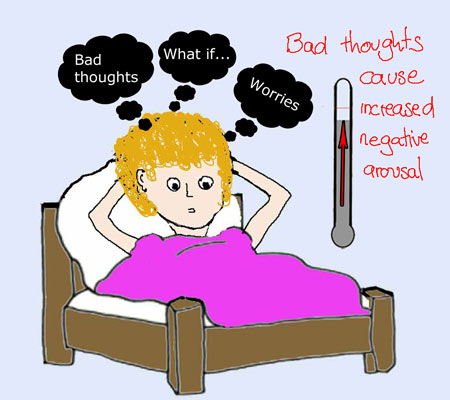
    cantsleep1Perhaps you’re someone whose mind is always busy. Do you think about the events of your day as you wind down for the evening? Do you worry about your family, your job, your finances, and what tomorrow will bring?

    Sometimes it’s difficult to empty your mind of all these details long enough to fall asleep. This can lead to tossing and turning as your mind fights sleep.

    There are several ways that you can reduce the worry about situations and events in your life long enough to allow you to rest and fall asleep. The key is finding a process that works for you. The goal is to clear your mind and consciously realize that tomorrow is the time to tackle problems and tonight is the time to sleep.

    One technique you can try is the practice of writing down all your worries and concerns before you retire for the night. Keep a notebook available for just this purpose.

    List in point form those things that you are worrying about. Make note of which of these items you can deal with tomorrow. Have a decisive plan of action for what you are going to accomplish tomorrow.

    This will make you feel positive that tomorrow you will take care of certain items on your “worry list”.

    Make a separate list in your notebook that contains only those things in your life over which you have no control. Firmly tell yourself that these items are beyond your power.

    Once you have completed your two lists it is time to close the notebook and repeat to yourself that you will not think of these worries until tomorrow. If, during the night, you find yourself thinking about any of the items in either list make a mental note to catch yourself and sternly remind yourself that the covers of the notebook are closed and cannot be opened.

    Another technique for keeping daily anxiety and worry out of your thoughts while you try to fall asleep is to keep a daily diary.

    Make sure to include all your worries and fears in your diary along with the events of the day. The goal here is to actualize your feelings in writing so that you can be free of them in the evening.

    The act of physically writing is the key here to acknowledging that you are worried while at the same time giving yourself permission to rest and deal with these feeling tomorrow.

    You can reduce the effects that worry and stress can create for your body by using some of the other methods for achieving relaxation described in this book.

    You may want to consider a combination of soothing music and yoga to clear your mind. Or perhaps reading quietly will keep your mind from wandering back to the stressful thoughts you had during the day.

    Once again, the goal here is to relax and prepare you for a night of restful sleep.

  • Create More Romance In Your Life

    how-to-embrace-self-loveAh, romance, that wonderful and exciting feeling, that most glorious intertwining of two hearts. So intense, such a high, but so fleeting, and so often for so many once gone never to return. But does it have to be that way? Can we intentionally create and sustain more romance in our lives?

    Most folks profess to want more romance in their lives. Indeed, for some, romance is a goal unto itself, or at least high on the list of goals for their love relationships.

    But if having romance in our committed love relationships is a highly prized goal, and if so many people want more of it in their lives, how can we create, cultivate, and encourage it? What concrete steps can we take to make sure that romance takes seed and flourishes?

    The purpose of this article is to explore the idea that romance begins in your heart-center and grows outward, and is, to some significant degree, a reflection of how you feel about yourself. In other words, by romancing yourself first you can create the conditions that allow you to experience and express romance with another more easily.

    Listen: your capacity to love and accept yourself is the measure of your capacity to love and accept others. The same can be said for romance: your ability and willingness to create romance within is the measure of the romance you can help create in a committed loving relationship.

    True romance isn’t just about flowers and poems. Flowers and poems are great, of course, but are really just an extension of a feeling that comes from within, something that starts in, and flows from, the heart. Without that heart-felt feeling, flowers and poems are but an attempt be to romantic, not an expression of true romance.

    So how do you create more romance in your life? Begin by romancing yourself. Love, accept, and forgive yourself on a deep level. Treat yourself with respect and understanding. Buy yourself flowers. Write yourself a poem. Treat yourself with respect and dignity. And remember: if you don’t love yourself first, you can’t truly love another.

    And remember that it is far more important to be the right person than to find the right person. Our relationships are a reflection of the relationship we have with ourselves. Romance, too, is a reflection of that inner state. By first creating romance within, you’ll be well on your way to creating more romance in your life.

  • Anxiety Attack

    coping-with-anxiety-and-depression-722x406As a human being, it is normal that we feel anxious, worried, and fears from time to time due to the things that our complicated lives bring. Anxiety is just a part of life. It helps us cope with the stresses we may encounter. If you are in a state of anxiety, it is likely that you experience anxiety attack.


    Anxiety attack is a sudden surge of overwhelming fear that comes without warning and without any apparent reason and this would usually last for no more than 10 minutes. It is far more intense than having anxiety or the feeling of being stressed out. One in every 75 people worldwide will experience an anxiety attack at one point in his/her life.

    Most anxiety sufferers report fear of dying, going crazy or losing control of emotions as well as behavior. The incidents generally provoke a strong urge to escape or run away from the place where the attack begins, and they are associated with chest pain or shortness of breath, and feeling of impending doom

    A person with a phobia will often experience an anxiety attack as a direct result to the hung-up trigger. These anxiety attacks are brief and quickly relieved once the trigger is escaped. In the conditions of chronic anxiety, one anxiety attack can usually turn into another one, leading to a nervous fatigue over a period of days.

    An anxiety attack has symptoms that often occur suddenly without any apparent cause. The symptoms can be as follows”

    •  Pounding heartbeat, generally faster in nature
    • Increased sweating
    • Dizziness, lightheadedness, nausea
    • Difficulty breathing
    • Tingling and/or numbness in the face
    • Dreamlike sensations or perceptual distortions (de-realization)
    • Disassociation, the perception that one is not connected to the body and time.
    • Fear of losing control and doing something embarrassing
    • Fear of dying
    • Feeling of impending doom
    • Crying, associated to the above symptoms

    Anxiety attack usually last for several minutes and is considered one of the most disturbing condition that anyone can live through in everyday life. The way to understand the different symptoms of anxiety attack is: first, comes the sudden jolt of fear with less or no triggering motivation, and then this will lead to a release of adrenaline (epinephrine), which causes the supposed fight-or-flight response, where the person’s body prepares for major physical activity. This results to an increased heart rate, labored breathing or hyperventilation, and sweating. The diaphragm, involved in the action of the lungs, is also a muscle and it can become overly tight. When there is continuous, inferior anxiety, a person frequently works too hard when breathing. However, if there is hyperanxiety or an anxiety attack, there is overwhelming excitement, and a person may hyperventilate.

    Because strenuous activity hardly ever arises, the hyperventilation leads to carbon dioxide levels lowering in the lungs and then the blood, resulting to the shift in the pH of the blood, which will then lead to many of the other symptoms, such as tingling or numbness, dizziness, and lightheadedness.

    Anxiety attack is a serious condition, but before you start thinking if you have this condition and go running to see a doctor, stop and take a deep breath! Relax before you start having an anxiety attack, even if you actually don’t have it. Don’t take things too hard for it may lead to something serious and may affect your daily routine. Take things lightly. In any case, if you think you have this condition, the first thing you should do is see a doctor. If you are diagnosed with anxiety attack condition, appropriate medication and good counseling can bring your life to normal again. Otherwise, tell yourself to relax and continue to live your life to the fullest.

  • 4 Step Dynamic Sales Letters

    perfect-sales-proposal-open-graphYou, like all marketers have a million and one things to do today! At the top of your priorities is marketing… finding more customers and raking in greater profits. If you’re looking for a simple, proven model to create sales content without spending hours hunched over the computer, try the AIDA (Attention, Interest, Desire, Action) model. You’ll be amazed at how fast you can create an effective salesletter.


    1. Attention
    What captures a reader’s attention more than an exciting list of things that will benefit THEM? Think about the affects of starting right off with 6 of the most appealing benefits of your product or service.

    A Multi Level Marketer might start a sales letter like this:

    * Experience the freedom of …
    * Being your own boss
    * Financial independence
    * Benefit 3 and so on …..

    That gets their attention, and compels them to read on.

    2. Interest
    Here’s where we sneak in the basic facts that might otherwise be uninteresting. The nitty gritty details of the product features won’t hold the customer’s attention for long, so keep it short and sweet. Hey, it’s great that your swimming pools have filters, etc., but let’s face it… there’s not a lot of excitement going on here!

    3. Desire
    Whet their appetite, but give them some cold, hard logic to back up their purchase. Most consumers buy on impulse, then ask themselve whether it was the right choice. Don’t make them second guess! Preparing them to face the doubts with a solid logical reason they got the best deal for their buck might include:

    * The advantages of purchasing from YOU.

    * Testimonials from other satisfied customers.

    * An unconditional money-back guarantee.

    * A good deal!

    4. Action
    Order now! Hey it says move it, but it doesn’t pack the wallop of a stronger action statement like this one:

    Hurry! Don’t miss out on this LIMITED TIME special offer. Call now to place an order, or visit us at www…..

    Be sure to give details of how to order. Make it a part of the command… make it easy to do… provide several options.

  • 4 Classic Cold Calling Mistakes

    cold-callingHave you noticed that the old “tried and true” cold calling techniques which were once successful have completely lost their effectiveness over the years? They just don’t work anymore.

    But many salespeople are still use them because that’s all they know. They’re working from that old, ineffective cold calling mindset. And they’re making the same mistakes over and over again.

    I’d like to talk about 4 classic cold calling mistakes from the old traditional approach that will put you on the wrong path if you’re not careful.

    1. Deliver a strong, enthusiastic sales pitch

    People almost always feel “pushed” by sales enthusiasm, especially when it’s coming from someone they don’t know.

    You see, a strong sales pitch includes the unspoken assumption that your product or service is a great fit for the other person. But think about it. You’ve never spoken with them before, much less had a full conversation. You can’t possibly know much about them at this point.

    So to them, you’re just another salesperson who wants them to buy something. And so the walls go up.

    It’s much better to modestly assume you know very little about your prospect. Invite them to share some of their concerns and difficulties with you. And allow them to guide the conversation, rather than your pre-ordained strategy or pitch.

    2. Your goal is to always make the sale

    When your target in cold calling is to always make the sale, prospects are aware of your agenda. And almost immediately, they’re on the defensive. After all, you’re primarily focused on yourself and the sale – not on them.

    In the old traditional mindset, you forge ahead with the hope of getting a sale. You’re coaxing, persuading, and pushing things forward.

    But most cold calls break down the moment the other person feels this sales pressure.

    Why? Because they don’t know you, and they don’t trust you.

    So the sales momentum you’re trying to create actually triggers a backlash of suspicion and resistance. They’re trying to protect themselves from a potential “intruder” with what appears to them as a self-serving agenda.

    Instead, you can approach cold calling with a different goal. Your focus can be on discovering whether you’re able to solve a problem for the other person.

    When you become a problem-solver, this feels vastly different to the person you’re talking to. You’re not triggering rejection. You’re calling with 100 percent of your thoughts and energy focused on their needs, rather than on making a sale.

    3. Focus on the end of the conversation – that’s when sales are lost

    If you believe that you lose sales because you’ve made a mistake at the end of the process, you’re looking in the wrong direction. Most mistakes are made at the beginning of a cold calling conversation.

    You see, it’s at the beginning that you convey whether you’re honest and trustworthy. If you’ve started out your cold call with a high-pressured sales pitch, then you’ve probably lost the other person in just a few seconds.

    When you follow a sales script, strategy, or presentation, then you’re not allowing a natural, trusting conversation to evolve. So the “problem” has been put into motion by your very first words. So the place to put all your focus is at the beginning of the cold call, not at the end.

    4. Overcome and counter all objections

    Most traditional sales programs spend a lot of time focusing on overcoming objections. But these tactics only put more sales pressure on your prospect, which triggers resistance. And you also fail to explore or understand the truth behind what’s being said.

    When you hear, “We don’t have the budget,” or, “Call me in a few months,” you can uncover the truth by replying, “That’s not a problem.”

    And then using gentle, dignified language, you can invite them to reveal the truth about their situation.

    So move away from the old sales mindset and try this new way of approaching your cold calling. You’ll find yourself being more natural, and others will respond to you in a much more positive way.