• Life Coach – Do you need one?

    Life coaching is one of those things that we hear about on TV and in the press and laugh at, thinking to ourselves how ridiculous people are that need such a thing. If you look into it further, however, you might be surprised at how useful a little life coaching can be.

    Advertisements

    Put simply, life coaches take techniques from psychology, counselling and mentoring, and combine them to help clients achieve their goals. Some examples of the techniques used include behaviour modification and goal-setting, although almost any technique can be brought in if the coach believes it will be helpful. The coach’s most important role is to simply listen to what their client has to say, and help them work through the problems that are standing between them and their goals.

    Life coaches are much-criticised from some quarters, mainly because it is not an official profession. You don’t need any kind of education or qualifications to become a life coach – you can pretty much just start putting up posters, asking for money and doing what you want with the people who call you. Critics say that life coaching basically amounts to practicing psychotherapy without any code of ethics or organising body.
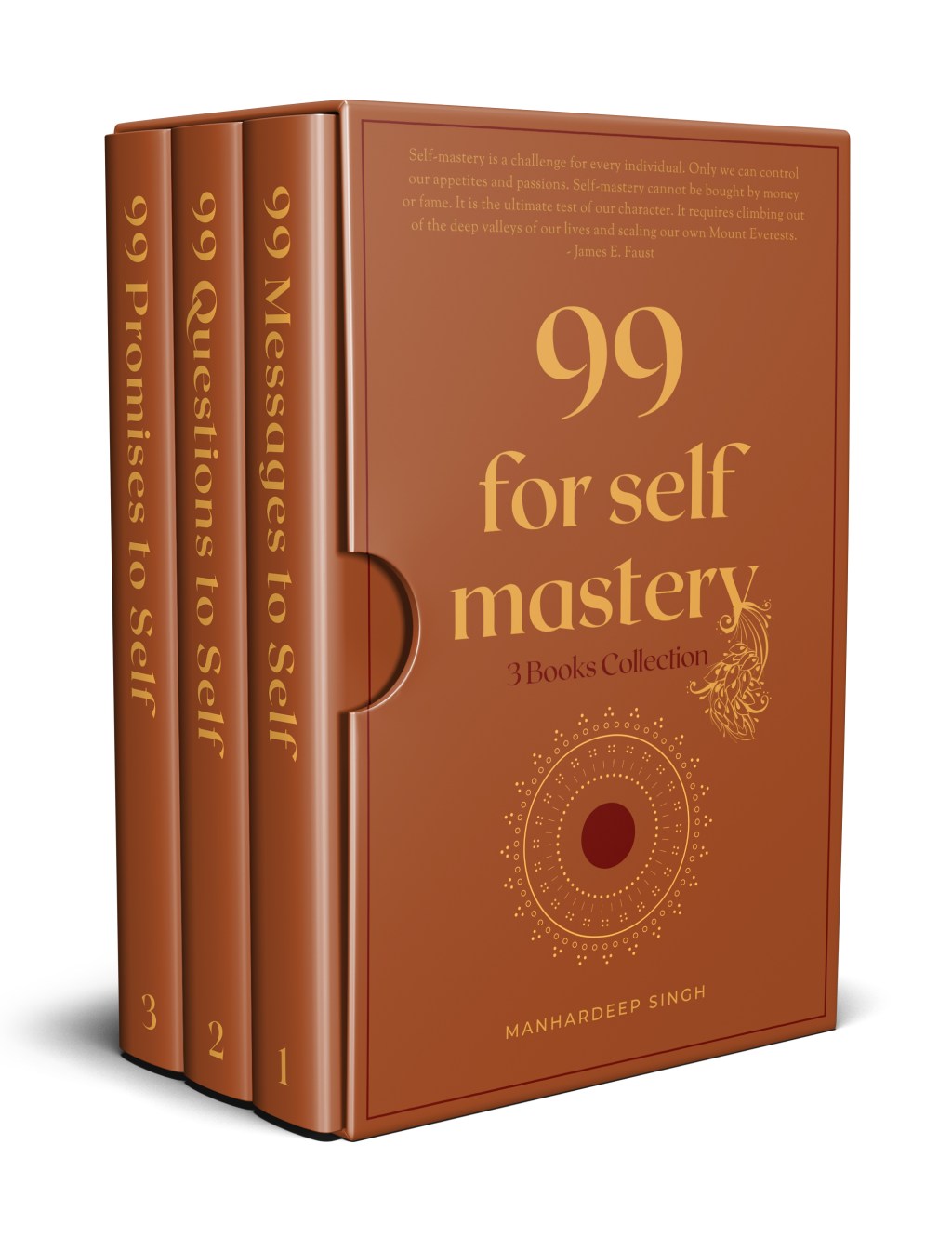
    Are you ready to take the journey of self-mastery? This 3 books collection takes on a guided voyage within.

    Book – 1: 99 Messages to Self

    Are you looking for messages meant for you? These 99 messages will enhance your life, and widen the horizons of your life.

    “Words are thought descriptors. They project thoughts from anonymity. They transfer thoughts into messages. Messages move the world.”― William E. Jefferson

    Book – 2: 99 Questions to Self (workbook)

    Would you like to tap into your full potential? Discover the 99 questions that can help you realize the superhuman in you.

    “An empowered life begins with serious personal questions about oneself. Those answers bare the seeds of success.” ― Steve Maraboli

    Book – 3: 99 Promises to Self

    Would you like to create a solid foundation of self? These 99 promises are the infrastructure of a strong self.

    “Promises are the uniquely human way of ordering the future, making it predictable and reliable to the extent that this is humanly possible.” ― Hannah Arendtread

    Buy 99 for self-mastery and start your journey to master yourself today!

    However, one organisation, the International Coach Federation, is attempting to fix this situation by introducing certification and standards for life coaches. There are several levels of ICF certified coach status, each one dependent on you having completed a certain number of hours of study and of coaching experience. However, many feel this to be counter-intuitive, as it is impossible to become a certified coach at all until you have completed 100 hours of coaching – hardly fair if you expect people to only seek coaching from certified coaches.

    Ultimately, if you are thinking of hiring a life coach, it is up to you to be cautious of who you take on. Meet them first, and be cautious of any attempts to manipulate you or force you into anything. Respond only to legitimate-looking advertisements, and insist on references from their previous clients. Ideally, get a life coach that someone you know has previously dealt with and liked, as that will always be the best option.

  • Living Profoundly

    When you realize that you really want to have an impact in this world, to make a difference, remember that it is in each moment that you are alive and in the present. When you are too busy worrying about what you don’t have, what you have to do, where you’ve been, and what you don’t have, you’re not in the present; you’re consumed by the past you can’t change and the future that has yet to happen. There is no impact in either place.

    Advertisements

    The impact is here and now. Stop, check in, and connect in relationship with those around you. Be present, make the impact with those you see in your life today. Your future will unfold more powerfully and profoundly than you could ever imagine when you focus on the right things; relationships, people, love and community.

    Being present will engage you in ways that will offer you greater insights into who you are; what others see in you; what gets you excited; and where you are going with your life. Giving time to others in the moment will enrich your experience of living as the energy of two create new possibilities. It’s never about what you get; it’s always about what you give! With greater awareness, that can only come through the being present, you will experience better decision-making and a much more profoundly lived life.

    RECOMMENDED RESOURCE:

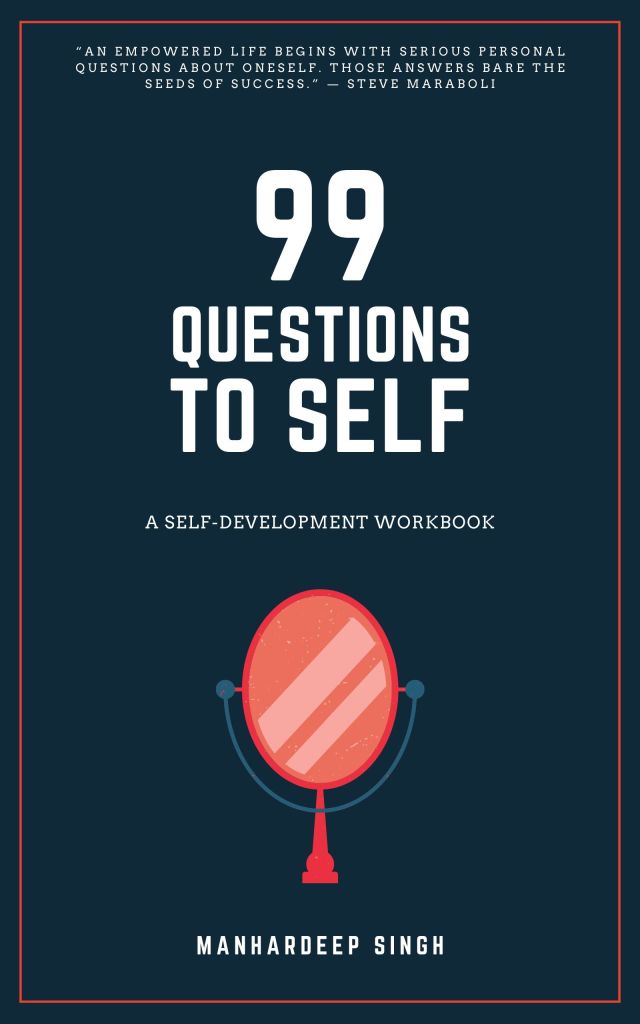
    Would you like to tap into your full potential? Discover the 99 questions that can help you realize the superhuman in you.

    This workbook will help you:

    • Discover your latent talents and hidden strengths
    • Learn how to create instant emotions of happiness and abundance
    • Improve every area of your life
    • Tap into unlimited source of power
    • Create a future you like

    99 Questions to Self is a comprehensive self-development workbook. If you like modern, practical, and interactive books, then you’ll love Manhardeep Singh’s self-help workbook.

    Buy 99 Questions to Self to start your journey of self-discovery today!

  • Anxiety

    Anxiety can be defined as emotions which are typically negative in nature. It will often consist of fear and worry, and some organisms may even experience physical signs such as nausea or chest pains. Anxiety is a complex emotion, and is composed of a number of different elements. Some of these elements are somatic or cognitive, and the body will prepare itself to deal with an external threat. The heart rate speeds up, and the blood pressure is increased. The various muscles in the body will also receive elevated levels of blood. At the same time, the functions of the digestive system will slow down.

    Advertisements

    People who have anxiety will generally have a sense of dread. A number of voluntary and involuntary processes will take place in the body, and the goal of these processes is to get the organism away from the source that is causing it to have anxiety. Anxiety is an important emotion, and is designed to increase the survival rate of organisms. In humans it appears that anxiety comes from the hippocampus and amygdala, two regions of the brain. When a person senses bad odors or tastes, there will be a large amount of blood flow which will be present in the amygdala. The evidence also shows that medium levels of anxiety will be present in this situation as well.

    Based on these studies, it appears that anxiety is designed to keep humans and other organisms from eating food or objects that may be harmful to their well being. While anxiety is normal, a person that has excessive amounts of it may have what is called an anxiety disorder. In extreme cases, people with anxiety disorders may have strong cases where they are terrorized. Anxiety disorders are broken down into phobias, panic disorders, generalized anxiety disorders, and obsessive compulsive disorders. Someone who is suffering from a phobia will have an abnormal amount of fear of a specific object or situation. People who have phobias tend to have extensive imaginations, and realize that their fear is often irrational.

    When a person suffers from a panic disorder, they will have extreme panic attacks, and may have dizziness or breathing problems. These attacks will typically reach their height in about 10 minutes. Generalized anxiety disorders are common, and effect a much larger portion of the population. It is prevalent in both men and woman, and is characterized by long periods of anxiety that are not related to any specific object or situation. With the obsessive compulsive disorder, the individual with have an obsession or compulsion when it comes to specific types of behavior. People who suffer from this disorder will see the need to do something obsessively in order to reduce their anxiety.

    Many people who have this disorder need to be extremely clean, and are afraid of germs. To reduce their anxiety, they will wash their hands numerous times in a single day. There are two primary methods that are used to help those who are suffering from anxiety, and this is either therapy or prescription medications.

  • Finding Happiness in Your Treasure Chest

    If you haven’t been able to find a lot of happiness in your life, maybe you’re looking in the wrong place. Our level of happiness is based on our thoughts and our thoughts are a reflection of what’s in our minds. We can begin the quest for happiness by separating our memories into three separate chests.

    Advertisements

    ‘The Treasure Chest’ of the mind is where we put our most cherished memories. We open this chest when looking for happiness, comfort and contentment.

    ‘The Hope Chest’ of our mind is for our goals and dreams of tomorrow. As each is fulfilled it is then moved to our Treasure Chest.

    ‘The Dumpster Chest’ of the mind is for letting go of the hurts and trash of yesterday. Once in this chest they are dumped, to be forever let go. Once these memories are put in the Dumpster Chest you should never go digging them out.

    Our thoughts are a reflection on who we are. Happy people have happy thoughts. That doesn’t mean that the happy person never has an unhappy thought, it means the happy person knows how to move these unhappy thoughts into the Dumpster Chest and then forget about them.

    Advertisements

    Would you like to tap into your full potential? Discover the 99 questions that can help you realize the superhuman in you.

    This workbook will help you:

    • Discover your latent talents and hidden strengths
    • Learn how to create instant emotions of happiness and abundance
    • Improve every area of your life
    • Tap into unlimited source of power
    • Create a future you like

    99 Questions to Self is a comprehensive self-development workbook. If you like modern, practical, and interactive books, then you’ll love Manhardeep Singh’s self-help workbook.

    Buy 99 Questions to Self to start your journey of self-discovery today!

    If someone speaks of you and is not pleasant or someone acts and is not nice to you, it is not a reflection of you but a reflection of them. Do you think they are happy? What is in their Treasure Chest or Hope Chest that should have been put in their Dumpster Chest? How sad for them, but don’t let it affect you.

    If you want to be happy, take the time to sit and think about your thoughts. Put the good ones in your Treasure Chest or Hope Chest and the bad ones in your Dumpster Chest. Focus only on your Treasure Chest and Hope Chest for they are now full of the jewels of hope and joy.

    Happy people spend their effort adding to their Treasure and Hope chests while unhappy people spend their time sorting through the dumpster. If you are serious about finding happiness, leave the trash behind and become a treasure hunter.

  • Change your mind and the rest will follow!

    “Progress is impossible without change, and those who
    cannot change their minds cannot change anything.”

    George Bernard Shaw

    Change has a very negative connotation for most people. On a deep emotional level we are creatures of comfort and we automatically seek out that which feels good in the moment. We long for comfort and this usually comes from that which we know; that which is familiar to us. Once we can comfortably deal with and “know” all the “unknowns” we can “relax” – because your nervous system and your mind is designed to find and attach a meaning(s) to everything and therefore something new is always a confrontation between that which is and that which will be in your mind.

    Advertisements

    The unknown is always something that your mind and your nervous system has to “unravel” afresh and this very process feels uncomfortable on many levels. When something becomes comfortable you get used to it as you remove all the “unknowns” and your automatic behaviour can take over again. Our nervous system works primarily by conditioning and by repetition we notice and assume patterns that are consistent. This system is really there to serve us in helping us being more efficient and to be able to do more, more efficiently. Your mind is designed to always look for the best way. Through repetition we learn certain orders and sequences in which things happen and we learn to recognize and respond according to these sequences. Every emotion you experience, for instance, is nothing but the result of a sequence of events and reactions triggered by your unconscious awareness that generates and creates the actual feeling which is nothing but a sensation in your nervous system.

    To change anything, you must first of all become aware of these patterns. You must become aware of what goes on under the surface of your conscious awareness. This is not difficult and everybody can do this. You need not understand everything about the human nervous system to use it. Simply be aware of the fact that there is a part of you that responds and acts “automatically” based on your past experiences and associations. The challenge is to go from one pattern, one that does not serve you, to one which does. You quite literally would have to change your mind in that you have to change the way you perceive yourself and your life. Doing things differently will feel uncomfortable at first, but you can rest assured that the “uncomfortable” will become “comfortable” as you start to form new associations and new patterns of association.

    The process of making the “uncomfortable” comfortable or making the “unknown” known is the way we grow as human beings. What you are comfortable with represents your comfort zone which includes all the experiences that you can comfortably deal with. If you don’t expand this “zone” then you simply won’t expand yourself as a person. The need to grow and become more as a person, is a deep emotional need that all humans have. Without growth you simply won’t be happy. All growth, although it feels uncomfortable in the moment always feels immensely fulfilling in the long term and it is this feeling that we all really crave for; the feeling that we call “good”. You can do something that feels comfortable and “good” in the moment by staying with what you know, but true fulfilment comes from pushing beyond your comfort zone and creating a sense of pride in yourself. Growth means change and change involves risk and risk is the process of stepping from the known to the unknown.

    The truth is that all of life is constantly in a process of change. Nothing ever stays the same. It is the nature of all of life, including you. Even if you do nothing life will still change. For you to progress, you have to decide to consciously initiate and create the change. You have to consciously put yourself in the uncomfortable place where you can grow and as you do this you progress. Progress is by choice while change is automatic. To be in control of your life you have to consciously choose to change and to keep changing yourself to become the person you want to be.

    Advertisements

    Would you like to tap into your full potential? Discover the 99 questions that can help you realize the superhuman in you.

    This workbook will help you:

    • Discover your latent talents and hidden strengths
    • Learn how to create instant emotions of happiness and abundance
    • Improve every area of your life
    • Tap into unlimited source of power
    • Create a future you like

    99 Questions to Self is a comprehensive self-development workbook. If you like modern, practical, and interactive books, then you’ll love Manhardeep Singh’s self-help workbook.

    Buy 99 Questions to Self to start your journey of self-discovery today!

    All change starts with a change of mind. You have to start by changing your thoughts about want you want to change. In changing the way you think about something you immediately change your perception and consequently the way you feel about it. When you change the way you feel you change your behaviour and that is how you progress. Constantly trying to change behaviour will rarely create long term and lasting change. Change your mind and the rest will follow! If you don’t change then you simply won’t grow and if you don’t grow you are not really living.

  • Ways to crank up your Creativity

    Creativity is a quality that we all have buried inside of us, one way or the other. It involves the invention of something new or the re-invention of something already existing to make it useful of interesting.

    Advertisements

    Some people’s creative abilities are closer to the surface and one can easily see the manifestations of them. People say that their creativity is “inborn”. For others, expressing creativity takes more time and cultivation. The important thing to note is that we can all be creative. You just have to take steps to extract it from within you. Try the following:

    1. Change your perspective

    You might have heard the phrase ‘Think outside the box’. You should try looking at the situation from a different point of view. Change your perspective. Consider all factors that are affected by your problem or your concern. Try to breakdown the problem into several elements then shuffle them. Think of what would happen if an idea is replaced. This aspect is important in enhancing creativity because it helps you remove possible fixations that may hinder creativity.

    2. Mentally move away from your current location

    Imagine how another person would react if subjected in the same situation. Picture how different situations would continue when dealing with the same problem. Application in different settings can also be done; and then from there, adapt a solution to the current setting.

    3. Let your imagination run wild

    Exercise your imagination. Modification can trigger creativity because you see things in a different light. You can also try to exaggerate or think of the extremes, be it magnification or minimization of something. Thinking of the possible differences between these two situations could produce ideas. This is the ultimate brain exercise.

    4. Your comfort spot

    The environment has to be right. You should have somewhere you can focus without being unnecessarily disturbed so you can give a problem your full attention. This should extend to the people you are with. You tend to do better at something when you are with like-minded people. To put it simply, hang out with creative people to help enhance your creative abilities.

    Most of the time, people tend to be more creative when they are with people who are doing the same thing. It was also found that if you wish to be more creative, you should try hanging out with creative people.

    5. Time, time, time

    You can’t rush creativity. Hurrying does not help in the outflow of ideas. Your mind tends to go into a state of slight disarray when you are trying to force things. Studies show that results produced in this state are generally lacking. If you are low on time, then keep a list of activities like this one close to you. Go over each of the activities and exercise each one. Give it time.

    Advertisements

    6. Get help…communicate your ideas to others

    A different view of the problem could help. Better yet, many different views! Never be shy to ask. Diversity is very helpful in relation with creativity. Organize a brainstorming session. The spontaneous generation of new ideas helps in formulation of more ideas. The products of brainstorming can be the raw material in the construction of the idea.

    Remember that in brainstorming, 4 rules are followed for it to be successful:

    • There should be no criticisms. Criticism hinders the free flow of ideas. This can be postponed until the session has ended.
    • Combining and/or modifying ideas are encouraged.
    • Quantity is preferred over quality in brainstorming.
    • Weird or strange ideas are encouraged.

    These are just some ideas to get your creative juices going. They can be adapted to suit each individual. A large amount of it is down to you. How inventive can you be? How open are you? Remove the boundaries from your mind and you will find your creativity will increase.

    RECOMMENDED RESOURCE:

    Are you tired of motivating people or staying motivated? Start seeing motivation like never before concept with a single shift in perspective.

    The Ultimate Book of Motivation will help you:
    • Take responsibility for your life
    • Be unstoppable on the face of failure
    • Turn self-defeating thoughts around
    • Change your outlook on life
    • Motivate anyone to do anything

    Buy The Ultimate Book of Motivation to start motivating today.

  • The 7 Keys To Your Creative Genius

    Here are 7 ways you can instantly access your natural creativity and create anything you like.

    1. Think Like A Child. As adults we tend to think in a conditioned way aimed at showing how clever we are. Yet, as children, we were simply spontaneous and far more creative in our thinking. To re-capture your childhood curiosity, allow yourself to just wonder at things, to be completely present in the here and now, and to detach yourself from what you thought was real.

    Advertisements

    2. Make New Connections. To be innovative doesn’t require a university degree; it simply requires making a connection between existing ideas. For instance, did you know that ice cream was invented in 2000 BC yet it took another 3900 years for someone to come up with the idea of a cone? It’s when you take two seemingly unrelated items and use the spark of creativity that genius happens.

    3. Be A Little Illogical. It is a peculiarly Western trait to want to tie things up in neat bundles. We prefer solutions to problems, and answers to questions. To be creative, you need to be comfortable with things that don’t fit. The Eastern tradition is more in tune with incongruence. As in this Zen koan, or problem: what is the sound of one hand clapping?

    4. Laugh More. Tom Peters says that the creativity of a workplace can be measured by a laughometer, ie how much it laughs. Humour is one of the greatest creative devices. It jolts us out of our normal patterns and puts ideas together that shouldn’t go together. It has been found that after listening to comedy tapes, students’ ability to solve problems rises by 60%.

    5. Think Outside Your Limits. Many of the products we take for granted today are the result of people thinking outside their limits. John Lynn recalls attending a computer conference in the 1980’s at a hotel when someone joked that the next thing they’d be thinking of would be computerized doors. When he went back to the same hotel 20 years later, all the doors used computer-programmed key cards.

    6. Adopt and Adapt. To be creative doesn’t require blue-sky thinking. You can still be creative by adapting what works elsewhere. An American airline that wanted quicker turnarounds on their flights adopted the techniques of Formula One pit crews. Another source of ideas is nature. Georges de Mestral adapted the way certain seeds stick to clothing and invented Velcro.

    Advertisements

    7. Remember Your Dreams. Dreaming and day-dreaming can create a rich stream of ideas, because that’s when we relax and let the subconscious mind work by itself. The Roffey Park Management Institute calls this “washing-up creativity” because most flashes of inspiration come when we are walking the dog, sitting Archimedes-like in the bath, or doing the washing up.

    Apply these 7 creative thinking techniques and make them part of your daily thinking and I guarantee that new solutions to your problems will open up to you with ease and speed.

    RECOMMENDED RESOURCE:

    Are you tired of motivating people or staying motivated? Start seeing motivation like never before concept with a single shift in perspective.

    The Ultimate Book of Motivation will help you:
    • Take responsibility for your life
    • Be unstoppable on the face of failure
    • Turn self-defeating thoughts around
    • Change your outlook on life
    • Motivate anyone to do anything

    Buy The Ultimate Book of Motivation to start motivating today.

  • It’s all in the Voice

    Maybe one of the most common occurrences that happens in a public speaking situation is to see someone in the audience go to sleep on you. When you are the one going to sleep, you just hope the speaker doesn’t notice. But when you are the speaker, you know that you do notice and you wonder what you are doing wrong. You worked hard on your speech and you thought it was pretty interesting stuff. So why do they doze off?

    Advertisements

    Well you are in good company if you see that happen. For some reason this phenomenon happens routinely in churches all over the country every Sunday morning. And that preacher is a skilled public speaker who you would think could keep that crowd riveted. But in many public situations, even when the speaker has decades of experience, he may still not know how to keep that audience awake. That is because there is a public speaking technique that if you learn it early, you will become one of the rare public speakers that routinely is considered to be “great” no matter what the quality of your material.

    That technique is quite simply how you use your voice. The voice is a marvelous tool. It has the power to express emotions, complex ideas, humor or outrage. And yet for some reason, many public speakers when they stand up to do a formal presentation lose 90% of the expression in their voices. All of a sudden we all start to sound like a boring math teacher droning on in a monotone even if the subject we are talking about is very interesting, human or emotional. You could talk about the day you fell in love or how to skydive but if you say it in a monotone, you are going to put people to sleep.

    You have a lot of vocal tone available to you that you naturally use when you speak person to person and you are relaxed. What causes speakers to switch to a monotone or a reduced amount of vocal tones when speaking formally starts with nervousness. You are so focused on speaking clearly so you are understood that you end up sounding like you are reading the phone book. This is especially true if you have your entire speech written out and you are reading it. The strange thing is you would never read like that to children. It’s strange we fall back to that style of speaking when talking to a group of adults.

    Two great exercises can be used to help you get control over your vocal range as you speak. It really isn’t something you want to think a lot about when you are in front of people because then you will become self conscious. But listen to other speakers and think about how they can improve their range of vocal tones. That will help you process your own range of expression. But also practice your presentation focusing on the ideas themselves but also on how you say them. Don’t be afraid to express emotions while speaking. If the subject is exciting, be excited. If it’s troubling, be troubled. Be a human in front your audience will respond.

    In addition, you can add a lot of variety to your presentation varying the volume with which you speak and the speed. You don’t want to shout but when you speak softly at times and with more force at others, that sudden change of tone and volume can capture the ear of the audience and hold their attention. In a way your focal presentation takes on elements of music as you use your voice as an instrument to make sure not only that the information is given to the audience but that they stay awake long enough to hear it.

    RECOMMENDED RESOURCE:

    Fear of public speaking or glossophobia is the second top fear human beings have. Studies suggest that upto 75% of the population is affected by it. This means out of every 10 people, at least 7 has it.

    Phobias limit a person from doing something, imagine what fear of public speaking might be robbing the people from in their lives – addressing the team to achieve objective, getting the next promotion that can change the life, expressing freely in front of people.

    “Don’t Fear the Mic” enlists 101 tips that helps you discover how you can stand up in front of the crowd you always feared from, that made you shiver, and do not fear the mic anymore.

  • Just Launched – 99 for self mastery

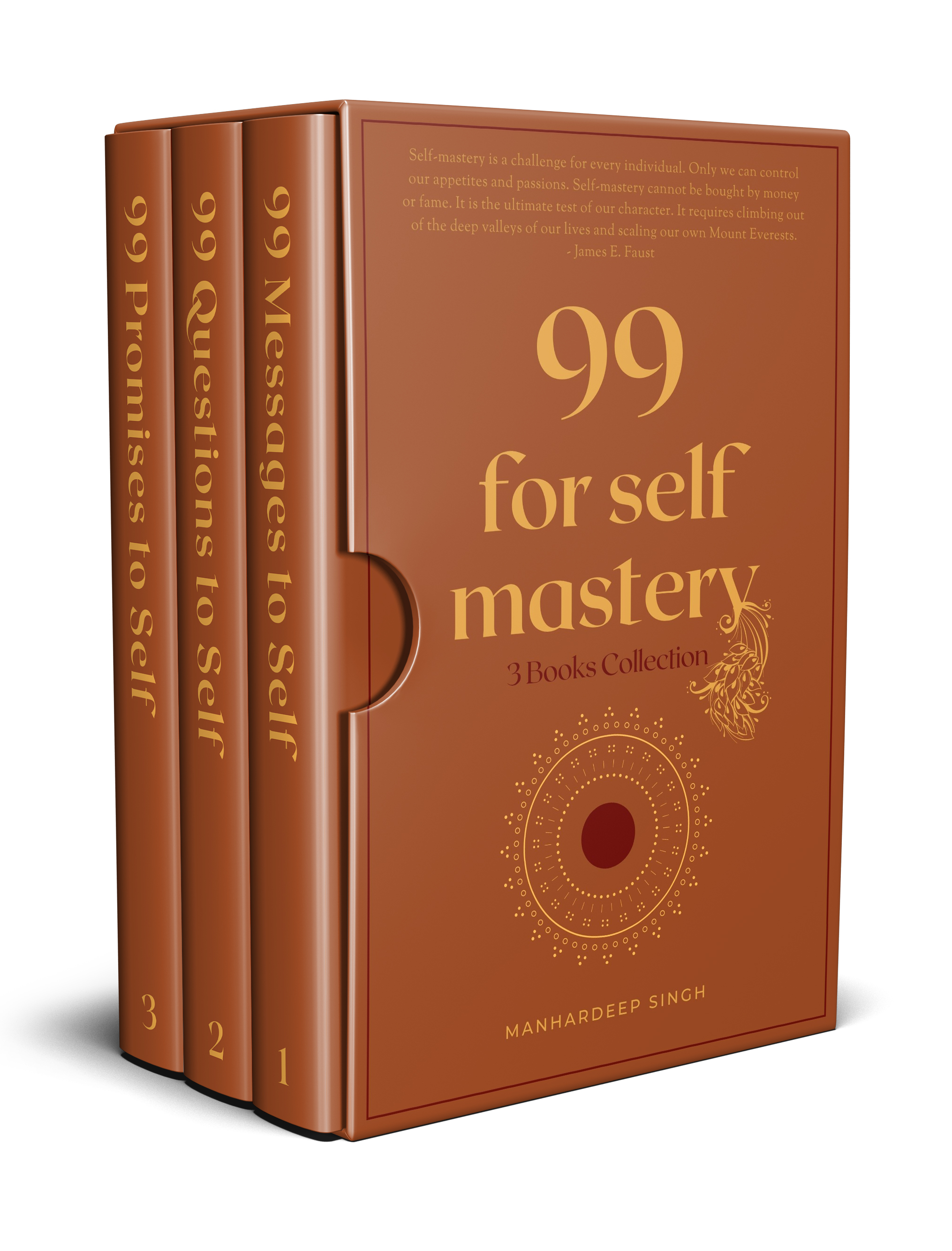
    Are you ready to take the journey of self-mastery? This 3 books collection takes on a guided voyage within.

    Book – 1: 99 Messages to Self

    Are you looking for messages meant for you? These 99 messages will enhance your life, and widen the horizons of your life.

    “Words are thought descriptors. They project thoughts from anonymity. They transfer thoughts into messages. Messages move the world.”― William E. Jefferson

    Book – 2: 99 Questions to Self (workbook)

    Would you like to tap into your full potential? Discover the 99 questions that can help you realize the superhuman in you.

    “An empowered life begins with serious personal questions about oneself. Those answers bare the seeds of success.” ― Steve Maraboli

    Book – 3: 99 Promises to Self

    Would you like to create a solid foundation of self? These 99 promises are the infrastructure of a strong self.

    “Promises are the uniquely human way of ordering the future, making it predictable and reliable to the extent that this is humanly possible.” ― Hannah Arendtread

    Buy 99 for self-mastery and start your journey to master yourself today!

  • Becoming Larger Than Life

    To say that there is no ego in a person who does public speaking regularly or for a living would be clearly a false statement. But for those of us who only speak from time to time, when you see a speaker who can walk out in a room of 30 people or a auditorium of 3000 and literally “own the room”, it really is an amazing transformation. To imagine how you could ever be that much larger than life is mind boggling.

    Advertisements

    But in a lot of ways, when you step out to talk to a group of people, you do become larger than life. That is because you are doing the impossible. You are having a conversation with dozens of people all at once. Now, whether you feel like you are having that conversation or not isn’t important. If your talk is not interactive, you may not know the dialogue is happening. But in the minds of every single individual in that hall, they are interacting with you. What you are saying is getting down inside of them and they are reacting to it. But even more than what you are saying, how you are saying it is having an even bigger impact.

    So are there things you can do to “become” larger than life? Well there are some ways of behaving in front of a crowd that differ from daily life. We do have to accept that you will develop a “stage persona” that is different from your daily personality when you speak to a group. Does that make you a phony? No. Both of those personalities are you. It is just a different you when you relate to a group than to people one on one and it seems strange because that form of you only comes out on stage. But it isn’t a Dr. Jekyll, Mr. Hyde thing. Just as you speak to a child differently than you speak to an adult, you will develop a way to talking to a group that differs from speaking to an individual.

    Part of becoming larger than life is learning to what they call “own the room”. This sound egotistic and strange but it really does work when you are about to speak. Owning the room simply means that when you step out in front of that crowd, they are no longer some random group of people, they are YOUR people. They are there to listen to you and what you say is of value to them. If you had any ego problems before you stepped out in front of that audience, check that ego problem at the door.

    You must assume that you are adored when you speak to a group of people. This doesn’t mean you strut about like God’s gift to the world. But it does mean that you recognize that your value to this group is as a speaker and that your services are wanted and needed here. In fact, the only way you will be an effective public speaker is if you own the room. Treat that room like it was your home and these people came here just because being with you is just that great. If you step out there with that attitude, the audience will buy into your attitude and they will give you the room and be glad you took it over.

    It can be a bit strange if you watch yourself become larger than life. But you can be humble about it and just recognize it is part of the craft of becoming a great public speaker. And if being good at this art you are gifted to give to the world means owning rooms and becoming bigger for an hour or so, well then why deny the world that experience? Enjoy it and let others enjoy it too.

    RECOMMENDED RESOURCE:

    Fear of public speaking or glossophobia is the second top fear human beings have. Studies suggest that upto 75% of the population is affected by it. This means out of every 10 people, at least 7 has it.

    Phobias limit a person from doing something, imagine what fear of public speaking might be robbing the people from in their lives – addressing the team to achieve objective, getting the next promotion that can change the life, expressing freely in front of people.

    “Don’t Fear the Mic” enlists 101 tips that helps you discover how you can stand up in front of the crowd you always feared from, that made you shiver, and do not fear the mic anymore.