• A Key Element In Public Speaking: Timing Pauses

    Timing is essential when speaking in public. The cliché: It is not what you say but more on how you say it, applies so much to public speaking.

    Advertisements

    Where you put your pauses during your presentation is one of the important aspects of maintaining an audience that is free from drowsing off. Couple this with humor and you are definitely on a roll.

    Timing is the element involved during reactions that are spontaneous especially on developments during your delivery that are unexpectedly expected.

    Do not forget, though, that when you expect any laughter to burst any time soon, avoid speaking as your voice and whatever it is that you are saying will most probably be drowned out by the noise of the audience.

    Make sure to remember that laughter is extremely difficult to get and so very much easy to discourage. Try as much as possible to maintain eye contact with the audience for a little time longer when you deliver that punch line.

    The audience size could also affect the way you use your timing. When the audience is small, the presentation you have will most probably be delivered in a lesser time compared to if you have a large audience. The reaction of a large audience will get to be a little longer and not as quick as if the audience is small. You also have to wait until the seemingly ripple effect of your punch line gets to that audience in the back row.

    Believe it or not, putting that much needed silence in your presentation is one of the hallmarks of a skilled and good presenter. No public speaker should jabber constantly away in the hopes of keeping an audience glued to anything it is you have to say. Ironically, this is one effective way to keep their focus off you. The use of silence adds that much needed polish in your presentation making you appear as a confident expert.

    Advertisements

    Short pauses are effective to use in order for you to separate your thoughts. These pauses last from half a second to two. You do not have to literally count though, just keep in mind to slow down. This gives the audience a chance to absorb all of what it is you are getting across. It also helps if you change the inflection in your voice during the end of a thought as this could also signal to the audience that another thought is coming their way. Pauses are also an effective means if you want to highlight something. Put it before any word or thought you want the audience to focus on, they will most definitely get that.

  • A Look At Different Depression Treatment Regimens And Programs

    One of the most prevalent health problem in many countries around the world is depression. Indeed, researchers have concluded that a majority of people will experience clinical depression at some point during their lifetimes. As a result, all people should at least have a basic awareness of what different depression treatment regimens are available in the 21st. Indeed, when it comes to depression treatment, there are a number of different options available to people afflicted with this possibly debilitating disease.

    Advertisements

    If a person is suffering from a mild, isolated case of depression, an effective depression treatment program may include more sleep, an improved diet and increased exercise. In some instances, a combination of these recourses does result in an effective depression treatment regimen.

    Many people find themselves suffering through a more serious bout of depression. In such instances, a depression treatment program must include professional assistance. When consulting with a qualified health care professional, a depression treatment program that includes therapy and medication or medications is likely to be recommended.

    When it comes to a depression treatment program, medications are helpful to aid in the reduction of the symptoms that commonly are associated with a depressive illness. With that said, in most cases, it is important that a depression treatment program include therapy. Therapy is an important element of a depression treatment program in many cases to assist the afflicted patient with discovering the root causes of the depressive illness with which he or she is afflicted.

    In some instances, a depressive illness is so serious that a depression treatment program includes inpatient hospitalization. In most instances, a person who is hospitalized for a depressive illness will only be confined for a short period of time — for a matter of days. The goal of hospitalization as a depression treatment regimen in the 21st century is patient stabilization. The long term treatment will be conducted on an outpatient basis. Long gone are the days (in most cases) in which stabilization and intensive treatment occurs while a patient is involved in an inpatient depression treatment program.

    In recent years, many mental health care professionals have again begun to advocate the use of EST (electro-shock therapy) for patients who have a more profound depressive illness. For some period of time in the 1970s and 1980s, EST as a depression treatment option was frowned upon by a wide sector of the mental health care professional community. However, in recent years, the techniques associated with EST have been refined and many doctors have come to see beneficial results in their patients who are subjected to a depression treatment regimen that includes EST. But, again, EST is utilized as a depression treatment option in only a limited number of cases in which the depression of a particular patient is severe and unabated over an extended period of time. As with depression treatment programs that include medication, patients who receive EST also participate in a course of therapy to try and discover the root causes of the depressive illness.

    RECOMMENDED RESOURCE:

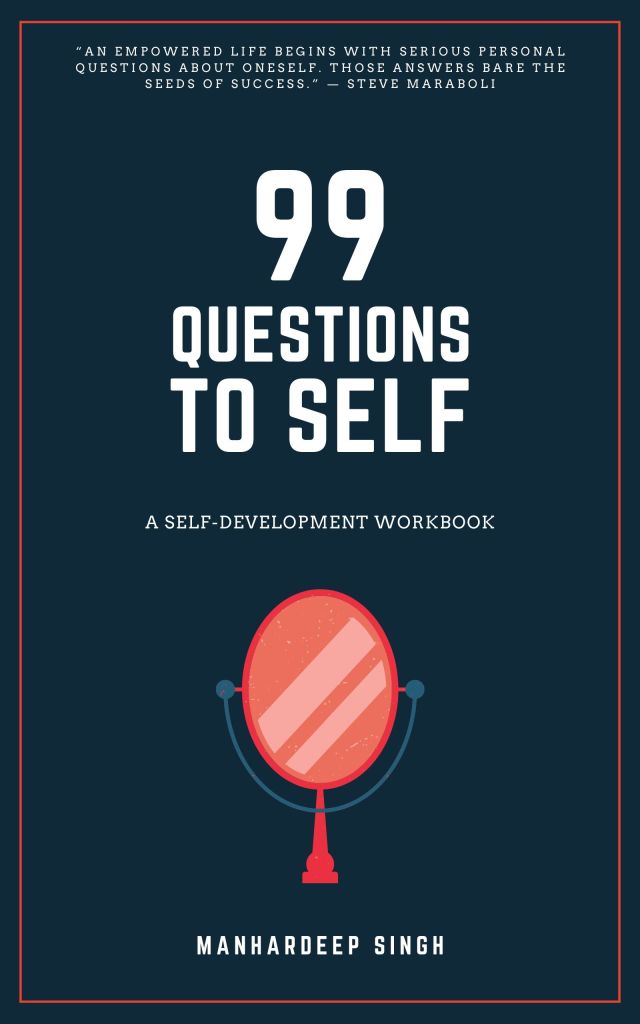
    Would you like to tap into your full potential? Discover the 99 questions that can help you realize the superhuman in you.

    This workbook will help you:

    • Discover your latent talents and hidden strengths
    • Learn how to create instant emotions of happiness and abundance
    • Improve every area of your life
    • Tap into unlimited source of power
    • Create a future you like

    99 Questions to Self is a comprehensive self-development workbook. If you like modern, practical, and interactive books, then you’ll love Manhardeep Singh’s self-help workbook.

    Buy 99 Questions to Self to start your journey of self-discovery today!

  • Exploring Mindfulness And Meditation

    In our every day lives, we are all guilty of neglecting our minds, allowing our brains to be lulled into a lazy, neglected, and unaware state. It is as if we are allowing ourselves to be sculpted by bland and repetitive consumerism, our individuality being chiseled away by a tedium we cannot even be bothered to challenge with any will.

    Advertisements

    Life need not be like that. We are each blessed with a powerful mind; but normally people have forgotten or, most likely, never even knew how, to use it. It is such a waste of our own greatest resource.

    One way to start to extricate ourselves from the mindless quicksand is to gently exercise our minds, using mindfulness and meditation as a way of bringing ourselves more emphatically into the real world, and start the process of exercising control over our minds and our lives.

    Creating a mindfulness meditation is a gentle but powerful exercise. But how do you go about it?

    A Simple Mindfulness Meditation Exercise

    As with any meditation session, you need to get into a relaxed and comfortable position, eyes closed, and then commence with deep nasal breathing, focusing your thoughts on the breathing to ease yourself into a meditative state.

    Once you feel that you are calmed by your breathing and that your breath is under your rhythmic control, then you can move on to focusing on your own body, a part at a time. I was first taught this at yoga class, where we were taught to concentrate first of all on the left foot, focusing on it from a position above ourselves. Then move up the body slowly, left ankle, knee, thigh and so on. When reaching your head, you then do the same in reverse on the other side of the body: right shoulder, right elbow, right hand and so on.

    Once you have completed your tour of your own body, as if you were someone else examining it, then it is time to open your eyes and increase your mindfulness of your surroundings.

    To do this, focus on any object in the room; it does not have to be anything special: a cup on the coffee table, a vase, a plastic flower, anything. Try to maintain that focus for half a minute, and then move on to any other object. You can repeat this several times, always maintaining a focus on your own body and your own breathing, creating a triple harmony with each object on which you focus.

    By using this simple mindfulness meditation you are increasing awareness both of yourself and your surroundings, in a very gentle and easy way. It can serve as a prelude to some mental task, as well as being part of an ongoing mindfulness campaign to strengthen and expand the use of your own mind.

    For example, most days I write, but sometimes I just do not seem able to concentrate on what I am supposed to be writing about. I find this type of exercise, even just for 10 minutes, will snap me out of that inexplicable malaise, and I can get right on and write what I should have written earlier.

    RECOMMENDED RESOURCE:

    Ready to take yourself to the next level? Find 101 ways that can work as a launchpad. These nuggets are delivered to you one page at a time. Implement it, see the result, repeat!

    These nuggets can help you:
    • Be goal-driven vs emotion-driven
    • Be strong on the face of criticism
    • Handle difficult situations smoothly
    • Increase likability among peers
    • Be irresistibly charismatic

    Buy 101 Nuggets for Life to take every area of your life to the next level today!

  • Great Teachers

    A great teacher always leaves knowledge in his/her wake. They leave you with an understanding and knowingness you had not previously been aware of.

    Great teachers do not always make their presence known. The teacher is sometimes disguised as an adversary such as the domineering parent, unfair employer, dishonest business partner, or unfaithful mate. The adversarial guide causes you to dig deep within your own spirit to reveal your own courage and power. On the contrary, a great teacher can be a wise and enlightened soul whose very presence is inspiring. They challenge you to find your own answers. A great teacher is a mentor who instructs by example. A true guide will never give you the answers or tell you what to do. They will assist by leading you inward to discover your own wisdom.

    In either case, your life is greatly impacted when a teacher has appeared. You will walk away from the encounter with new knowledge and wisdom. You are never the same once they have entered your life. Each day you encounter numerous teachers and by embracing this understanding you open yourself up to many opportunities for growth.

    Take a moment and consider this, “How was your life changed by someone in your life?” If it was an emotionally painful experience, what did you learn? If it was a mentor or guide, how did they inspire you? What wisdom or knowingness was left by their appearance in your life?

    RECOMMENDED RESOURCE:

    Ready to take yourself to the next level? Find 101 ways that can work as a launchpad. These nuggets are delivered to you one page at a time. Implement it, see the result, repeat!

    These nuggets can help you:
    • Be goal-driven vs emotion-driven
    • Be strong on the face of criticism
    • Handle difficult situations smoothly
    • Increase likability among peers
    • Be irresistibly charismatic

    Buy 101 Nuggets for Life to take every area of your life to the next level today!

  • Anxiety Panic Attacks

    This world is no doubt a stressful place to live in. So many people spend their precious time working at jobs with long hours, raising children, paying for a house, trying to save for the future and dealing with a constant flow of bills. Yeah, when it’s put that way, life sounds a bit more stressful than most of us would like it to be. No wonder so many individuals every year suffer from random anxiety panic attacks. All the stress they grapple with on a daily basis can certainly bring about such undesirable reactions. The key is balancing life’s issues and getting help.

    Advertisements

    How do you deal with the infinite stresses of life? One way to approach this subject so that you don’t suffer from anxiety panic attacks in the future is by taking a deep breath every once in a while. Naturally this is somewhat of a metaphor. However, there is much to be said about stopping to take a break and just clear your mind. If you are one of the millions of individuals that routinely have to grapple with anxiety panic attacks and other stress related issues, then it’s prudent to acquire assistance from a professional.

    There are a few different ways to approach this topic/burden. Maybe you’d feel comfortable seeing a psychiatrist. He/she has the training and knowledge to help you deal with anxiety panic attacks. The key is pinpointing a great doctor who can truly assist you in remedying your dilemma. Start by seeking a professional out on the web. There is likely a few located in your area. A second route is physical and mental healing through massage therapy and acupuncture. This can also assist with anxiety panic attacks. The key is releasing much of the stress and angst from your body and mind, hence allowing you to relax.

    Most businesses and professionals regarding anxiety panic attacks can be located online in this day and age. Therefore it’s wise to access the web and see which ones you can find in your town or city. Call several to inquire about rates, which are often left off of websites. It’s high time you got your stress levels and anxiety issues in order to improve your overall health and happiness.

  • How to deal with Failure

    Failure is something that can really be hard on a person and their outlook. There are some that may have a hard time dealing with the failure that is in their life. You need to consider the fact that failure is something that many people have to experience in their lifetime. Failure is something that can be overcome if you have the right tools.

    Advertisements

    Do not get discouraged when you find that you fail at something. It is going to be a learning experience and something that you need to take in stride. You should think about the one thing that you are good at and remember it when you do end up failing at something. Look at it as part of life and how you can learn from it. Making an effort at working hard to deal with failure is what you need to do.

    You need to start thinking about the things that you are good at and what makes you happy. Once you think about them and know what you need to do in order to achieve this type of success you will be on your way to making yourself feel better. Having a good work ethic and positive thoughts will help you deal with any type of failure that you may have in your life.

    You need to build up a resistance to failure in your life. When you are feeling bad and you notice that you are failing you should keep your head up high and know that you are good at other things and that we all have our ups and downs. It is something that is part of lie and you should learn how to keep moving past it all.

    When failure is in your future you should use this time to channel out the negative energy and put into your positive future. When you go through something bad you need to use what you have learned and make it good. Having the feeling of accomplishment will make you feel better and give you the self-confidence that you are looking for. The worst thing that you can do is be depressed about any type of failure that goes on in your life. This will only bring you down and make you more upset about what is going on. You should always look on the bright side of things.

    Keep the negative thoughts out of your head and do not dwell on them. You need to rise up to the occasion and keep positive about life. You are good at certain things and there is a reason why you should do what you have to in order to a great lead in life. Failure comes with the good points and the bad ones and it is all a part of how you look at it all.

    Never judge who you are and always learn from the mistakes that you make. There is only something good to come from it all and you can deal with failure as it comes. Taking each moment into consideration and using all the skills that you have learned over the years to completely get over it and make life as you need. There are endless ways to end your worries about failure and after you figure them all out you will be ready for all the new challenges life brings.

    RECOMMENDED RESOURCE:

    Ready to take yourself to the next level? Find 101 ways that can work as a launchpad. These nuggets are delivered to you one page at a time. Implement it, see the result, repeat!

    These nuggets can help you:
    • Be goal-driven vs emotion-driven
    • Be strong on the face of criticism
    • Handle difficult situations smoothly
    • Increase likability among peers
    • Be irresistibly charismatic

    Buy 101 Nuggets for Life to take every area of your life to the next level today!

  • The Habit of Identity

    In a famous experiment, students were asked to take a lemon home and to get used to it. Three days later, they were able to single out “their” lemon from a pile of rather similar ones. They seemed to have bonded. Is this the true meaning of love, bonding, coupling? Do we simply get used to other human beings, pets, or objects?

    Advertisements

    Habit forming in humans is reflexive. We change ourselves and our environment in order to attain maximum comfort and well being. It is the effort that goes into these adaptive processes that forms a habit. The habit is intended to prevent us from constant experimenting and risk taking. The greater our well being, the better we function and the longer we survive.

    Actually, when we get used to something or to someone – we get used to ourselves. In the object of the habit we see a part of our history, all the time and effort we had put into it. It is an encapsulated version of our acts, intentions, emotions and reactions. It is a mirror reflecting that part in us which formed the habit in the first place. Hence, the feeling of comfort: we really feel comfortable with our own selves through the agency of our habitual objects.

    Advertisements

    Because of this, we tend to confuse habits with identity. When asked WHO they are, most people resort to communicating their habits. They describe their work, their loved ones, their pets, their hobbies, or their material possessions. Yet, surely, all of these do not constitute identity! Removing them does not change it. They are habits and they make people comfortable and relaxed. But they are not part of one’s identity in the truest, deepest sense.

    Still, it is this simple mechanism of deception that binds people together. A mother feels that her offspring are part of her identity because she is so used to them that her well being depends on their existence and availability. Thus, any threat to her children is perceived by her as a threat to her own Self. Her reaction is, therefore, strong and enduring and can be recurrently elicited.

    The truth, of course, is that her children ARE a part of her identity in a superficial manner. Removing them will make her a different person, but only in the shallow, phenomenological sense of the word. Her deep-set, true identity will not change as a result. Children do die at times and the mother does go on living, essentially unchanged.

    But what is this kernel of identity that I am referring to? This immutable entity which is who we are and what we are and which, ostensibly, is not influenced by the death of our loved ones? What can resist the breakdown of habits that die hard?

    It is our personality. This elusive, loosely interconnected, interacting, pattern of reactions to our changing environment. Like the Brain, it is difficult to define or to capture. Like the Soul, many believe that it does not exist, that it is a fictitious convention.

    Yet, we know that we do have a personality. We feel it, we experience it. It sometimes encourages us to do things – at other times, it prevents us from doing them. It can be supple or rigid, benign or malignant, open or closed. Its power lies in its looseness. It is able to combine, recombine and permute in hundreds of unforeseeable ways. It metamorphoses and the constancy of these changes is what gives us a sense of identity.

    Actually, when the personality is rigid to the point of being unable to change in reaction to shifting circumstances – we say that it is disordered. One has a personality disorder when one’s habits substitute for one’s identity. Such a person identifies himself with his environment, taking behavioural, emotional, and cognitive cues exclusively from it. His inner world is, so to speak, vacated, his True Self merely an apparition.

    Such a person is incapable of loving and of living. He is incapable of loving because to love another one must first love oneself. And, in the absence of a Self that is impossible. And, in the long-term, he is incapable of living because life is a struggle towards multiple goals, a striving, a drive at something. In other words: life is change. He who cannot change, cannot live.

  • Creating Your Future

    The questions of life may call to you. You may wonder about your purpose. You may feel out of place, disconnected, just a bit out of sync. You may want to find clarity; to find the stillness in your mind. That elusive quality where time loses all meaning. You may not even know what it is that you seek but you sit there in your skin and you know something is making you uncomfortable.

    Well, I’m here to tell you that it’s okay. It’s not unusual or abnormal. The bigger questions of life and the role you want to play in that are great questions! Important questions! To not ask them and seek your own answers would resign you to an existence of numbness and one day, possibly regret. But it doesn’t have to be that way. It’s never too late and there is no deadline.

    The journey itself can be a tremendous reward. And don’t be fooled! The pursuit of worthy goals and self-discovery is not easy. There will be plenty of tough times, inner soul searching, periods of enormous movement and change, periods of stagnation and possibly even despair. There will be times when you think you have found that groove you’ve always been looking for and then there will be times when you feel as though you haven’t a hope in the world of finding your place. This is normal.

    Everyone who experiences life will encounter variations of questions pertaining to their values that will challenge them at crossroads in life. Sometimes we heed these inner callings but often times, external forces to our sense of security in the world will push these inner callings deep into the mud. Instead we are fearful of change or to focused on the negatives or “what if” scenarios. So we play it safe and ignore our inner callings.

    We’re all looking for “that career” that will reward us in the way we need to be rewarded. For some it may be money. For others it may be prestige, recognition and yet someone else it is just the fact they get to “do what they love doing.” Everyone will have a unique journey to reach their discovery. The journey will be made intentionally or unintentionally. It will be confused and painful or it can be enlightened by your own self-awareness. Don’t get so focused on the goal that you don’t get the full experience of the journey. The journey is so critical.

    During the journey your experiences will offer you with so many valuable clues about yourself. Who you are. What makes you thrive. What puts you to sleep. The kind of people you like to work with. The environments you prefer. All of these experiences and many many more specific pieces relevant to you, your profession, passion, skills, and personality. All of them can be incorporated into your goal.

    You, your life, your values, and beliefs, and many other things, will change. So keep dreaming, keep looking at the goal. But do so with the knowledge and understanding of your journey. Implement adjustments to your navigation system towards your goal if it changes. The experiences of your life and the decisions and their consequences will teach you so much.

    Allow yourself to take that journey, without knowing when it will end nor where it will take you. Get comfortable with not knowing. Keep seeking. Don’t be afraid to take that next step. This is the very thing I too have to challenge myself on every day.

    RECOMMENDED RESOURCE:

    Would you like to tap into your full potential? Discover the 99 questions that can help you realize the superhuman in you.

    This workbook will help you:

    • Discover your latent talents and hidden strengths
    • Learn how to create instant emotions of happiness and abundance
    • Improve every area of your life
    • Tap into unlimited source of power
    • Create a future you like

    99 Questions to Self is a comprehensive self-development workbook. If you like modern, practical, and interactive books, then you’ll love Manhardeep Singh’s self-help workbook.

    Buy 99 Questions to Self to start your journey of self-discovery today!

  • The Senses of Soul

    Have you ever had a sense that there is more to something than what appears on the surface? As a child, you may have walked by a pond and picked up a pebble. Then, energy grew inside you directing your mind to send signals within you and pick up this rock with your hand. As your mind, body, and spirit united, a coordinated effort took place resulting in a thrust of energy tossing this rock into this pond.

    The effects of this driving force created a ripple effect on the surface of the pond making its way to the outer edges of the pond. You and I are this same driving force at the core of our being. Everything is energy. We all know its there even though we may not readily see it.

    There are five experiences in our life allowing us to touch this energy or our soul.

    We touch our soul in the following ways:

    1. The Sense of Smell

    When we breathe, we embrace our world. We draw in various aromas into our inner self. It is our opportunity to take in the world around us, and allow it to fill us with its essence. As we breathe, our soul absorbs the world around it through identification with the earth merging into what cannot be seen. It is the experience of spirit expressing itself in unlimited ways.

    2. The Sense of Taste

    Taste allows us to tangibly experience different qualities of our world. As a child, we experienced our world through the sense of taste. It was as though our life was meant to be devoured. In a real way, our sense of taste helps us to determine if we like or do not like what is before us i.e. food, experiences, or way of life.

    3. The Sense of Touch

    Our ability to feel the world awakens our body. Touch sends vibrations throughout our body in the form of tingling sensations. These tingling sensations are expressions of consciousness helping our body understand the direction of spirit in our lives and our place in the world. It is the home of our soul, yet our body cannot fully contain it alone. At the same time, our body is a symbol radiating our unique expression of our soul.

    4. The Sense of Sight

    The gift of sight enables us to take in the world through visual contact with the world around us. As we draw in our environment, we become part of it and it becomes part of us. Eventually, we deepen this sense of sight creating the ability to see from within. At this point, we are able to see through our eyes, and not, just with them. Here, we see with the eyes of soul. We see with the eyes of unconditional love.

    5. The Sense of Hearing

    What do we really hear? Sounds are echoes, vibrations interacting with the vibrations of another entity. Behind every sound or word is a tone, a quality of sound, we can connect to within us. The resonance of sound creates signals inside us that we may choose to repel or encompass. As we discern these inner qualities of what appears before us in sound, we are getting in tune with the soul of another person, place, or thing.

    When you throw a rock into a pond, I suspect you have a difficult time watching it float all the way to the bottom. The deeper your rock enters the pond, the harder it becomes to see with your five senses. A higher sense of yourself is engaged.

    As your imagination and your heart begins to direct your perspective on this experience, your soul is revealed. It is the part of you able to sense and know your rock eventually reached its destination. Although you may not be able to see the foundation of the pond below its surface, you know it is there.

  • Jealousy In Relationships

    This is a common theme that is discussed by those who are in love, or by their friends. Why does one feel jealous? Is the relationship weak? If the relationship is strong, should one feel jealous at all? Or it is one’s genes? I mean, if I am very sure that I love a girl and I am totally committed to her, and I believe that she is equally in love with me, why should I feel jealous? Or why should she feel jealous? But jealousy is a fact of life. Let us examine more of jealousy.

    Let us take a simple example. Say, your child loves one of your neighbors and she is equally attentive to him/her. Would you feel jealous of that or proud about that? Would you try to take away your child from the neighbor? Would you confront the neighbor? You may do nothing like this, if I am not wrong in my analysis. But what if your child is replaced by your spouse/girlfriend/boyfriend? Your reaction may be entirely different. If yes, why? What is the difference in both the situations?

    The main difference is faith. You have total faith that your child may run around and play with many people around the day. But he/she will return to you at night, or if hungry, or if injured? Am I correct? You don’t have the same faith with your lover/spouse. And that is the main cause of jealousy. Somewhere in your mind, you are always wondering about your looks, your intelligence, your relationship skills and all other factors that may break your relationship and make your spouse/lover go into another relationship.

    Can any relationship that is based on such slippery thoughts be a happy relationship? Can it survive long without problems? No. The best way out is to discuss without hesitation everything in your mind with your spouse/lover and expose all your fears. Be totally open. Try to find out all that is in the mind of your partner in the same way.

    Discuss everything and decide that come what may, your relationship is here to stay. Give that commitment and take that commitment in return. And enjoy life forever without bothering about jealousy. If after all the discussion, both of you come to a conclusion that the commitment is not strong for each other, make a clean break.

    We cannot sail in a boat in the deep seas, and try to enjoy sailing, while constantly getting worried about the sea worthiness of the boat. Am I correct? We should begin sailing only after making sure about the boat first. Jealousy mainly comes in our mind because we are not sure of the love and commitment. Take care of that to live a happy life.

    RECOMMENDED RESOURCE:

    Finding Love Through Graphology aims at providing knowledge to find perfect love. This book will help you in:

    • Understanding your personality
    • Quickly finding the hell traits in partner’s handwriting
    • Knowing what makes the relationship work
    • Filtering out incompatible partners
    • Improving one’s personality through grapho-therapy

    Finding Love Through Graphology is no lover’s guide but a guide to finding the perfect love.